
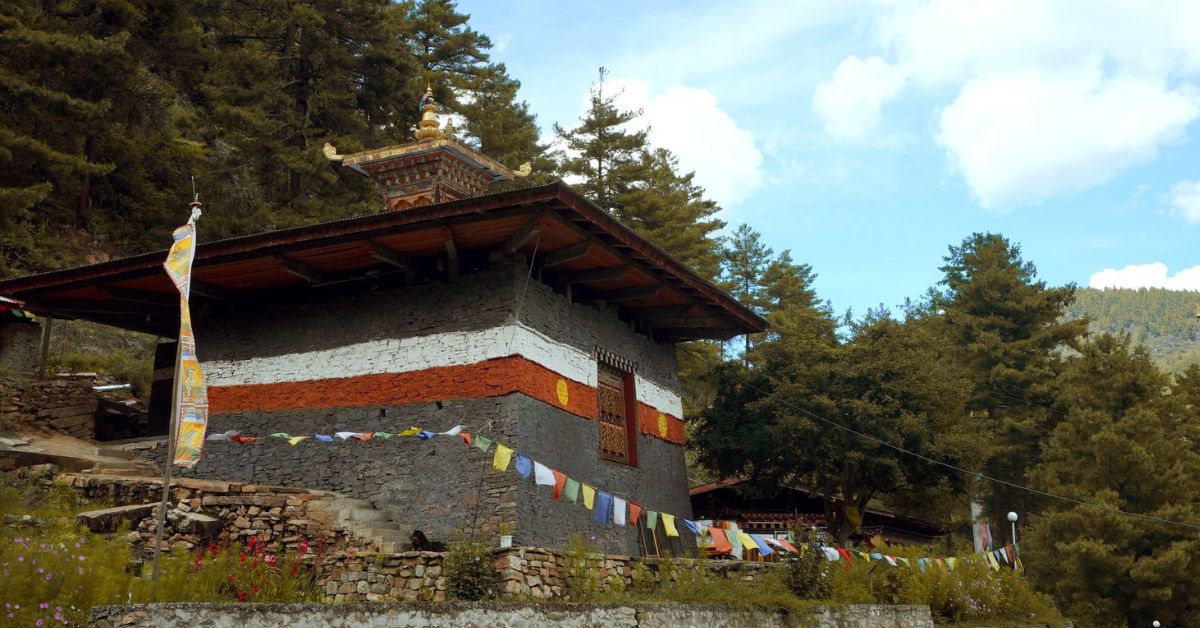
Lhakhang Nagpo, known as the “Black Temple”, is a one-storey temple in Dumchoe village, Eusu Gewog, Haa Dzongkhag. Traditionally attributed to the Tibetan Dharma King Songtsen Gampo and dated to 659 CE, it is associated with the tradition of the 108 temples established to subdue a demoness and protect the spread of Buddhism in the Himalayan region. The temple stands near the base of the sacred Meri Puensum Mountains, at an elevation of approximately 2,727 metres.
Planning a visit to Lhakhang Nagpo?
Discover Haa’s Black Temple, visit nearby Lhakhang Karpo and explore the sacred places around the Meri Puensum mountains.
WhatsApp UsWith its counterpart, Lhakhang Karpo (White Temple), the Black Temple is located at the base of the revered Meri Puensum Mountains in Dumchoe village of Uesu Gewog, under Haa Dzongkhag.
Among the 108 temples built in Bhutan, the most well-known temples are Kyichu Lhakhang in Paro and Jambay Lhakhang in Bumthang. Other lesser-known temples include Khiney Lhakhang in Lhuentse and Konchogsum Lhakhang in Bumthang.
Table of Contents
How to Reach Lhakhang Nagpo
Lhakhang Nagpo is about 4.5 kilometres from Haa town, a drive of roughly 10 minutes. It stands a short distance uphill from Lhakhang Karpo (White Temple); the two temples are approximately 280 metres apart. You can make the short uphill walk from the White Temple or arrange a vehicle drop-off closer to the Black Temple. The final approach is steep and has no step-free alternative. Opening hours are not published, and entry to the inner shrine may depend on the caretaker’s availability, so ask your guide or local residents to check access before visiting.
Sacred Relics to See at Lhakhang Nagpo
- Jowo Shakyamuni (the historical Buddha);
- Tadin (Hayagriva);
- Chana Dorji (Vajrapani);
- The deities associated with Expiratory Rituals;
- Statues of Zhabdrung Rinpoche, Songtsen Gampo and Guru Padmasambhava;
- A life-like statue of His Holiness the Je Khenpo, offered by communities from Dumcho, Bangayna, Takchu and Kipri in September 2026;
- Pal Yeshey Gempo’s La-tsho;
- Pel Yeshey Gempo’s Rangjung Kilkor (Mahakala’s Mandala);
- Be-dang-kha, the “subdued place of the snake”.
Historical Background of Lhakhang Nagpo
Lhakhang Nagpo is traditionally attributed to Songtsen Gampo, the Tibetan Dharma King, and is commonly dated to the 7th century (659 CE). Its origins are connected with the Buddhist tradition that the king established 108 temples across the Himalayan region in a single day to subdue an ogress who obstructed the spread of Buddhism. Lhakhang Nagpo and its white counterpart, Lhakhang Karpo, are both associated with this sacred tradition.
According to local legend, Songtsen Gampo released a black pigeon to select the destined site, and the bird landed at the foothills of the Meri Puensum mountains. The temple was then constructed over a lake. The name Lhakhang Nagpo, meaning “Black Temple,” is associated with the black pigeon. The white pigeon is said to have selected the site of Lhakhang Karpo.
It is said that Songtsen Gampo released a black pigeon to select the destined site, and the bird landed at the foothills of the Meri Puensum mountains. The temple was then constructed over a lake. The temple was named Lhakhang Nagpo, meaning “Black Temple,” referring to the black pigeon.
Initially, the Lhakhang Nagpo was maintained by the Kiri village community with Boepa Lodrue as the first lama and Nagay as the second Lama. Later, the community handed it over to the Zhung Dratshang, which subsequently appointed Ponpung as the first lama, followed by Lam Tshering Nidup and Lam Penchu.
Description of Lhakhang Nagpo
The main relic of Lhakhang Nagpo is a statue of Jowo Shakyamuni.
Lhakhang Nagpo is a small, one-story, rectangular structure built in the traditional Tibetan Buddhist architectural style. It has a flaring jabzhi-style roof, topped by an ornamental lantern capped with a gilded sertog. The outer walls of the Lhakhang have only two openings, a small door and a window. The stonework is painted with a double khemar band in red and white, featuring golden medallions in place of the traditional circular copper plates.
Inside, the main relic is Jowo Shakyamuni, said to be identical in terms of size, height, and appearance to the Jowo Shakyamuni at Lhasa, except for the ornaments. Therefore, it is believed that receiving blessings from the Jowo of Lhakhang Nagpo carries equal merit as visiting the one in Lhasa.
A popular legend has it that during the plague epidemic in the early 1980s, the people of Haa survived as the Jowo took the disease. The marks left by the disease on the abdomen of the Jowo are still visible to this day.
The other important relics include Tadin (Hayagriva), Chana Dorji (Vajrapani) and the deities of Expiratory Rituals. The temple also houses statues of Zhabdrung Rinpoche, Songtsen Gampo and Guru Rinpoche, along with mural paintings of Zhabdrung Phunseum Tshogpa, Neten Chudruk (Sixteen Arhats) and Mithrugpa Lhatshog (Aksobhya Buddha). On 10 September 2026, a life-like statue of His Holiness the Je Khenpo was ushered into the shrine. The statue was offered by people from Dumcho, Bangayna, Takchu and Kipri villages of Eusu Gewog.
Pal Yeshey Gempo’s La-tsho
An opening in the temple’s floor leads to the Pal Yeshey Gempo’s La-tsho. It is home to a protecting deity, Tshomen Dechen Gyalpo. A concrete protection and a glass cover were installed to prevent offerings, such as milk or money, from entering the lake.
Pel Yeshey Gempo’s Rangjung Kilkor (Mahakala’s Mandala)
Just above the temple is Pel Yeshey Gempo’s Rangjoen (natural raising) Kilkor (mandala) on the rock, painted in gold. It is said that a crow appeared while people were performing a smoke offering ritual, making them believe it was a Choechong Sungma (guardian deity). Even today, the community continues a tradition of Ola-chag-tshel-lo, an offering made to a crow.
Be-dang-kha, the “Subdued place of the snake”
A 15-minute walk northwest of the Lhakhang Nagpo leads to the sacred site of Be-dang-kha, meaning the “subdued place of the snake”, located at Yipri (now Kipri). An oral tradition holds that in the 8th century, Guru Rinpoche subdued a demonic serpent, a present-day deity of Shelkar Drak Lhakhang, that haunted the villagers, thereby restoring the community to normalcy.
The rock still bears the imprint of the serpent and the body print of Guru Rinpoche. Locals say that even today, people with low Lung-ta (win-horse) can see the snake (a bad omen), while those with high Lung-ta may see the Dungkar (conch), symbolizing a good omen.
Renovations of Lhakhang Nagpo
Minor renovation work was undertaken in 2019, including re-roofing with metal sheets and repainting the walls. A lama’s residence, a kitchen, and a toilet were added in front of the Lhakhang.
Festivals and Rituals of Lhakhang Nagpo
Lhakhang Nagpo conducts a variety of rituals throughout the year, including:
- Yarngo and Marngo, a monthly practice dedicated to the triple gem and all sentient beings by performing rituals of Tshepai (Buddha of Longevity ritual) and Neten chudruk chokha (sixteen arhats).
- The Zhabdrung Dhanangmai ritual is performed in the 3rd Month of the Bhutanese calendar.
- Namjom and Tshepai rituals are observed in the 4th month of the Bhutanese calendar.
- Invocation to Pal Yeshey Gonpo (Mahakala) is conducted in the 10th month of the Bhutanese Calendar.
Best Time to Visit Lhakhang Nagpo
While Lhakhang Nagpo is a year-round destination, the best time to visit is during the autumn months (September-November). This period offers clear skies and pleasant weather, coinciding with the vibrant Haa Tshechu Festival. You can visit the major pilgrimage sites of Haa with the Bhutan Pilgrimage Package.
Places to Explore in Haa
Rangtse Ney: A sacred abode of Guru Rinpoche located in Chego village under Haa Dzongkhag at an altitude of 879 meters above sea level.
Shelkar Drak Lhakhang: A small temple built on a cliffside in Haa, founded by Choglay Jigme Tenzin, the sixth speech incarnation of Zhabdrung Rinpoche.
Lhakhang Karpo: Also known as the “White Temple”, it is a one-story temple founded by Songtsen Gampo in 659 CE to subdue a demoness in the Haa Valley.
Jo Bay Tsho: A hidden lake stretching approximately 300 by 200 meters, nestled along the border of Sombaykha and Gakiling Gewogs in Haa.
Frequently Asked Questions
Where is Lhakhang Nagpo located?
Lhakhang Nagpo is in Dumchoe village, Eusu Gewog, Haa Dzongkhag, western Bhutan. It stands near the base of the Meri Puensum Mountains, close to Lhakhang Karpo at the southern entrance to Haa Valley.
Why is Lhakhang Nagpo called the Black Temple?
According to local religious tradition, Songtsen Gampo released a black pigeon to identify the site for the temple. The bird landed at this location, while a white pigeon is said to have selected the site of Lhakhang Karpo (White Temple).
Who built Lhakhang Nagpo, and how old is it?
The temple is traditionally attributed to the Tibetan Dharma King Songtsen Gampo and is commonly dated to 659 CE, in the 7th century. This date belongs to the religious tradition surrounding the 108 temples associated with the king.
What are the main relics at Lhakhang Nagpo?
The principal relic is Jowo Shakyamuni. Other important objects include statues of Tadin (Hayagriva), Chana Dorji (Vajrapani), Zhabdrung Rinpoche, Guru Rinpoche and Songtsen Gampo. A life-like statue of His Holiness the Je Khenpo was installed in September 2026.
Is Lhakhang Nagpo built over an underground lake?
Local tradition holds that the temple stands above a sacred lake associated with a protective deity and a tshomen (water spirit). An opening in the temple floor is associated with this lake. Follow the caretaker’s guidance and do not place offerings into the opening.
How do I reach Lhakhang Nagpo from Haa town?
Lhakhang Nagpo is about 4.5 kilometres, or roughly a 10-minute drive, from Haa town. It is also a short uphill walk of around 280 metres from Lhakhang Karpo. The two temples are commonly visited together.
Are there fixed opening hours at Lhakhang Nagpo?
Published opening hours are not available, and access to the inner shrine may depend on whether the caretaker is present. Ask your guide or local residents to check access before planning your visit.
Can visitors take photographs inside Lhakhang Nagpo?
Photography may be permitted in the courtyard but not inside the temple. Always ask the caretaker before taking photographs and respect any restrictions in the shrine.
Explore Haa Valley
Discover the sacred places of Haa
Make time for Lhakhang Nagpo, Lhakhang Karpo, Rangtse Ney, Shelkar Drak and Jo Bay Tsho. Ask us about the best way to explore Haa’s sacred sites, local traditions and walking routes.
Plan Your Haa Visit