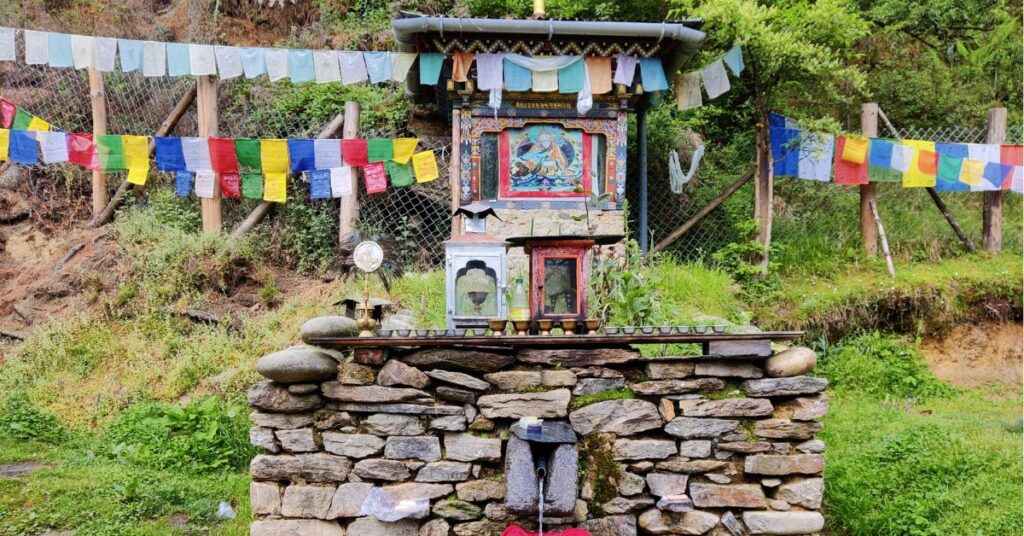
Kurje Drupchhu is a holy spring water created by Guru Rinpoche in the 8th century near Kurjey Lhakhang in Bumthang Dzongkhag to heal the ailing Sindhu Raja. According to locals, the holy water cures all sorts of diseases.
How to Reach Kurjey Drupchhu
The Kurjey Drupchhu is located near Kurjey Lhakhang in Bumthang, 5 km from Jakar town, at an altitude of 2800 meters above sea level. It takes only 15 minutes by car to reach Kurjey Lhakhang.
Historical Significance of Kurje Drupchhu
The holy water has a long history, dating back to Guru Rimpoche’s visit to Bhutan. History has it that after being exiled from India, the Indian prince Sendha Gyab, also known as Sindhuraja, eventually entered Bhutan and took control of the Bumthang region.
After Sindhu Raja became the king of the Kingdom of Bumthang, he clashed with Naochhe, also called “Big Nose,” a king to the south. Before sending his troops—one of whom was his son—into war with Naochhe, King Sindhu Raja of Bumthang prayed to local deities to protect his soldiers, specifically his son.
However, Sindhu Raja’s son was killed during the war, and that caused Sindhu to become angry at the local deities. Sindhu Raja then ordered his men to destroy the sites of local deities. This act, in turn, angered the chief local protective deity, Shelging Karpo. Shelging Karpo thus stole the soul of Sindhu Raja to kill him. As a result, Sindhu Raja became ill and could not be healed by any astrologers or local shamans.
Also Read: Guru Rinpoche in Bhutan: His Visits to Bhutan and Sacred Sites
The Invitation of Guru Rinpoche to Bumthang
In a final attempt to treat Sindhu Raja, one of his ministers invited Guru Rinpoche, whose extraordinary abilities were well known across the Himalayan region.
Guru Rinpoche spent three months meditating in a cave above Sindhu Raja’s Palace after reaching Bumthang. During the meditation, Guru Rinpoche pierced the Vajra Piled Red Cave, which hit the palace of the Naga King and shook it. Lui Gyalpo Pemachen, knowing it was Guru Rinpoche, humbly asked what service he should offer.
To this, Guru said, “I need Chhu Drowa Drenpa, an elixir that would liberate all sentient beings“. The Naga king did not understand what it meant and asked what it was. Guru said, “It is the mixture of 9 different glasses of water”. The Naga King understood it and said he would offer.
Then, on the morning of the 7th day after this, Guru told Khandro, “Today we will exhibit the miracle of our achievement. Lhachig Bumden, you take the golden container Gahta and go in the direction of north-west, where there is a small crag. From there, holy water will come out. Before it touches the ground, hold the container and receive it.” As Khandro arrived there, as destiny would have it, the holy water (Kurje Drupchhu) gushed out, and Khandro received it in her container. Instantly, five Dakinis appeared, and each Dakini held the same container.
Also Read: Drupchhu or Holy Spring Waters in Bhutan: Beliefs and Benefits
Guru Padmasambhava and Khandro rushed to Chagkhar Gyalpo Sindhu Raja’s bed, carrying the holy water and the king’s life force. Guru opened the skin, and the king inhaled his breath. Then the King was cured after drinking the holy water.
Also Read: Kurjey Lhakhang, a Cave of the Red Cliff, where Guru Rinpoche left an Impression of his Body
Ethnopharmacological Uses and Benefits of Kurjey Drupchhu
People in Bhutan believe that Kurjey Drupchu is the holiest of all waters that cured the ailing King Sindhu Raja. Therefore, they travel from all over the country to Kurjey to seek the blessings of holy water. Every day, thousands flock to fetch the sacred waters. Kurjey Drupchhu is popular for treating eye diseases, wounds, and mental disorders. The holy spring is also thought to aid in the relief of body aches.
Best Time to Visit Kurje Drupchu
If you intend to fetch Kurje Drubchu, plan it for the weekdays. This is because many people come to fetch the Drubchu on weekends.
People with containers ranging from empty mineral water bottles to 20-litre jerry cans form long queues every Saturday and Sunday. The crowd fetching the Drubchu indicates that almost everyone in Chamkhar drinks Kurje Drubchu, and some even cook with it. People from other places who visit Bumthang also make a point to see and take the Drubchu.
Many monks from monasteries like Kharchu Dratshang and Jakar Lhakhang collect Drubchu, which they offer as Yoenchab (water offering). You can visit the Holy Spring Waters in Bhutan with the Bhutan Pilgrimage Package.
Frequently Asked Questions
What is Kurje Drupchhu?
Kurje Drupchhu is a sacred natural spring located near Kurjey Lhakhang in Bumthang, believed to have been blessed by Guru Rinpoche in the 8th century. According to local tradition, Guru Rinpoche created this holy water while meditating in the cave to heal the ailing King Sindhu Raja (also known as Sendha Raja). The water is revered as one of the holiest in Bhutan and is said to possess powerful healing properties.
What are the believed benefits of Kurje Drupchhu?
Devotees believe that Kurje Drupchhu can cure various ailments, particularly eye diseases, skin wounds, mental disorders, and body aches. Many pilgrims travel from across Bhutan and beyond to collect and consume the water, seeking both physical healing and spiritual blessings. The spring is especially popular among those suffering from chronic illnesses who hope for miraculous recovery through its sacred properties.
Where exactly is Kurje Drupchhu located?
Kurje Drupchhu is situated in the Bumthang valley of central Bhutan, approximately a five-minute walk uphill from the main Kurjey Lhakhang temple complex. The spring emerges near the entrance of the sacred cave where Guru Rinpoche meditated and left his body imprint on the rock wall. The site is easily accessible from Jakar, the main town of Bumthang, and is well-signposted for visitors.
How do I collect Kurje Drupchhu water?
Visitors can collect the holy water directly from the spring using clean containers brought from home or purchased locally. There are designated areas near the spring where people gather to fill their bottles and jars. It is customary to approach the water with reverence, often making a small prayer or offering before collecting. Many pilgrims also bathe their faces and hands in the water as part of their purification ritual.
Is Kurje Drupchhu accessible year-round?
Yes, Kurje Drupchhu is accessible throughout the year, though winter months (December to February) can be quite cold in Bumthang. The spring flows continuously and does not freeze, making it available for pilgrims even during the harshest weather conditions. Road access is generally good, though travelers should be prepared for potential delays during monsoon season (June to September) due to heavy rainfall in the region.
What other attractions are near Kurje Drupchhu?
Kurje Drupchhu is part of the larger Kurjey Lhakhang complex, which includes three main temples built around the sacred cave where Guru Rinpoche meditated. Nearby attractions include the crawl-through rock passage believed to cleanse sins, the main temple housing the body imprint of Guru Rinpoche, and the beautiful Bumthang valley landscape. Other significant sites in the vicinity include Jambay Lhakhang, Tamshing Lhakhang, and the scenic Ura village, all within easy driving distance.