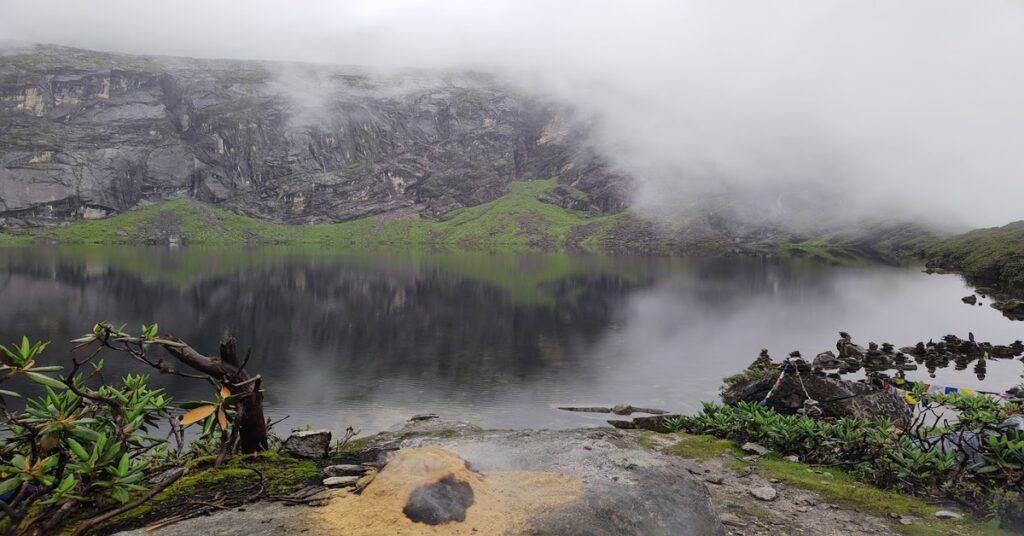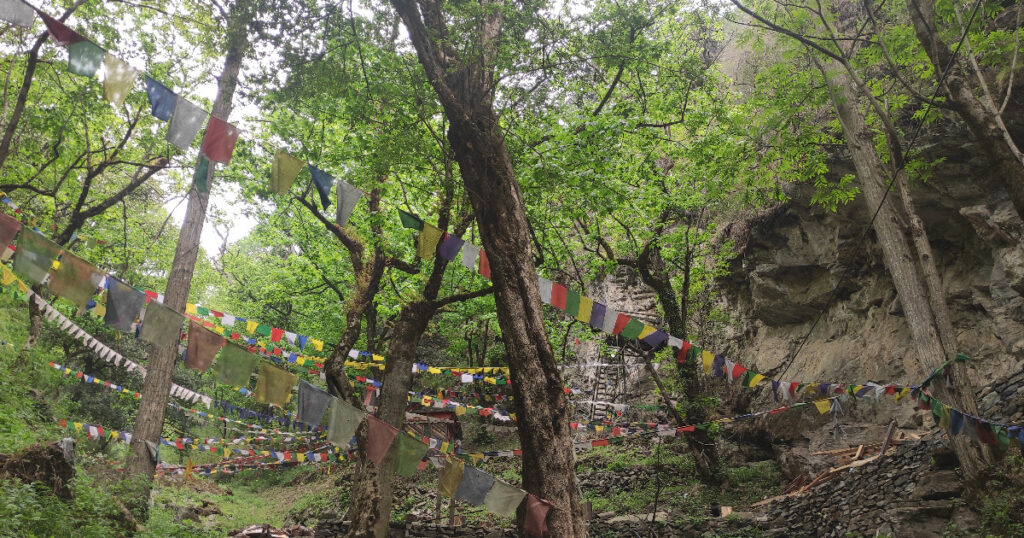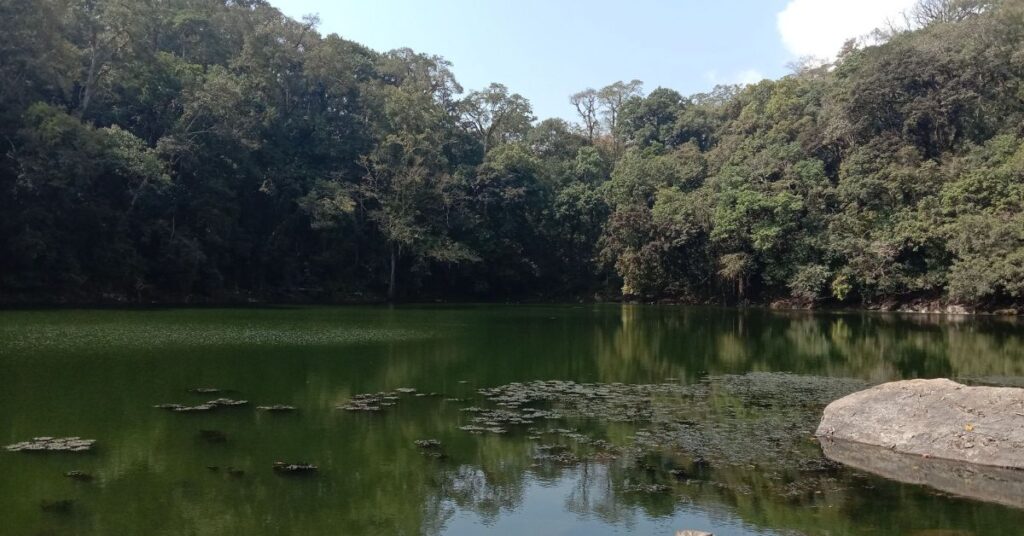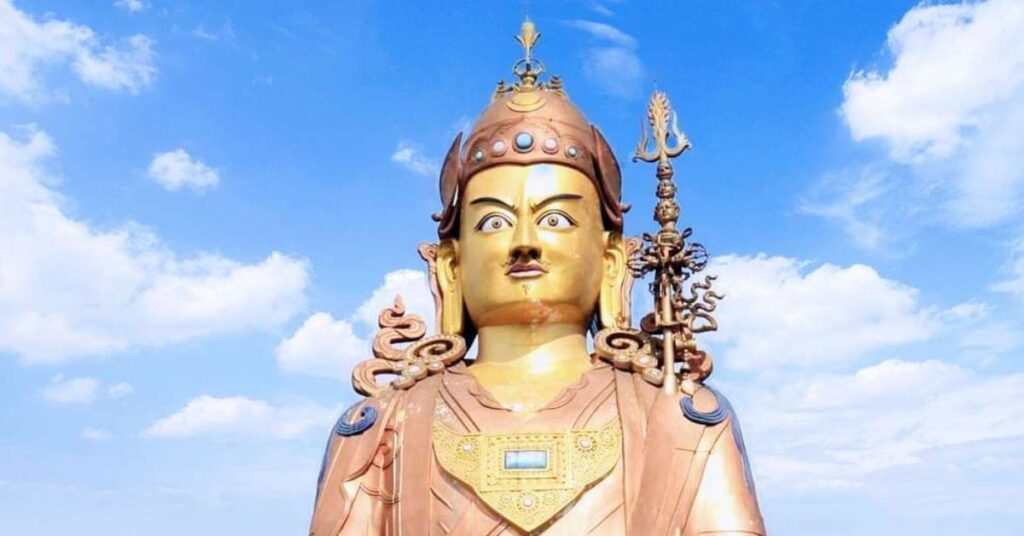
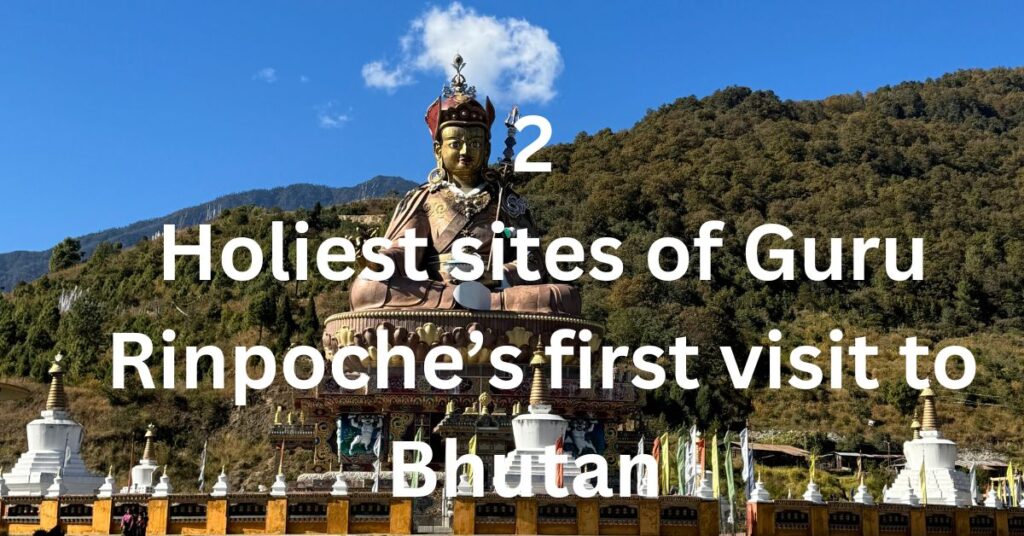
The 2 Holiest sites of Guru Rinpoche, blessed during his first visit to Bhutan from Nepal at the invitation of King Sindhu Raja in the 8th century, are in Bumthang and Trongsa.
During Guru Rimpoche’s first visit to Bhutan, he blessed 2 Holiest sites, Bumthang Kurjey Lhakhang and Trongsa Nabji Lhakhang.
The 2 Holiest Sites of Guru Rinpoche Blessed during his first visit to Bhutan
The 2 holiest sites of Guru Padmasambhava, blessed during his first visit to Bhutan, are:
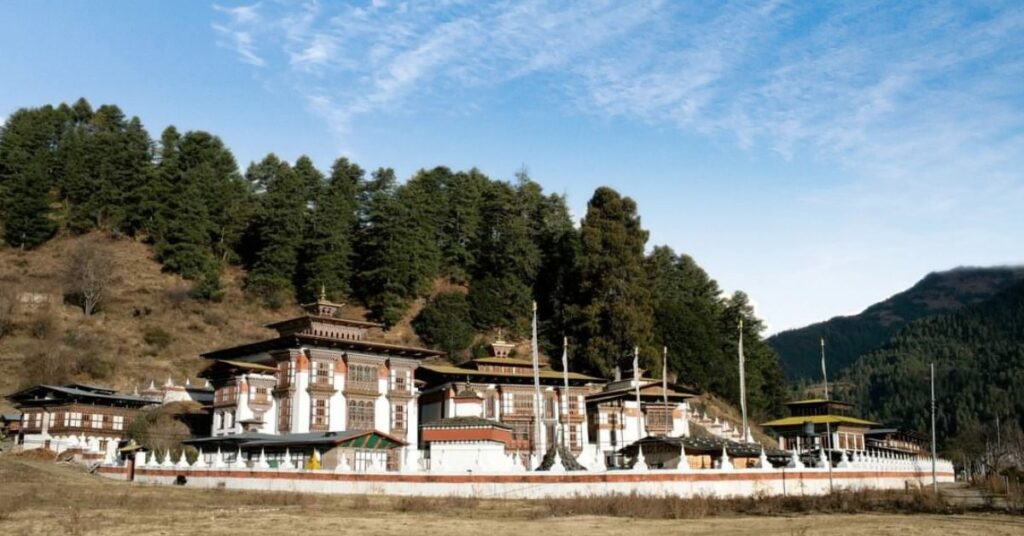
1. Kurje Lhakhang
Bumthang Kurjey is one of the 2 holiest sites blessed by Guru Rinpoche during his first visit to Bhutan. It is one of the first sacred places of Guru Rinpoche. Guru Rinpoche is believed to have left his body impression while meditating to subdue Shelging Karpo, who took the sog (life force) of King Sindhu Raja of Bumthang in the cave of the Red Cliff (Drakmar Dorje Tsekpa). Therefore, it was known as Kurjey. The body impression can be seen even today.
Later, the Lhakhang was built by Mingyur Tenpa at the site in 1652. This site of pilgrimage is known as Kurje Lhakhang. Therefore, Kurjey is a very sacred place and the most venerated place of pilgrimage.
Kurjey is located at the Drakmar Dorje Tsekpa (the red cliff of stacked scepters), 5 km from Jakar town. It takes only 15 minutes by car to reach Kurjey. If you visit from Chakhar Lhakhang, Kurjey is 2.5 kilometers away. The Kurjey Lhakhang is only 1 kilometer from Jambay Lhakhang.
There are three main temples in Kurje. They are Guru Lhakhang, Sampa Lhundrup Lhakhang, and Ka Gon Phor Sum Lhakhang. The oldest, Guru Lhakhang, was built in 1652 on the site where the Guru Meditated; the second temple was built where he left his body imprints; and the third was added in 1984.
The Kurjey Lhakhang can be visited throughout the year, but the best time would be in June when the popular Kurjey Tshechu is held. During the Tshechu, a large Thongdrel of Guru Tshengye, the eight manifestations of Guru Rinpoche, is unfurled in the early morning. The Tshechu has a unique and historical mask dance that portrays Guru Rinpoche subduing the local deity Shelging Karpo.
Read More: Kurjey, a Cave where Guru Rinpoche left his Body Impression.
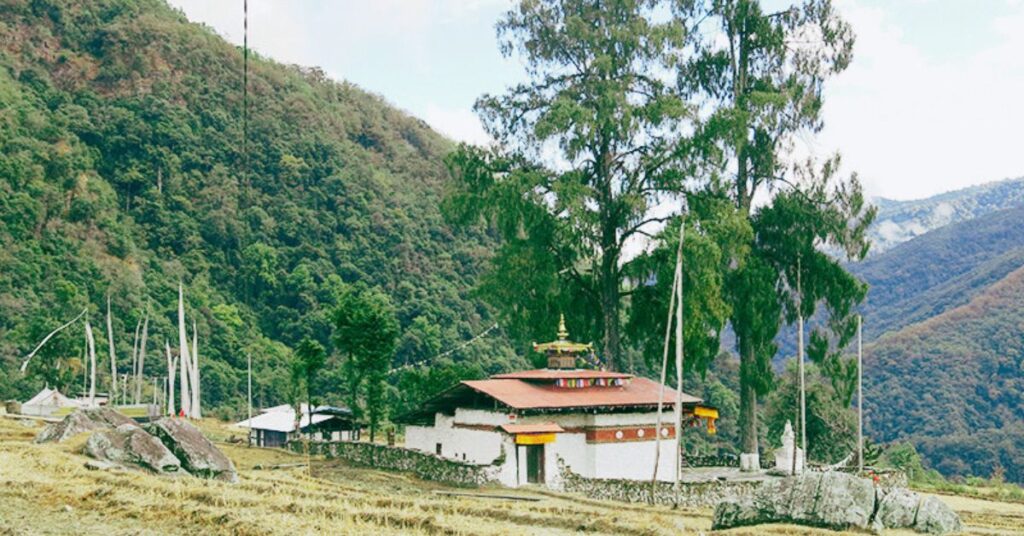
2. Nabji Lhakhang
Nabji Lhakhang is one of the 2 holiest sites blessed by Guru Rinpoche during his first visit to Bhutan. It is a one-story traditional Bhutanese temple built by Khandro Tashi Khyidren. The temple was constructed at the site where Guru Rinpoche made peace between the two kings, Sindhu Raja and Nawoche, by erecting a stone pillar of oath (Nado). A stone pillar of the oath still stands inside the temple as the main relic with the handprints of Guru Rinpoche, King Sindhu Raja, and King Nawoche.
This Lhakhang is in the middle of a field surrounded by a wall in Nabji village, Korphu Gewog, under Trongsa Dzongkhag at an elevation of 2156 masl.
To visit the historic Nabji Lhakhang, drive to the road’s end at Nabji Primary School. The school is 115 km away from Trongsa town. From the school, hike up for half an hour to reach the sacred Nabji. If you are an ardent trekker, you can also reach Nabji from Reotala, between Trongsa and Zhemgang.
You can visit Nabji Lhakhang at any time of the year. However, staying during the annual Nabji Lhakhang Drup, conducted from the 15th to the 20th day of the 11th month of the Bhutanese calendar, would be a bonus. You can witness a five-day festival where the monks and the local villagers of Nabji perform the dances of Pema Lingpa (Terchams).
Read More: Nabji Lhakhang, a Place where Guru Rinpoche erected a Stone Pillar of Oath.
Conclusion
Guru Rinpoche sanctified 2 holy sites during his first visit to Bhutan in the 8th century. The 2 holiest sites are Kurjey Lhakhang in Bumthang and Nabji Lhakhang in Trongsa. Kurjey Lhakhang features a cave where he meditated and left his body imprint while subduing a deity. Today, the temple marks its sacredness with the Kurjey Tshechu festival. Nabji Lhakhang commemorates Guru Rinpoche’s peacemaking between two kings. A stone pillar inside bears their handprints, symbolizing their oath. The annual Nabji Lhakhang Drup festival offers traditional dances. Both sites are significant to Bhutanese history and spirituality, reflecting Guru Rinpoche’s profound influence. You can visit the sacred sites of Guru Rinpoche in Bhutan with the Bhutan Pilgrimage Package.
Frequently Asked Questions
Which two sites are considered the holiest from Guru Rinpoche’s first visit to Bhutan?
The 2 holiest sites blessed by Guru Rinpoche during his first visit to Bhutan are Kurjey Lhakhang in Bumthang and Nabji Korphu Lhakhang in Trongsa. These sacred places mark key moments of his early 8th-century mission, when he was invited by King Sindhu Raja to subdue local deities and establish Buddhism in the region.
Why are Kurjey Lhakhang and Nabji Korphu so significant for pilgrims?
Kurjey Lhakhang is revered as the place where Guru Rinpoche left a physical imprint of his body on a cave wall while meditating to subdue the local deity Shelging Karpo. Nabji Korphu, in Trongsa, is traditionally recognized as the site of Guru Rinpoche’s first entry into Bhutan and where he began his blessings in the country. Together, they represent the spiritual gateway and foundational blessings of his mission.
When did Guru Rinpoche first visit Bhutan?
Guru Rinpoche’s first visit to Bhutan is traditionally dated to the early 8th century, with many Bhutanese sources citing 746 CE or 810 CE (the year of the Iron Tiger). He came from Nepal via eastern Bhutan at the invitation of King Sindhu Raja of Bumthang, who sought his help in overcoming illness and spiritual obstacles.
Where exactly are these two sacred sites located?
The 2 Holiest sites are located in the Bumthang valley of central Bhutan, within the Tang region known for its cluster of ancient temples, and in the Trongsa district, along the historic route from Nepal into central Bhutan. Both sites are accessible as part of classic central Bhutan cultural and pilgrimage itineraries.
Are these sites suitable for all types of travelers?
Yes, both Kurjey Lhakhang and Nabji Korphu are suitable for cultural travelers and pilgrims alike. The sites involve modest walking and are generally included in central Bhutan tours that also cover Bumthang’s other temples, Trongsa Dzong, and nearby attractions. Visitors should dress respectfully and be prepared for a spiritual atmosphere with chanting, prayer flags, and local devotees.
How can I include these two holiest sites in a Bhutan pilgrimage itinerary?
A practical way to visit both sites is through a central Bhutan pilgrimage circuit: start in Thimphu, travel via Trongsa (stopping at Nabji Korphu), then continue to Bumthang for Kurjey Lhakhang and other Guru Rinpoche sites like Tamshing Lhakhang and Mebartsho.