
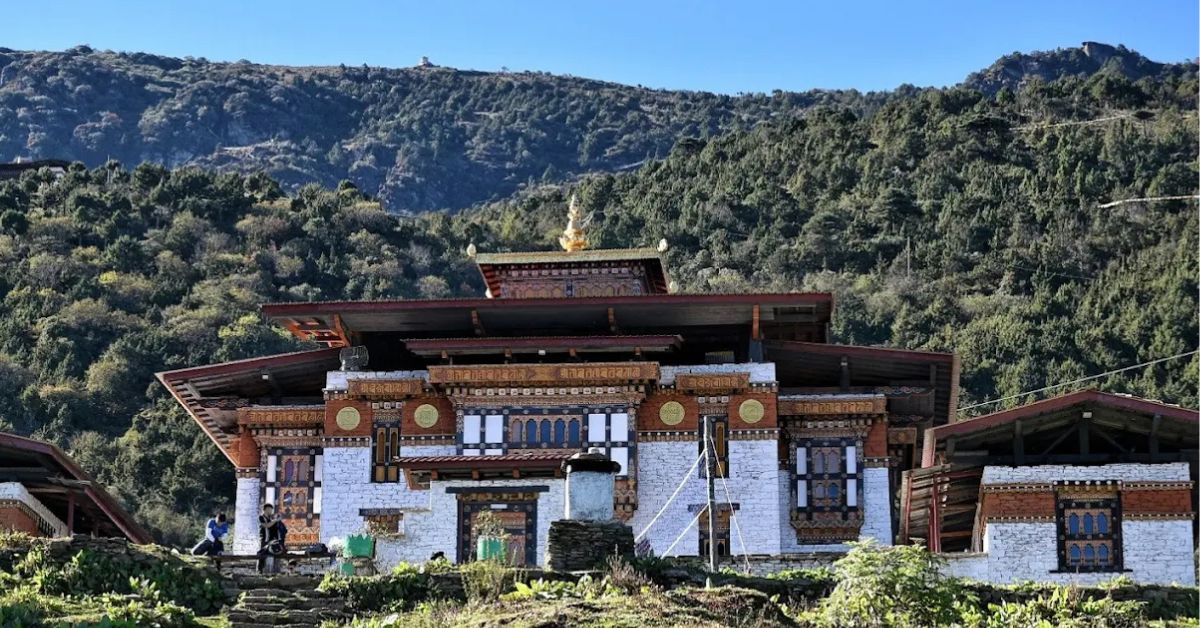
Phajoding Monastery, also known as Phajoding Sheydrup Ling Buddhist Institute, is a historic meditation and monastic complex above Thimphu. Tradition associates its founding as a meditation hermitage with Phajo Drugom Zhigpo in the 13th century. Its name is commonly understood as “Phajo’s spacious land”. Set on a high ridge below Thujidra Goenpa, the monastery overlooks the Thimphu Valley and remains an important place of Drukpa Kagyu practice.
Phajoding forms part of the wider sacred landscape associated with Guru Rinpoche and the Drukpa Kagyu lineage established in Bhutan by Phajo Drugom Zhigpo.
Planning a hike to Phajoding Monastery?
Include this sacred mountain monastery in your Thimphu visit. Contact us for help planning the hike, understanding the route and preparing for the high-altitude conditions around Phajoding and Thujidra.
The present temple complex took shape in the mid-18th century, with major construction and expansion associated with Sherab Wangchuk, the 13th Druk Desi, and Gyalwa Shakya Rinchen, the 9th Je Khenpo. After years of neglect, the monastery underwent a major conservation project between 2013 and 2018. Today, Phajoding is also home to a monastic school and a community of young monks.
For hikers, Phajoding is one of the memorable high-altitude walks above the capital. The monastery is reached by a demanding uphill trail from the Motithang side, and it is also connected with the route towards Thujidra, Dungtsho and the Druk Path trekking area. The climb rewards visitors with forest scenery, open mountain views and the quiet atmosphere of a working monastic community.
Table of Contents
How To Reach Phajoding Monastery
Phajoding lies in the mountains north of Thimphu. The commonly used trailhead is above the Royal Takin Preserve in Motithang, near a small roadside tea shop. From the trailhead, allow around 3–4 hours uphill to reach the monastery, depending on your pace, weather and trail conditions. The walking distance is commonly described as about 5 kilometres, but the climb is steep in places.
An alternative approach begins around Sangaygang (BBS Tower). The two routes meet the wider network of forest trails above Thimphu, but their gradients and walking times differ. Confirm the starting point and route with a local guide before setting out, as trail junctions are not always obvious. From Sangaygang, you can also take the route to Wangditse Lhakhang, which is a separate and shorter walk.
Phajoding Hike in Thimphu
The Phajoding hike is a strenuous uphill walk rather than an easy stroll. From the Motithang trailhead, most hikers should allow approximately 3–4 hours to climb to the monastery, with additional time for rest stops and the return journey. The route rises through forest and becomes more exposed as you approach the open ridge.
The trail passes through stands of blue pine and other mountain vegetation, with resting places along the way and views opening towards the Thimphu Valley. Some sections are steep, and the path can be muddy and slippery during the summer monsoon. Horse teams also use parts of the route, so step aside safely and allow them to pass.
Phajoding is also a useful staging point for longer walks towards Thujidra Top and Dungtsho. If you plan to continue beyond the monastery, treat it as a separate mountain trek: check the route, weather and daylight, carry sufficient food and water, and arrange any overnight stay in advance rather than assuming that accommodation or camping facilities will be available.
Sacred Relics to See at Phajoding Monastery
- Library of Buddhist Scriptures;
- Ancient Chortens;
- Meditation Hermitages;
- Temple complex;
- Reliquary stupa and Thongdrel of Shakya Rinchen;
- The Sky Burial Hill.
History of Phajoding Monastery
Phajoding is closely associated with Phajo Drugom Zhigpo, who is believed to have visited and blessed this mountain site during the 13th century while spreading the Drukpa Kagyu teachings in Bhutan. A meditation hermitage was established here in his name. The word Phajoding is commonly explained as “Phajo’s spacious land”, combining Phajo’s name with ding, meaning an open or spacious place.
The monastery’s main construction is traditionally dated to 1749 and associated with Sherab Wangchuk, the 13th Druk Desi. In 1755, Gyalwa Shakya Rinchen, the 9th Je Khenpo, constructed and developed additional temples and later retired at Phajoding. The monastery’s full name is Phajoding Thubten Jago Phungpo Wogmin Nampar Gyalwai Khangzang, expressing its association with the Buddha’s doctrine, Vulture Peak and the Akanishtha mansion of complete victory.
Shakya Rinchen made Phajoding an important place of retreat and religious practice and is closely associated with Jampa Lhakhang and Khangzang Lhakhang. Later religious and political figures, including Druk Tenzin, the 19th Druk Desi, and Jampel Drakpa, the 21st Je Khenpo, also contributed to the complex. The temples, reliquary and sacred images preserve the memory of these successive generations of spiritual patrons.
Over time, the remote location and difficult access contributed to the deterioration of the buildings. In 2010, the World Monuments Fund included Phajoding among its five most endangered monuments of the year, drawing attention to the urgent need to protect the historic complex.
Importance of Phajoding Monastery
Phajoding is valued both as a sacred meditation site linked to Phajo Drugom Zhigpo and as a living centre of Drukpa Kagyu learning and practice. The Phajoding Sheydrup Ling Buddhist Institute has provided monastic education and a home for young monks, including children from disadvantaged backgrounds. Visitors should remember that this is first and foremost a place of study, worship and retreat, not simply a hiking destination.
Phajoding Monastery Conservation Project
The Phajoding Monastery Conservation Project was carried out from July 2013 to June 2018, with a grant of Nu. 200 million from the Government of India. The work was implemented by the Division for Conservation of Heritage Sites and focused on conserving the historic temples while improving essential facilities for the monastic community.
Conservation work included replacing the front three rabseys and timber joists on the ground and first floors of Wogmin Lhakhang, restoring Khangzang Lhakhang, and repairing paths, chortens, drainage and retaining walls around the complex. The remote mountain location made transporting materials difficult. A ropeway system from the Sangaygang side was used to move construction materials uphill, avoiding the need to build a vehicle road through the forest.
The project also provided supporting facilities for the monks, including a two-storey drasha, a kitchen and dining area, toilets, shower facilities and a residence for the former Yangpoi Lopen, Boso Karp. These additions were intended to support daily monastic life while preserving the character of the historic site.
Description of Phajoding Temple Complex
Phajoding is an open mountain complex spread across a grassy ridge. It includes around ten temples, a monastic school, meditation hermitages and seven small residences for the monks. Earlier descriptions have placed the community at around 80 young monks, although the number living at the monastery can change. A hill used for sky burial, marked by prayer flags, is also part of the wider sacred landscape. The complex is not laid out as a single compact building; visitors walk between separate temples and structures across the hillside.
Among the temples, Jampa Lhakhang is one of the largest and most prominent. It is a three-storey stone structure associated with the 9th Je Khenpo, Gyalwa Shakya Rinchen, and is enclosed by shabkor walls. Nearby stands the reliquary stupa containing his remains, an important focus of devotion at Phajoding.
Higher up the hillside are Khangzang Lhakhang and Wogmin Lhakhang. Khangzang Lhakhang is closely associated with Shakya Rinchen and houses his Thongdrel, which was consecrated at Changangkha Lhakhang. The sacred image and its history connect Phajoding with other important religious sites in Thimphu.
Wogmin Lhakhang is a three-storey stone-walled temple. Its construction is associated with the 16th Je Khenpo, Sherub Singye, and it was later enlarged to its present form by the 21st Je Khenpo, Jampel Drakpa. Together, these temples and their associated relics give Phajoding its distinctive architectural and spiritual character.
Best Time to Visit Phajoding Monastery
Spring (March to May) and autumn (September to November) are generally the most comfortable seasons for the Phajoding–Thujidra hike, with clearer skies and more settled walking conditions. During the monsoon, the trail can become muddy and slippery. In winter, temperatures drop and snow or ice may affect the higher sections, so check conditions before leaving Thimphu.
Visitor Information and Hiking Safety
Phajoding is reached on foot and there is no vehicle road to the monastery. Start early so you have enough daylight for the climb and descent. The altitude is considerable, so spend time acclimatising in Thimphu, keep a comfortable pace and drink water regularly. If you develop a headache, dizziness, nausea or unusual breathlessness, stop and descend if symptoms persist or worsen.
Two restroom facilities have been provided along the Phajoding trail, roughly 1.5 km and 2.5 km from the base. Their availability and condition can change, so carry basic supplies and do not leave tissues, food wrappers or other rubbish behind. The trail is used by hikers and horse teams; give way safely and avoid disturbing the forest.
At the monastery, dress modestly, speak quietly and follow the instructions of the monks. Ask before entering temple rooms or taking photographs, and do not touch sacred objects or disturb prayer and teaching sessions. A small offering of tea, rice, sugar or other useful provisions may be appreciated, but it is not an obligation.
Conclusion
Phajoding Monastery is one of the most significant sacred places in the mountains above Thimphu. Its spiritual connection with Phajo Drugom Zhigpo reaches back to the 13th century, while its temples and monastic buildings reflect centuries of development, especially during the 18th century. The conservation project helped protect this remarkable complex, which remains both a place of worship and a rewarding destination for well-prepared hikers.
Other Sacred Sites to Explore in Thimphu
Buddha Dordenma: It is a massive golden statue of Buddha Shakyamuni overlooking the Thimphu valley. The site also houses thousands of smaller Buddha statues and a meditation hall.
Tashichho Dzong: It is a fortress that houses the king’s throne room, government offices, and the central monastic body. Known as the “Fortress of the Glorious Religion,” it blends religious and administrative functions with stunning Bhutanese architecture.
Pangri Zampa Monastery: It is one of Bhutan’s oldest monasteries, founded in the 16th century by Ngawang Chogyal. The monastery now functions as Bhutan’s Royal College of Astrology, responsible for determining dates for important national events.
Dechenphu Lhakhang: It is a monastery dedicated to Geynyen Jagpa Melen, a powerful protective deity, located at the northern end of the Thimphu Valley in Bhutan. The Temple was constructed in the 12th century by Dampa, the son of Phajo Drugom Zhigpo.
Cheri Monastery: It is the first monastery established in Bhutan by Zhabdrung Ngawang Namgyel in 1620.
Tango Monastery: The Tango Choying Dzong was founded in the 13th century by Phajo Drugom Zhigpo. The monastery is perched on a forested hillside near Cheri Mountain.
Thuji Dra Monastery: It is one of the four cliffs prophesied by Guru Rinpoche to Phajo Drugom Zhigpo. The Thujidra Temple is located at an altitude of nearly 4,000 meters, where Phagpa Thujechenpo saw in a vision while meditating here.
Frequently Asked Questions
What is Phajoding Monastery?
Phajoding is a historic Drukpa Kagyu monastic and meditation complex above Thimphu, traditionally associated with Phajo Drugom Zhigpo and his 13th-century visit to the site.
How high is Phajoding Monastery?
The monastery is generally described as lying at approximately 3,600–3,700 metres above sea level. Elevation figures vary slightly between sources and points within the wider complex.
How long does it take to hike to Phajoding?
Allow about 3–4 hours to climb from the commonly used Motithang trailhead. The time depends on fitness, weather, stops and trail conditions; allow additional time for the descent.
Where does the Phajoding hike start?
The commonly used trailhead is above the Royal Takin Preserve in Motithang, near a small roadside tea shop. There is also an approach from the Sangaygang or BBS Tower area. Confirm the route before setting out.
Is the Phajoding hike difficult?
Yes. It is a sustained uphill hike at high altitude, with steep sections. Walk at a steady pace, allow time to acclimatise in Thimphu, and do not continue if you feel unwell.
Are there toilets along the Phajoding trail?
Two public restroom facilities have been provided along the trail. Their operating condition and supplies may vary, so do not rely on them as your only option; carry tissues and take all rubbish back with you.
When is the best time to hike to Phajoding?
Spring (March to May) and autumn (September to November) are generally the most comfortable seasons. Monsoon rain can make the trail muddy and slippery, while winter may bring snow or ice at higher elevations.
Explore Thimphu
Make Phajoding Monastery part of your Thimphu journey
Discover Phajoding’s sacred temples, meditation heritage and mountain setting alongside Thujidra, Tango and other spiritual places around Thimphu. Let us help you plan your visit.
