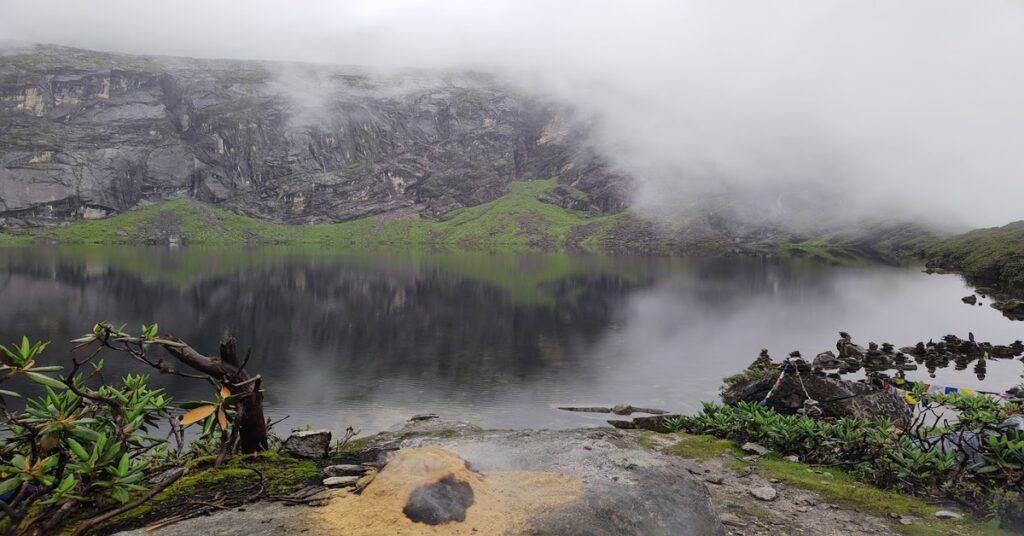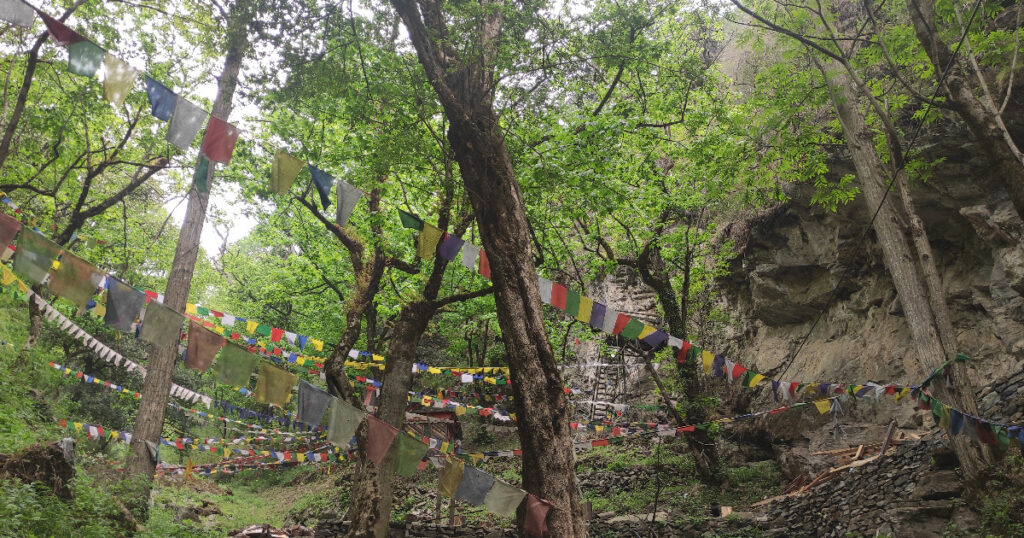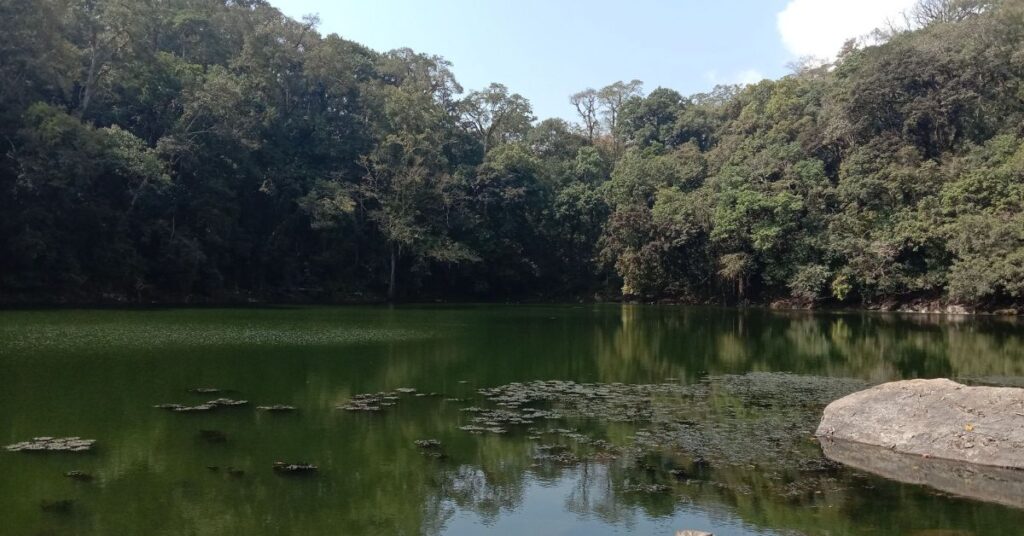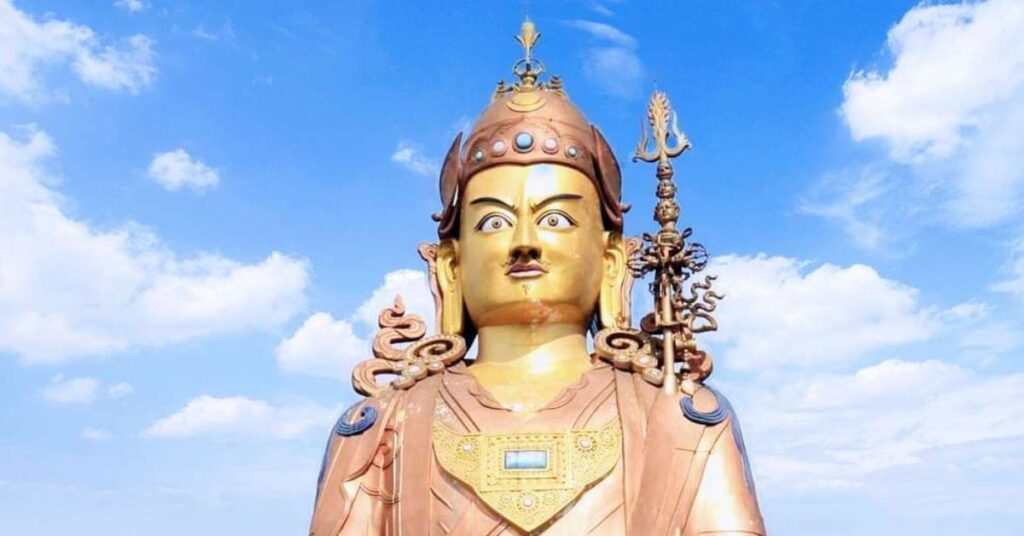
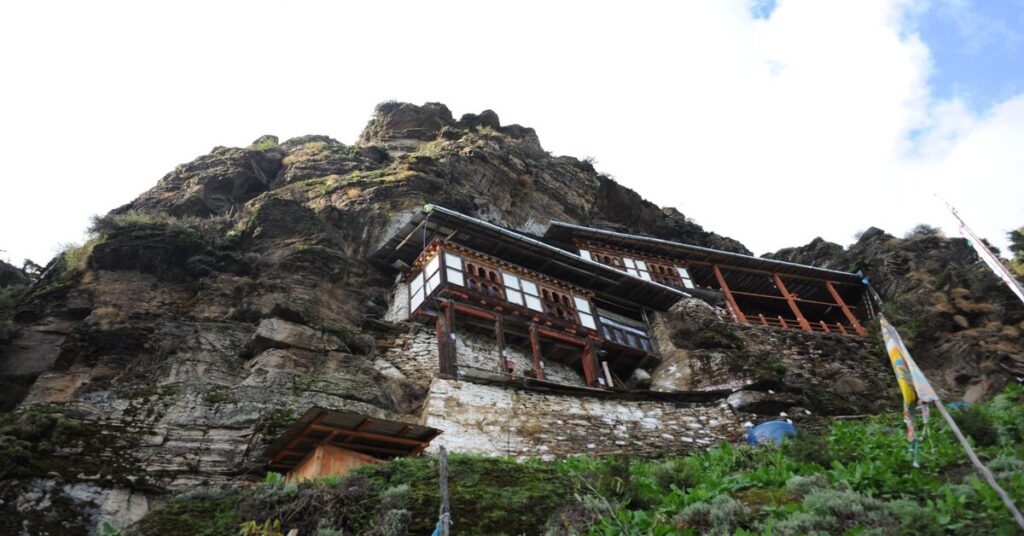
Bumdrak is a sacred cliff of Guru Rinpoche where Dakinis, the Goddess of the Fairies, are said to have left 100,000 footprints located at an altitude of 3500 masl in Tsento Gewog under Paro Dzongkhag.
You will see numerous sacred caves in Bumdrak, where a hundred thousand Dakinis descended on the rocks and left their footprints. While on the Bumdra Trek, you will also be visiting Taktsang Monastery, one of Bhutan’s most revered Buddhist pilgrimage sites in Bhutan.
Sacred Relics to See at Bumdrak
- The cave where Dakinis, Goddess of the Fairies, is said to have left 100,000 footprints;
- Ancient Bumdra sky burial sites;
- Guru Rinpoche’s Uhzha;
- Dorji Phagmo’s holy water below the temple;
- Drilbu Dra, a cliff resembling a Drilbu;
- Khandro’s secret path (Sanglam);
- Bumdrak Monastery;
- Taktsang (Tiger’s Nest) Monastery.
Also Read: Guru Rinpoche in Bhutan: His Visits to Bhutan and Sacred Sites
How to Reach Bumdrak Monastery
Bumdrak Monastery is 22 kilometers from Paro. You can reach the monastery from Sangchhoekor Monastery, Shari Village, or Taktsang Monastery. The monastery can be visited as a day hike or a two-day trek.
The Trek to Bumdrak Monastery
Also known as the “Trek of the Thousand Dakinis“, the Bumdra trek in Paro is one of Bhutan’s favorite pilgrimage treks. It requires only one night of camping and is a two-day trek with a distance of 22 km. The Bumdrak, which Guru Rimpoche blessed in the 8th century, inspires this religious trek to Bumdra.
Trek cost and Bumdra camp price vary depending on your tour operator. Please get in touch with Bumdra Camp at 17162455/17612487 for booking.
Also Read: Tiger’s Nest Trek in Bhutan
Here’s the brief itinerary for the pilgrimage trek to Bumdra monastery:
Day 1: Sangchhoekor to Bumdrak Monastery
Distance: 7 km
Time: 3-4 hours
Ascent: Ascent 960 m
Camp Altitude: 3,500 m
Your adventure will start with a drive up to the Sangchen Choekhor in the morning, a brief visit, and a blessing for a safe trek ahead. Then start your hike from the parking lot and follow the trail to the left. Keep on climbing through a forestry ridge of blue pine woven by oak and rhododendron. You will reach Yak Pasture with prayer flags, providing a breathtaking view of the Paro and Do Chhu valleys.
Have your lunch on the wooden seats near the Choechotse Lhakhang, where the Denpa statue inside the temple is said to have once rescued the valley from a measles outbreak. After lunch, the trail steadily ascends. Finally, descend for about 40 minutes, and you will reach the Bumdra campsite.
Bumdra Campsite
The semi-permanent camping spot is near the Bumdra Monastery. Bumdra’s camping facilities are the most comfortable in Bhutan, with sun loungers, gas heaters, and wooden beds. The trek can include the luxury of a bed or plain sleeping bags, depending on your preferences, providing a unique perspective on the whole trip.
Warm clothing and a torch are two things you should carry in your backpack while trekking here. The experience is one to remember with family and friends as the cold winds buffet the tent and everyone huddles around the campfire with hot food, creating a lasting memory.
Day 2: Bumdrak Monastery to Ramthangkha
Distance: 15 km
Time: 5-6 hours
Descent: 1260 m
Day two. It’s time to leave the place and make memories. With a hearty breakfast, it’s a one-hour downhill walk from the Bumdra campsite to Yoeselgang. After another 10 minutes, you will reach Ugyen Tshemo Lhakhang, followed by Zangdo Pelri Lhakhang. After a 2-hour descent back into Paro Valley, you will see the golden roofs of the great Monastery of Taktsang signaling the end of the Bumdra trek. From Taktsang, it’s a 90-minute downhill to the Ramthangkha parking.
Historical Significance of Bumdrak
The history of Bumdra is deeply rooted in Buddhist mythology and legends. Guru Rinpoche predicted that a sacred place called Bumdra would be founded in Bhutan. He said this place would be as holy as the cremation ground in India where Buddha’s relics are kept.
Therefore, in the 8th century, Guru Padmasambhava and Khandro Yeshey Tshogyel came to the site and meditated there. It is said that Khandro Yeshey Tshogyel could represent 100 thousand Dakinis through her miraculous ability. In disbelief, Guru asked all the Dakinis to demonstrate their existence and divinity. In response, 100,000 Dakinis left their right leg impressions on the cliff, which can still be seen today. Thus, the name Bumdrak, which translates to “a cliff with 100 thousand footprints.”
Guru from Gyem Jango in Drukgyal discovered Bumdra in the 13th century. Zhabdrung also blessed Bumdra in the 17th century.
Description of Bumdra
When you reach Bumdra, on the front of the Temple, adjacent to the two Chortens, is Khandro’s leisure ground. It is believed that dancing on the ground would please the Gods and spirits. Below the temple, you will see the 100 thousand footprints and Dorji Phagmo’s holy water.
Further left of the Temple is Drupchhu, which has two sources: Phochu-Mochu. These Drupchhus are water sources for both the temple and the campsite.
Also Read: Drupchhu or Holy Spring Waters in Bhutan: Beliefs and Benefits
To the temple’s right is Drilbu Dra, a cliff resembling a Drilbu. Right below the Dra is Bumdra Rinpoche’s retreat house. Next to the Drilbudra is a drain-like canyon, said to be Khandro’s secret path (Sanglam) used during the retreat.
Dhuthroe (Cremation Site) at Bumdra
There are three ancient sky burial sites (Duethroe) on the Namgo La, the Pass as high as the sky above Bumdra Monastery. The practice of placing a human corpse on a mountaintop to be eaten by scavenging animals, especially vultures, is known as sky burial, but it is no longer practiced.
Hike up for about 30-40 minutes from the campsite to reach the sites. Reaching these sky burial sites can be difficult as no proper trails exist. The first cremation site you reach is the Third cremation ground (Duethroe Sumpa). The chronological order of the Cremation grounds is the opposite. You reach the third cremation site first and the first cremation site last.
As you go to the first cremation site, you will come across a rock resembling a hat, said to be Guru Rinpoche’s Uzha, and a small meditation cave. After Guru Uzha, the Second cremation site is Duethri Nyipa as you move further up. The beak of the peak at around 4300 meters is the First cremation ground, Duethri Dangpa.
A stupa can be found near these sky burials. You cut a strand of hair and burn it here. You can also take Buddha’s Parinirvana position as you lie on these cremation grounds. The Buddha’s Parinirvana position is described as lying on his right side and supporting his head with his right hand, known as Mahaparinirvasana.
You can also take a different path from the campsite’s right, which is lengthy but easy. Hike to the Duethroe Dangpa first and loop down through the other two.
History of Bumdrak Monastery
Bumdrak Monastery was built by Gyalsey Tenzin Rabgye.
In the 17th century, Zhabdrung Rinpoche visited Bumdra and ordered Gyalsey Tenzin Rabgye to build a monastery. Accordingly, the Gyalsey assigned Lam Drapa Jamtso to initiate the construction of the Bumdrak monastery. However, Lam Drapa Jamtso could not lay the temple’s foundation, as the work progressed during the day was brought down to the ground by evil spirits during the night. It is said that the monastery could only be built when Gyalsey Tenzin Rabgye pinned his hair with stones.
Bumdrak monastery is a small temple with colorful walls of old paintings protected with yellow mentsi curtains and Thangkas. In the corner of the shrine, you can see the actual rock where Dakinis, Goddesses of the Fairies, are said to have left 100,000 footprints. The main relic of Bumdrak monastery is a statue of Dorje Phagmo, an emanation of Guru Rinpoche’s consort, Yeshe Tsogyel.
Best Time for Bumdra Trekking
Depending on the trekking area you want, you can trek year-round. Trekking is possible even during the summer, but it is not recommended because the weather can be unpredictable and change without warning. However, the best time to trek in Bhutan is from late September to the end of May. You can visit major pilgrimage sites in Paro with the Bhutan Pilgrimage Package.
Frequently Asked Questions
Where is Bumdrak Monastery located?
Bumdrak Monastery is a remote Buddhist hermitage in Tsento Gewog, Paro District, Bhutan. It is situated high above Paro Valley and near the famous Paro Taktsang, or Tiger’s Nest Monastery.
What is Bumdrak Monastery famous for?
Bumdrak Monastery is famous for its sacred rock formations, spiritual significance, high-altitude location, and panoramic views of the Himalayan landscape. It is also an important stop on the Bumdrak Trek.
What does the name Bumdrak mean?
Bumdrak means “Rock of One Hundred Thousand Footprints” or “Cave of a Hundred Thousand Prayers.” According to local Buddhist tradition, dakinis left sacred footprints at the site.
How high is Bumdrak Monastery?
Bumdrak Monastery is located at approximately 3,800 metres above sea level. The nearby trekking route can reach elevations of around 3,900 to 4,000 metres.
How can you reach Bumdrak Monastery?
Bumdrak Monastery can be reached by trekking from Sang Choekhor Buddhist College above Paro. The trail passes through pine and rhododendron forests, mountain meadows, and scenic ridges before reaching the monastery and campsite.
Is there a road to Bumdrak Monastery?
No, there is no direct road access to Bumdrak Monastery. Visitors must complete a steep mountain hike as part of the Bumdrak Trek.
How long does the Bumdrak Trek take?
The standard Bumdrak Trek usually takes two days and one night. The trek generally includes an ascent to the Bumdrak campsite on the first day and a descent toward Paro Taktsang and Paro Valley on the second day.
How difficult is the Bumdrak Trek?
The Bumdrak Trek is considered moderately difficult, with several steep sections and high-altitude trails. Good physical fitness, suitable walking shoes, and proper preparation are recommended.
Can Bumdrak Monastery be visited in one day?
A one-day visit may be possible for experienced hikers, but most travelers visit Bumdrak Monastery through a two-day trekking itinerary with an overnight camp. The longer itinerary allows more time for rest and sightseeing.
Is camping available near Bumdrak Monastery?
Yes, visitors usually stay overnight in a tented campsite near Bumdrak Monastery. The campsite is located in a high mountain meadow and offers beautiful views of the surrounding valleys and peaks.
Can beginners do the Bumdrak Trek?
Fit beginners may be able to complete the Bumdrak Trek with a licensed guide and adequate preparation. However, the steep ascent and high altitude can be challenging, so beginners should train beforehand and walk at a comfortable pace.
What should visitors carry for the Bumdrak Trek?
Visitors should carry warm clothing, rain protection, a water bottle, sun protection, personal medicines, a flashlight, comfortable trekking shoes, and basic toiletries. Since the trek includes overnight camping, a local tour operator normally arranges tents, meals, and other camping equipment.
Does the Bumdrak Trek include Tiger’s Nest Monastery?
Yes, many Bumdrak Trek itineraries descend toward Paro Taktsang, commonly known as Tiger’s Nest Monastery. This allows travelers to combine a high-altitude camping experience with a visit to one of Bhutan’s most important cultural landmarks.
Is Bumdrak Monastery suitable for a pilgrimage tour?
Yes, Bumdrak Monastery is suitable for travelers interested in Buddhist pilgrimage, meditation, sacred landscapes, and traditional Bhutanese spirituality. Visitors should maintain silence where appropriate and respect local religious customs.
Is Bumdrak Monastery suitable for children and elderly travelers?
The trek may not be suitable for young children, elderly travelers, or people with mobility or altitude-related concerns because of the steep trail and high elevation. A medical consultation and professional travel advice are recommended before planning the trek.
What to Pack for Bumdra Trekking?
What things to bring for the Bumdra trek are determined by the time of year. Although some items are required, such as sturdy hiking boots, waterproofs in case of rain, and a hat and jacket, warm clothing is unlikely to be needed if you are trekking during the summer months. The necessary items to pack for the trek are all basic. A walking stick, comfortable shoes, sunglasses, and sunscreen lotion are all recommended to protect you from high altitude. A cap and a good pair of socks will help you start and finish the trek.