
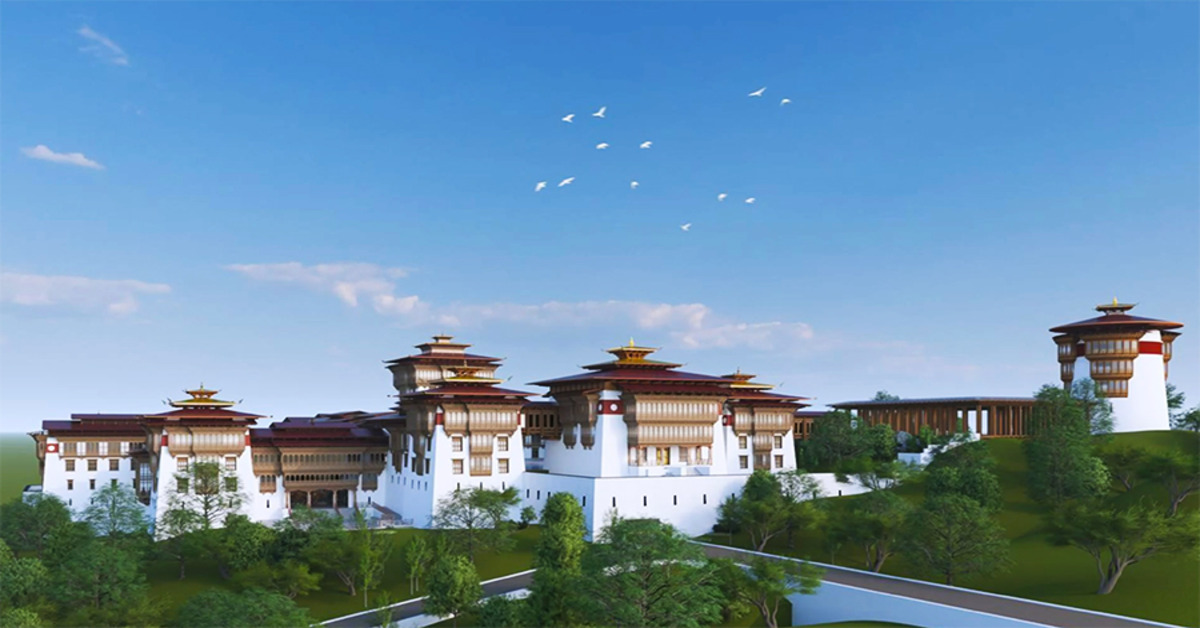
Gelephu Dzong, now named Shambhala Dzong, is a major Vajrayana training and exhibition centre being developed in Gelephu Mindfulness City (GMC), Bhutan. Led by the Central Monastic Body, the project is intended to preserve Bhutan’s Buddhist sacred arts, ritual practices and spiritual knowledge. Its architectural concept draws on the country’s established dzong tradition, including Paro Rinpung Dzong.
Planning a visit to Gelephu Dzong (Shambhala Dzong)?
Learn about this major Vajrayana centre being developed at Phulari in Gelephu Mindfulness City and its place in the spiritual vision for southern Bhutan. Contact Bhutan Pilgrimage to plan a wider spiritual journey through Gelephu and southern Bhutan. As the project is still developing, please confirm site access and local arrangements before travelling.
WhatsApp UsThe dzong is planned at the base of Phulari, after the original site at Phulari Viewpoint was relocated to a larger and more practical area. The main structure is planned on seven acres within a wider 50-acre campus. This guide brings together the project’s background, location, design and the latest publicly reported construction progress.
Shambhala Dzong is one of the eight spiritual projects that received Royal Kashos in May 2025. It is distinct from the wider group of spiritual initiatives being developed across GMC, although it forms part of the city’s larger vision to place Buddhist learning, practice and cultural heritage at the heart of its development.
Table of Contents
Where Is Shambhala Dzong Located?
Shambhala Dzong is being developed at the base of Phulari in Gelephu, within Gelephu Mindfulness City in southern Bhutan. The project was originally planned for the Phulari Viewpoint, which overlooks Gelephu, but the site was later shifted to the base of Phulari. The revised location provides a larger area for the planned complex. The dzong itself is expected to occupy seven acres within a broader 50-acre campus, according to project information reported by the Bhutan Broadcasting Service.
Royal Recognition and Spiritual Purpose
On 12 May 2025, His Majesty The King approved eight spiritual projects under Gelephu Mindfulness City and the Royal Kashos were formally handed over at Simtokha Dzong. The projects were recognised as part of the spiritual foundations of GMC. Gelephu Dzong, identified as the Vajrayana Centre, is led by the Central Monastic Body and is intended to serve as a centre for Buddhist training, sacred arts and ritual traditions.
The eight Royal Kasho projects were Gelephu Dzong (Vajrayana Centre), Tashi Gomang Chorten, Barchey Kuensel Chorten, Vajrakilaya Research Centre, Kurukulle Centre, Kesang Do-ngag Shedrupling, Kangyur Labyrinth and Gyenyen Nyekhang. You can explore the individual GMC projects through our guides to Barchey Kuensel Chorten, Kurukulle Centre, Kesang Do-ngag Shedrupling and Kangyur Labyrinth.
Two additional sacred initiatives announced as Royal projects were Gelephu Chorten and Guru Nangsid Zilnon Lhakhang. These projects should not be confused with the eight Royal Kasho projects. GMC’s spiritual programme has continued to evolve, and the official project list may be updated as further plans are confirmed.
Construction Progress and Project Cost
The Bhutan Broadcasting Service report published on 13 January 2026 confirmed that construction of Shambhala Dzong had officially begun. Initial on-site work included the development of labour camps and workspaces. At the time, facilities were being prepared for around 200 workers, while the overall project was expected to require a workforce of approximately 400. The outer architectural design was nearing completion, with internal design work continuing. This marked the start of initial construction activity, not the completion of the dzong or its opening to visitors.
The dzong itself is planned on seven acres within a 50-acre campus. The project director told BBS that the final cost had not yet been determined, but the preliminary estimate for construction of the dzong was around Nu. 3 billion. This is an estimate based on the current designs and plans, not a confirmed final budget.
The project’s religious foundation predates the current construction phase. On 17 November 2024, His Majesty The King graced the Sachu Bumter ceremony for Gelephu Dzong, presided over by the Dorji Lopen of the Central Monastic Body. The Central Monastic Body is leading the project, with the intention that the dzong will become a comprehensive Vajrayana training and exhibition centre. BBS reported that the outer architectural designs were nearing completion while internal design work was continuing.
Access infrastructure around Phulari is also being upgraded. A six-kilometre road connecting Tashiling Demkhong to Phulari through Dzomlingthang and Dechhen Pelri has been undergoing blacktopping, with drainage and footpaths included in the works. BBS reported in September 2026 that the road project was divided among three local contractors, with some packages expected to finish in November 2026 and the final package targeted for January 2027. These are road-work targets and should not be mistaken for a confirmed completion date for the dzong.
Architectural Design: Paro Rinpung and Dungkar
The architectural concept for Gelephu Dzong draws inspiration from Paro Rinpung Dzong, one of Bhutan’s best-known fortress-monasteries. Earlier reporting by The Bhutanese also noted that the interior design was expected to take inspiration from Dungkar Dzong. The intention is to bring the visual language and cultural character of traditional Bhutanese dzongs into a major new monastic and learning complex.
Related Components of the Shambhala Dzong Project
The Central Monastic Body’s Shambhala Dzong initiative includes more than the main fortress-monastery. In its 13 January 2026 report, BBS identified three main components: Shambhala Dzong itself, the Jarung Khashor Stupa and Gyenyen Nyekhang. These related sacred structures form part of the wider religious and cultural setting planned for the Phulari area.
Can Visitors Visit Shambhala Dzong?
Shambhala Dzong is an active construction project, not an established visitor attraction. Travellers should not assume that the site or work areas are open to the public. If you are planning a trip to Gelephu, confirm access with the relevant local authorities or your travel organiser before approaching the Phulari site. You can still plan a wider visit to Gelephu and explore spiritual landmarks that are open to visitors, subject to current local arrangements.
Conclusion
Shambhala Dzong is an important part of Gelephu Mindfulness City’s spiritual foundations. Led by the Central Monastic Body, the project is intended to provide a major centre for Vajrayana training and the preservation of Bhutanese sacred arts. With construction now officially underway, its development will be one to follow as the wider GMC vision takes shape. For more context, read our guide to spiritual sites in Gelephu Mindfulness City.
Frequently Asked Questions
What is Gelephu Dzong, also known as Shambhala Dzong?
Gelephu Dzong, now named Shambhala Dzong, is a major Vajrayana training and exhibition centre being developed in Gelephu Mindfulness City under the leadership of Bhutan’s Central Monastic Body. It is intended to preserve and promote Bhutan’s Buddhist sacred arts and ritual traditions.
Where is Shambhala Dzong located?
The dzong is being developed at the base of Phulari in Gelephu Mindfulness City, Bhutan. The site was moved from the original Phulari Viewpoint location to a larger area at the base of the hill.
How large will the Shambhala Dzong project be?
The dzong itself is planned on seven acres within a wider 50-acre campus. A preliminary construction estimate of around Nu. 3 billion was reported in January 2026; the final cost had not yet been determined.
Has construction of Shambhala Dzong started?
Yes. BBS reported on 13 January 2026 that initial construction activities had begun, including the development of labour camps and workspaces. At that time, the outer architectural design was nearing completion and internal design work was continuing.
Can tourists visit Shambhala Dzong now?
The project is under development and the site should not be assumed to be open to visitors. Travellers should confirm access and local arrangements before visiting the Phulari construction area.
What is the role of the Central Monastic Body?
The Central Monastic Body is leading the Shambhala Dzong project. The centre is intended to support Vajrayana Buddhist training and the preservation and exhibition of sacred arts and ritual practices.
Explore Gelephu Mindfulness City
Discover the spiritual places of GMC
Explore Bhutan Pilgrimage’s GMC Paths of Peace journey and learn about the sacred places shaping Gelephu’s emerging spiritual landscape. Ask us about current visitor access and travel arrangements.
Explore GMC Paths of Peace →