
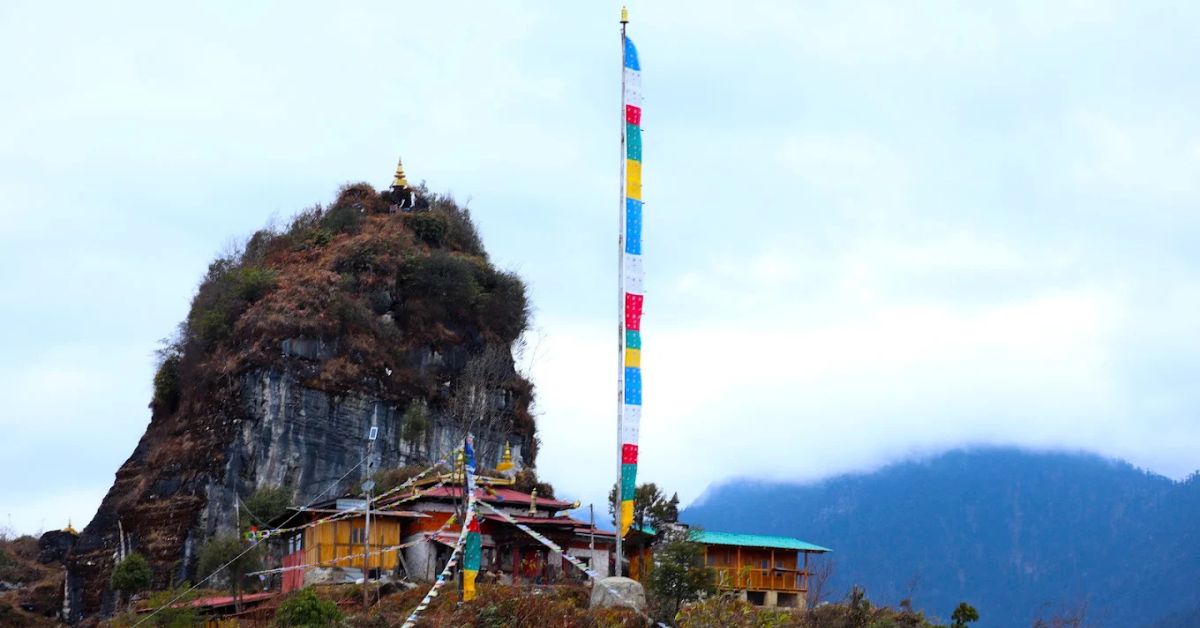
Rinchen Bumpa, also known as Neychen Rinchen Bumpa or Shedrup Chokhorling, is a revered Buddhist sacred site in the remote Kurtoe area of Dungkhar, Lhuentse Dzongkhag, eastern Bhutan. Bhutanese religious tradition associates the site with Guru Rinpoche, who is said to have meditated here for three months. The sacred landscape is known for its distinctive white cliff, meditation caves, sacred imprints and a stone slab on which religious letters are said to appear in the early sunlight.
Planning a pilgrimage to Rinchen Bumpa?
This remote sacred site in Kurtoe involves a long mountain approach and limited visitor facilities. Contact Bhutan Pilgrimage before travelling to discuss the route, seasonal access and an eastern Bhutan itinerary.
WhatsApp UsRinchen Bumpa is visited by pilgrims seeking blessings and spiritual merit. Traditional accounts describe it as a place of profound religious accomplishment and connect it with the aspiration to attain rebirth in Ngayab Ling, the pure land associated with Guru Rinpoche. These are expressions of Buddhist belief and devotion.
Table of Contents
How to Reach Rinchen Bumpa
Rinchen Bumpa lies in the remote mountain area above Kuenzangling Lhakhang. The walking time depends on the route and the point where a vehicle can reach. Recent pilgrims have reported that farm-road extensions bring vehicles closer to the site than the older approach, reducing the final uphill hike. The road is rough, and access may vary with weather and local conditions, so confirm the current roadhead with the monastery or Kurtoe Gewog Administration before travelling.
Walking Times by Route
- From the new roadhead: Approximately 1.5 to 2 hours uphill, based on reports from recent pilgrims using the extended motorable road. A 4WD or high-clearance vehicle is recommended for the rough final stretch, if the road is open and passable.
- From Chakzam Village: Approximately 4 hours on foot.
- From Kuenzangling Lhakhang (traditional base): Around 3.5 to 6 hours uphill, depending on walking pace, trail conditions and the exact starting point.
These are approximate route estimates rather than fixed timings. Ask locally which roadhead is currently usable, whether a 4WD can reach it, and whether there have been changes to the footpath. For planning, contact the Rinchen Bumpa Monastery in advance.
The final approach is a mountain hike, not a short walk from the road. Start early, wear sturdy footwear and carry drinking water, food and warm or rain-protective clothing. Trail conditions and vehicle access can change, so do not rely on an old travel time or attempt the route late in the day without local guidance.
Historical Significance of Rinchen Bumpa
According to Bhutanese religious tradition, Guru Padmasambhava (Guru Rinpoche) meditated at Rinchen Bumpa for three months. The sacred-site account also associates the place with Künkhyen Longchen Rabjam (Longchenpa, 1308–1363), Tertön Ratna Lingpa (1403–1478) and Tertön Pema Lingpa (1450–1521). The 2022 Lhuentse Tourism Attractions guide records these associations, while the monastery’s own account describes the site’s sacred landscape and religious features.
The name Rinchen Bumpa is commonly rendered as the “Vase of Jewels” or “Jewel Vase”. In Buddhist symbolism, a precious vase represents auspiciousness and abundance. The name is also used for the sacred site itself, rather than only for the monastery buildings.
Sacred Sites Around Rinchen Bumpa
The monastery’s traditional description compares the backdrop of Rinchen Bumpa to a glossy silk robe and the lower landscape to a hum khung, a triangular ritual fire pit used in tantric offerings. A nearby mountain is said to resemble a gingpo descending a cliff. These are sacred-landscape interpretations preserved in the site’s religious account.
The surrounding sacred geography includes Singye Dzong to the east, Aja Lung to the south, Choezang Cave to the west and Lha Chen Khari to the north. The monastery’s account also names Lhamo Khar, Rolmoding, Tajug Thang and several other caves, hills and sacred places in the surrounding area. These place names and directions follow the monastery’s own description and should be checked with a local guide when planning a route.
Other names recorded in the monastery’s account include Pema Tse, Kham Phug, Chittai Nyingpo, Choegyel Lung, Pelsum Phug, Choedzong Phug, Mangde Phug, Trashichoeling, Bading Phug and Chung Zay Phug. Not all of these places are necessarily accessible on a single visit.
Sacred Features of Rinchen Bumpa
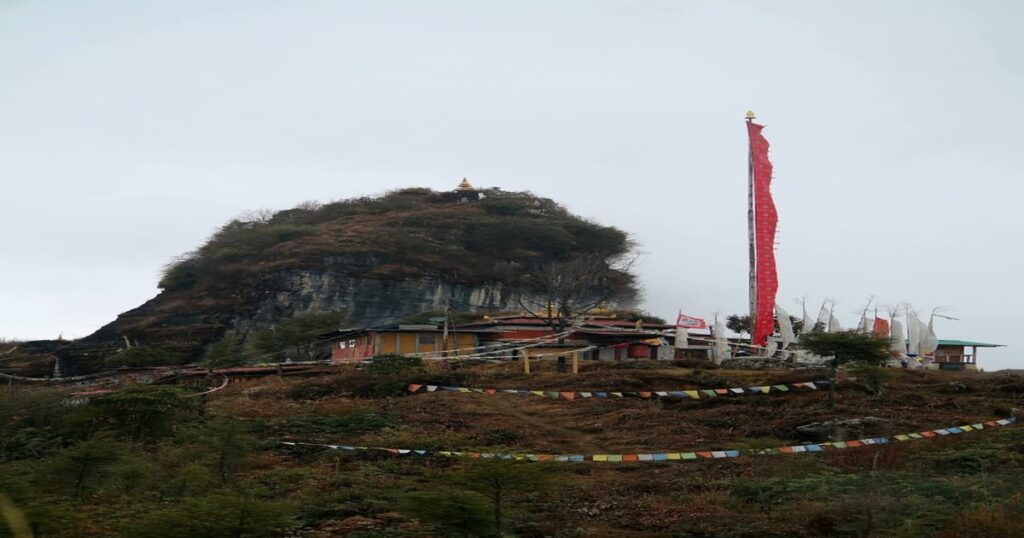
One of the most striking features of Rinchen Bumpa is a white cliff shaped like a stupa. The sacred-site tradition describes its three levels as symbolising the three bodies of a Buddha: Chöku (Dharmakaya), Longku (Sambhogakaya) and Trulku (Nirmanakaya). The cliff is also associated with images of peaceful and wrathful Buddhas.
Other sacred features described in the monastery’s account and the Lhuentse tourism guide include footprints associated with Guru Rinpoche and Yeshey Tshogyel, Yeshey Tshogyel’s meditation cave known as the “Point of a Knife”, a Lamp of the Aeon, a meditation cave and other naturally formed sacred impressions. These are revered as religious objects and places within local Buddhist tradition.
The Sacred Ba (Target) of Drangsong Rahula
One of the site’s best-known features is a large, target-shaped stone slab, traditionally believed to be the archery target of Drangsong Za Rahula, a protector revered in the Nyingma tradition. In a November 2021 report, BBS described how religious letters appear on the stone when the first rays of sunlight fall on its surface and gradually disappear as the sunlight moves away. The appearance is understood by devotees as a sacred phenomenon.
The temple’s principal, Goenpo Dorji, told BBS that the letters are associated with the mantras of Guru Rinpoche, Zhabdrung Ngawang Namgyal and the Buddha. The exact visibility and timing depend on sunlight and weather, so visitors hoping to witness the phenomenon should seek local advice and avoid treating it as a guaranteed daily display.
Rinchen Bumpa Monastery
The religious complex is also known as Shedrup Chokhorling and is commonly referred to as Rinchen Bumpa Monastery or Rinchen Bumpa Retreat Centre. It is important to distinguish the ancient sacred-site traditions from the history of the present temple: BBS reported in November 2021 that the present temple was initially constructed in 1957 by an individual from Maenbi Gewog. The monastery’s website currently describes the institution as being under establishment, headed by Tulku Shedrup, with a retreat centre being developed for tsampa (traditional meditation retreat) ranging from one month to three years. BBS also reported in 2021 that seven monks were serving under a principal; this is a historical figure, not a confirmed current headcount.
The monastery’s website describes a wish-fulfilling statue of Guru Rinpoche and other sacred objects at the site. For current information about religious activities, retreat arrangements, visiting etiquette or access, contact the monastery directly. Its official contact page lists Tulku Shedrup Kunzang Namgyel (+975 17 122 200) and Khenpo Gyembo Dorji (+975 17 475 553).
Accommodation and Visitor Facilities
There has been a guesthouse at Rinchen Bumpa, but facilities are limited. BBS reported in 2021 that the guesthouse could not accommodate everyone during busy periods and that some visitors had to sleep in tents. The monastery’s facilities and capacity may have changed since then. Arrange an overnight stay in advance and confirm meals, drinking water, bedding, washroom access and whether visitors are currently being accommodated. Do not assume that rooms or meals will be available on arrival.
Best Time to Visit Rinchen Bumpa
The 2022 Lhuentse Tourism Attractions guide lists November to March as the visitor season for Rinchen Bumpa Nye. Weather, trail conditions and local arrangements can still affect access, particularly in the mountains. Confirm the permitted visiting period and current route with the monastery or local authorities before travelling. If you plan to see the sacred letters on the stone, ask local caretakers about the best early-morning viewing conditions; the appearance depends on sunlight.
Frequently Asked Questions
What is Rinchen Bumpa Ney?
Rinchen Bumpa, also called Neychen Rinchen Bumpa or Shedrup Chokhorling, is a sacred site in Kurtoe, Lhuentse. Its name is commonly translated as “Vase of Jewels” or “Jewel Vase.”
Where is Rinchen Bumpa located?
It is in the remote Kurtoe area of Dungkhar, Lhuentse Dzongkhag, eastern Bhutan. The site is approached on foot from a local roadhead or nearby village, depending on current access.
Why is Rinchen Bumpa sacred?
According to Bhutanese religious tradition, Guru Rinpoche meditated here for three months. The site is also associated with Tertön Ratna Lingpa, Longchenpa and Pema Lingpa.
How long does it take to hike to Rinchen Bumpa?
Recent pilgrims report around 1.5 to 2 hours uphill from the newer farm-road head, about 4 hours from Chakzam Village, or around 3.5 to 6 hours from Kuenzangling Lhakhang, the traditional base. These are approximate times; confirm the current roadhead and trail conditions locally before setting out.
What is special about the sacred stone at Rinchen Bumpa?
The large stone slab is traditionally believed to be the target of the protector Rahula. BBS reported that sacred letters become visible when the early sunlight falls on the stone and fade as the sunlight moves away.
When is the best time to visit Rinchen Bumpa?
The 2022 Lhuentse Tourism Attractions guide lists November to March as the visitor season. Check current local access, weather and any community restrictions before travelling.
Can visitors stay overnight at Rinchen Bumpa?
A guesthouse has been reported at the site, but BBS noted in 2021 that accommodation was limited and visitors sometimes had to use tents when demand was high. Contact the monastery in advance to confirm current availability and facilities.
How can I contact Rinchen Bumpa Monastery?
The monastery’s contact page lists Tulku Shedrup Kunzang Namgyel at +975 17 122 200 and Khenpo Gyembo Dorji at +975 17 475 553. Confirm the numbers and current arrangements before travelling.
Explore Eastern Bhutan
Make Rinchen Bumpa part of a meaningful Kurtoe pilgrimage
Ask us about planning a journey that combines Rinchen Bumpa with nearby sacred places, including Singye Dzong and other spiritual sites in Lhuentse. Routes and access should be confirmed locally before departure.
Plan Your Journey