
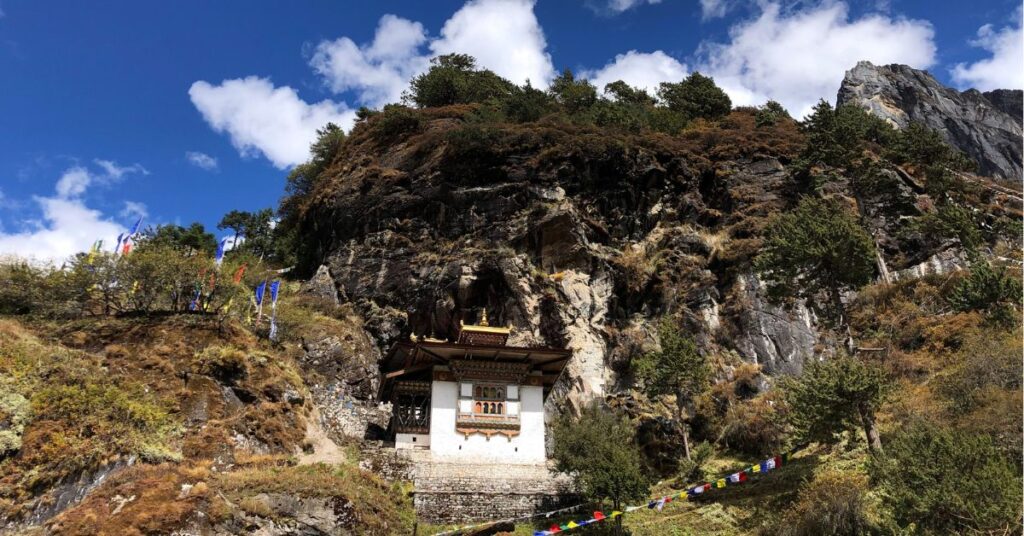
Singye Dzong is a sacred site of Guru Rinpoche’s enlightened activity located in Khoma Gewog under Lhuentse Dzongkhag at an altitude of more than 4482 meters above sea level. The Dzong is called Singye Dzong since the Dzong (rock) resembles a lion. Khandro Yeshey Tshogyal discovered Singye Dzong Ney in the 8th century.
According to the descriptions of sacred sites, a visit to Nering Senge Dzong is said to free oneself from being born in lower realms and fulfill whatever wishes and prayers one has for life. However, Sengye Dzong Neykor is considered one of the most arduous and sacred pilgrimages in Lhuentse. Singye Dzong Nye is a three-day hike from Khoma village.
Sengye Dzong is one of the three holiest Nyes of Guru Rimpoche in Bhutan, the other two being Paro Taktsang Monastery and Baylangdra Ney.
Please note: Singye Dzong is restricted to foreigners. The site is not open to tourists, and foreigners need a special permit from the Department of Culture to visit Senge Dzong.
What to Bring on a Senge Dzong Pilgrimage Trek
You should bring warm clothes and a good sleeping bag. The routes are mostly wet, so you should take good trekking boots and comfortable walking shoes. Shoe gaiters are also highly recommended.
How to Trek to Singye Dzong
Singye Dzong Nye is located near the Tibetan border in Lhuentse, within the Bumdeling Wildlife Sanctuary. It is a three-day trek from Khomazam in Khoma village. All visitors must obtain a travel permit from Khoma Gup, and before obtaining the permit, one must undergo mandatory medical checkups at Khoma BHU to prepare for the trip. The Singye Dzong trek requires a fee of Nu 100 per person.
There are no shops after passing Khoma village, so one must carry provisions for the entire pilgrimage. However, you can hire horses from the local area. Take horses from the Tsango and Relmoteng communities and begin the journey from there. A one-way horse ride can cost between Nu 3,500 and Nu 4,500. Please verify the latest cost!
The journey includes wooden bridges, a wide footpath, signage, and resting places. With support from the Department of Tourism, the trail to Singye Dzong has been enhanced with various facilities such as washrooms, continuous water supply, canopies, guest houses, and strategically placed dustbins.
On the first day, you can spend a night at Khomagang or Tsekang after walking for more than seven hours. If you have energy, you can continue to halt at Denchung. From Tsikhang, the second-day trek ends at Thangkarmo after traveling for more than 7 hours. Singye Dzong is a 9-hour walk from Thangkarmo on the third and final day of the trek.
Also Read: How to Trek to Aja Nye
Singye Dzong Route Map
- Khoma village to Momling: 2 hours;
- Momling to Changshingdung: 1 hour;
- Changshingdung to Khomagang: 3 hours; or Changshingdung to Tsekang: 4 hours. First night halt.
- Khomagang/Tsekang to Tsekang Gongma: 2 hours 30 minutes/1 hour 30 minutes;
- Tsekang Gongma to Chuna: 2 hours 30 minutes;
- Chuna to Thangkarmo: 3 hours 30 minutes. Second night halt.
- Thangkarmo to Toto Draphu: 2 hours;
- Toto Draphu to Terja: 2 hours 30 minutes;
- Terja to Duksum: 1 hour;
- Duksum to Singye Dzong: 3 hours 30 minutes. Final destination.
Khoma Village > Khomagang or Tsekang > Thangkarmo > Singye Dzong
The Six Wondrous Marks of Senge Dzong
In his Liberative biography, Terton Ratna Lingpa mentions the six wonderful marks as follows:
“On the right, the Pema Dzong of Heroes resembles a standing golden Vajra. What a huge wonder that this is the sacred place where the unchanging reality, the absolute essence, can be attained! On the left, the Rinchen Dzong of heroines resembles a mound of the five precious jewels. What a magnificent wonder that it is,s the sacred site to practice Tsalung and the technique route, and where one can achieve effortlessly! The white-cliff Senge Dzong in the center, which resembles a King on his throne, is the sacred site for completing the four types of enlightened activity and for fulfilling one’s every wish; what a wonderful wonder! The sacred place where one can have an unending bliss-emptiness experience and expand one’s experienced vision higher and higher is the front hill, which resembles a queen making an offering. What a wonderful gift it is to be able to achieve the siddhis! In the foreground of the Yui (turquoise) Dzong of Nering, a river bearing the eight qualities runs smoothly. Its source is inexhaustible by nature. What a wonderful miracle that consciousness becomes fresh naturally here! This sacred place has the appearance of a flowering lotus. It is a sacred place where sky-farers flock indefinitely and where gods and demons converse. What a wonderful miracle that it causes sadness toward samsara! These six types of wondrous marks, I noticed them in these ways as I studied”.
Sacred Relics to See at Singye Dzong
The sacred relics found in Singye Dzong are:
- Eight sacred Dzongs;
- A Duethroe;
- The body image of Guru Rinpoche;
- The imprint of Khandro Yeshey Tshogyal;
- The rock where Guru imprisoned 108 mythical Garudas;
- Khandro Yeshey Tshogyal’s Draphu;
- A flat rock where all the animals were believed to have gathered to receive teachings from Guru Rinpoche;
- A rock that turns red whenever a person dies in Kurtoe;
- Phurpa Terma (daggers), which Guru Rinpoche discovered from Senge Dzong.
Also Read: Guru Rinpoche in Bhutan: His Visits to Bhutan and Sacred Sites
Historical Significance of Singye Dzong
According to King Sindhu Raja’s biography, Guru Rinpoche arrived at Bumthang for the second time via Khempa Jong and Nering Singye Dzong’s cave from Tibet. Guru Padmasambhava came with a mission of subduing the demon King Khikharathoed, who had fled Tibet and established his demon kingdom in Khempajong in the eighth century.
Guru Rinpoche finally subdued the demon King Khikharathoed at Khempajong, then moved to Singay Dzong and undertook intense meditation.
Singye Dzong History
The history of Singye Dzong states that Guru Rinpoche spent three months undertaking accomplishment practices and blessed the place as the place of His enlightened activity. According to the description given to Tshangkha Rinpoche Lama Norbu Wangchuk by Rahor Choedrak Rinpoche, Singye Dzong is one of the most sacred places of Guru Rinpoche’s enlightened activity. The Tamboura, a Lute, a condensed biographical supplication to Khandro Yeshe Tshogyal, authored by Pema Garwang Lodoe Thaye, also mentions Senge Dzong’s sacredness. Khandro Yeshey Tshogyal discovered Singye Dzong.
Senge Dzong is one of Guru Rinpoche’s eight great Yang Oen Caves, where he performed accomplishment practices. According to the Guru’s Chronicle of Golden Rosary, Yangdzong, Chimphu, Kharchu, Sheldrak Monkha Nering, Taktshang Sengephug, Shampo Gang, Drakmar, and Yama Lung are the eight magnificent Yang-oen rocky caves where Guru Rinpoche meditated.
Also Read: Paro Taktsang (Tiger’s Nest), the Sacred Place of Guru Rinpoche’s Enlightened Mind
The Importance of Singye Dzong
Why is Singye Dzong important? Sengye Dzong is one of Guru Rinpoche’s eight great Yang Oen Caves, where he performed accomplishment practices for three months and blessed the place as the place of His enlightened activity. It is also the sacred place from which Guru Rinpoche took the form of Dorje Drolo and flew to Paro Taktsang (Tiger’s Nest) on a flaming tigress. A visit to Senge Dzong, according to the descriptions of sacred sites, is said to free oneself from being born in lower realms and fulfill whatever wishes and prayers one has for one’s life.
Singye Dzong gained religious significance and popularity in the 19th century when treasure discoverer Zilnon Namkha Dorji unearthed a treasure, Tse-Drup-Chimi-Sogthig, from the Sengye Dzong vicinity. The treasure contains religious scripts of Buddha Amitayus, including cures for disease, evil, and war, and ways to prolong life.
Also Read: The Importance of Tango Choying Dzong
Description of Senge Dzong
There are eight sacred Dzongs. They are Singye Dzong, Gawa Dzong, Rinchen Dzong, Tsemo Dzong, Dulwa Dzong, Namkha Dzong, Drakri Dzong, and Pema Dzong. Singye Dzong and Gawa Dzong are the two main fortresses.
All these Dzongs are in the form of rocks transformed and embedded by Guru Rinpoche. Though they are not real Dzongs, it is believed that the rocks will open up and become Dzongs when prophecy befalls. The eight Dzongs in the form of rocks are believed to be the eight manifestations of Guru Rinpoche. There is a Duethroe, a cremation ground, in each Dzong. It is believed that lying on these grounds and performing an artificial cremation ceremony will receive Wangku from Guru Rinpoche.
Sengye Dzong is filled with many relics like Guru Rinpoche’s body image, Khandro Yeshe Tsogyal’s imprint, and the rock where Guru Rinpoche imprisoned 108 Garudas. You can also see Khandro Yeshe Tsogyal’s Draphu, the cave where Khandro meditated. Other features are Guru Rinpoche’s religious texts and a rock that turns red. This rock is believed to change its color to red whenever a person dies in Kurtoe. It is said that the redder the color covers the stone, the greater the number of people who are said to have died.
On the opposite side of Senge Dzong is a flat rock where animals are believed to have gathered to receive teachings from Guru Rinpoche. There is another rock nearby, since not all animals could fit on the first rock. On both boulders, there are different footprints of various animals. You can also see the Guru’s saddle and Garuda’s egg.
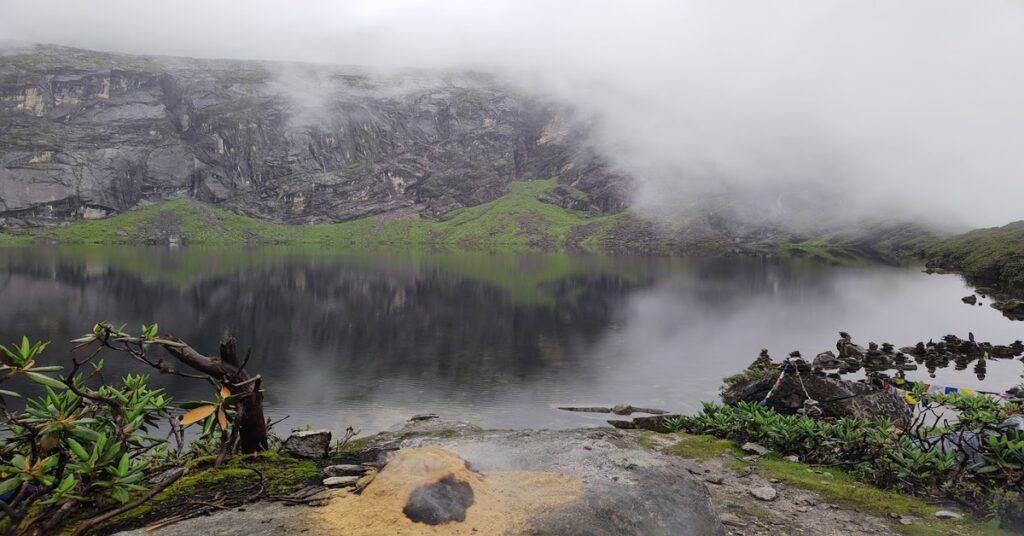
Yumtharma Lake, Tshokar (White Lake), Tshonag (Black Lake), and Terdha Latsho are other important sites around the Senge Dzong vicinity.
Singye Dzong Monastery
Singye Dzong has a monastery. Phurpa Terma is the main relic of Singye Dzong Lhakhang. The monastery also houses several treasures discovered by Guru Rinpoche from the Sengee Dzong Lake. Guru Rinpoche revealed five Phups (religious daggers) from the lake after conquering the lake deity.
Among the five Phups, one appears to be without a wing. When the next eon comes, it is believed that the same lake will resurface at the Senge Dzong and all five Phups will be drowned again. Guru Rinpoche will then return to this location to reveal the treasures (Phubs) in complete form.
Currently, the area has a meditation center that accommodates 12 monks in a three-year retreat, and two main monasteries are Gawa Dzong and Singye Dzong.
Singye Dzong Festival
The Singye Dzong Drubchhen festival is conducted annually. Thousands of pilgrims visit Sengye Dzong during the Drupchhen.
Accommodation at Singye Dzong
Tarayana Foundation, with the sponsorship of Richard Blum, the founder and chairman of the American Himalayan Foundation, has built a six-quarter guesthouse below the Khoma Gewog office to assist economically disadvantaged pilgrims. The free facility provides bedding and cooking services for around 40 people.
For accommodation along the way to Senge Dzong, you can take your tents or stay in a guesthouse. There is a guesthouse in Tsekang, a day’s walk from Khoma, two at Thangkarmo to halt on the second day, and around four to five at the Senge Dzong area. To avoid accommodation problems, you are advised to carry your tent, especially during the peak season.
Best Time for Singye Dzong Trek
Singye Dzong is open for pilgrims for about eight months, from June to November. The best season for the Singye Dzong pilgrimage runs from September to November. The last week of September to the second week of October is the best season, as there will be no rainfall or snowfall. Mid-August to mid-September is also the ideal time for pilgrimage, as the monsoon has dried and winter is far away. However, due to mud in the summer and snow during the winter and spring, the only time the paths are accessible is during October. You can go to Singye Dzong Neykor with the Bhutan Pilgrimage Package.
Places to Explore in Lhuentse
Lhuentse is known for the sacred pilgrimage sites (nye) such as Neychen Rinchen Bumpa, Phuningla, Ney Khenpajong, and Sangwai Dadru. The Dzongkhag is also home to several of Bhutan’s oldest Lhakhangs, including Menkhar, Karphu, Lukchu, Kuenzangling, Goshogpang, Timula, Khochung Lhakhang, and Dungkar Nagtshang.
Frequently Asked Questions
What is Singye Dzong?
Singye Dzong is one of Bhutan’s most sacred pilgrimage destinations, located in Khoma Gewog under Lhuentse Dzongkhag. It is a remote sacred valley associated with Guru Rinpoche’s enlightened activities.
Where is Singye Dzong located?
Singye Dzong is located in northeastern Bhutan, within Bumdeling Wildlife Sanctuary and close to the Tibetan border. The site lies in the remote northern region of Lhuentse.
Why is Singye Dzong important?
Singye Dzong is important because it is believed to be a sacred place where Guru Rinpoche meditated and subdued harmful forces. Bhutanese Buddhists consider it a powerful pilgrimage site and a beyul, or hidden sacred valley.
Who discovered Singye Dzong?
According to Bhutanese religious tradition, Singye Dzong was discovered by Khandro Yeshe Tsogyal, the spiritual consort of Guru Rinpoche, during the eighth century.
How do you reach Singye Dzong?
The journey to Singye Dzong usually begins from Kildung, the roadhead under Khoma Gewog in Lhuentse. Visitors must complete a challenging trek of approximately three days to reach the sacred site.
How long does the Singye Dzong trek take?
The Singye Dzong trek generally takes three days from the roadhead. Pilgrims usually spend two nights along the route, often staying near Khomakang or Tsikhang and then at Thangkarmo.
Is Singye Dzong suitable for beginner trekkers?
Singye Dzong is not usually suitable for beginner trekkers because the route is remote, physically demanding, and may include steep, muddy, or high-altitude sections. Proper preparation, fitness, local guidance, and suitable trekking equipment are recommended.
Can foreign tourists visit Singye Dzong?
No. Singye Dzong is located in a sensitive area near the Tibetan border, and access for foreign visitors is restricted. Foreign tourists require special permission to visit.
Do Bhutanese visitors need a permit for Singye Dzong?
Yes. Bhutanese pilgrims need an entry permit from the relevant local authority, such as Khoma Gewog. Permit requirements can change, so visitors should verify the current process before travelling.
Where do pilgrims stay during the Singye Dzong trek?
Pilgrims may stay in designated guesthouses, basic shelters, or village accommodations along the trekking route. Availability is limited, so it is advisable to arrange accommodation and food supplies in advance.
Are there facilities along the Singye Dzong trail?
The trail has been improved with facilities such as washrooms, water points, canopies, guesthouses, and dustbins in selected locations. However, the route remains remote, and visitors should not expect modern hotel-style services.
What should I carry for the Singye Dzong pilgrimage?
Visitors should carry warm and waterproof clothing, sturdy trekking shoes, personal medicines, a sleeping bag, snacks, a water bottle, a headlamp, sun protection, and basic hygiene supplies. A local guide or porter can also be helpful.
What religious sites can be seen at Singye Dzong?
The Singye Dzong area contains several sacred caves, rocks, lakes, and pilgrimage landmarks associated with Guru Rinpoche and Khandro Yeshe Tsogyal. Local guides can explain the religious significance of these sites.
Is Singye Dzong a fortress like other Bhutanese dzongs?
Despite its name, Singye Dzong is better understood as a sacred valley and pilgrimage site rather than a large administrative fortress. The name is connected with the spiritual and symbolic significance of the area.
What do people do to preserve the Singye Dzong?
To preserve Senge Dzong, the site is not open to tourists, and foreigners need a special permit from the Department of Culture to visit. To preserve its sacredness, the government has no immediate plans to connect Singye Dzong with a road. The local community is also educated about the importance of preserving Singye Dzong.
What do people think about the Singye Dzong?
People think of Sengye Dzong as one of Guru Rinpoche’s eight great Yang Oen Caves, where he performed accomplishment practices for three months and blessed the place as the place of His enlightened activity. They also believe that a visit to Singye Dzong will free one from being born in lower realms and fulfill whatever wishes and prayers one has for one’s life.
How do people promote the Singye Dzong?
People promote Sengye Dzong by providing information and facilitating visits for pilgrims through local communities, local tour operators, and travel agencies.
How can I get permission to visit Singye Dzong?
A permit is required for all visitors, including locals and foreigners, to visit Senge Dzong. You must obtain a travel permit from the Khoma Gup. Foreigners need a special permit from the Department of Culture to visit the site. Contact your tour operator in advance about your plans.
Thank you for the best description la…
It really amazed me and touched my heart with the majical words….
It really took me to the place though l have not been there…
Thank you very much again la..