

Dra Zhi means the Four Cliffs. In Bumthang, the name refers to four sacred cliffs associated with Guru Rinpoche: Choedrak, Kunzangdrak, Shugdra and Thowadra. Bhutanese Buddhist tradition connects these places with Guru Rinpoche’s meditation and the subduing of the local deity Shelging Karpo. The stories are part of Bumthang’s sacred geography and should be understood as religious tradition. The four Bumthang cliffs are a distinct group from the four sacred cliffs entrusted to Phajo Drugom Zhigpo in other parts of Bhutan. For the wider traditional account of Guru Rinpoche’s visits and the sacred sites associated with him across Bhutan, see our Guru Rinpoche in Bhutan: His Visits and Sacred Pilgrimage Sites.
For a broader account of Guru Rinpoche-related destinations and pilgrimage traditions across Bhutan, see our Bhutan Pilgrimage Guide.
Planning a Visit to the Four Sacred Cliffs of Bumthang?
Ask us about the Dra Zhi pilgrimage, local arrangements, road conditions and walking requirements at Choedrak, Kunzangdrak, Shugdra and Thowadra.
Table of Contents
The Four Great Meditation Cliffs of Guru Rinpoche in Bumthang
The four sacred cliffs known collectively as Dra Zhi in Bumthang are Choedrak in Chumey Valley, Kunzangdrak overlooking Tang Valley, Shugdra in upper Chhoekhor-toed valley, and Thowadra in the northern part of Tang Valley. Each has its own sacred history, access route and walking requirements. Road access is not the same at all four sites, and the route to Thowadra remains particularly challenging.
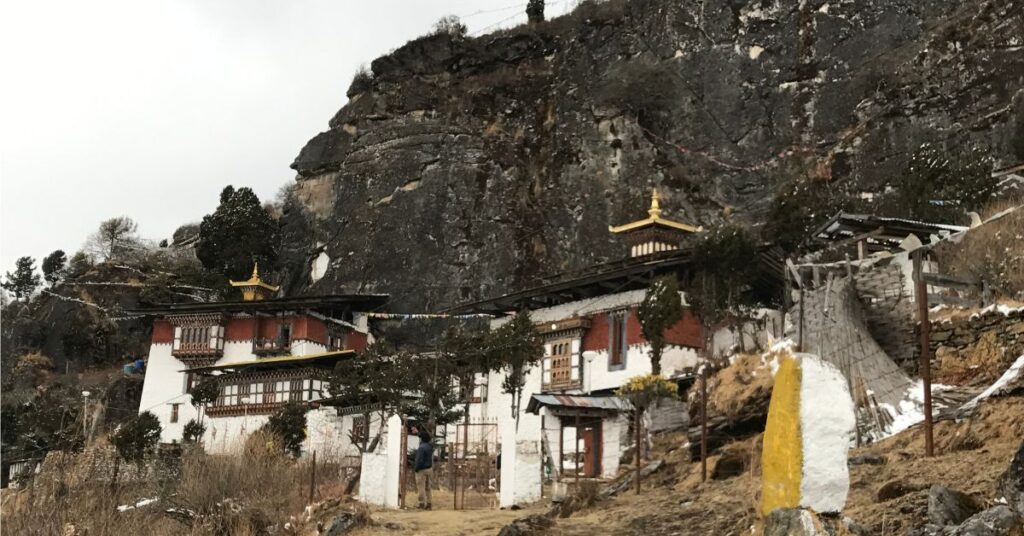
1. Choedrak, one of the four great cliffs (Dra Zhi)
Choedrak, also known as Choje Drak, stands on the northern ridge above Chumey Valley. Local and published accounts associate its foundation with the Drukpa Kagyupa master Lorepa Drakpa Wangchuk in 1234. Guru Rinpoche’s meditation at the cliff belongs to the site’s sacred tradition. The monastery later fell into decline and was rebuilt in the 18th century by Ngawang Trinley, a Drukpa master from Punakha.
Choedrak can be reached by a steep climb of about one hour from the motorable road near Tharpaling. An alternative route is a roughly three-hour hike from Lamey Goenpa through forest and over a pass. These are different approaches; confirm the actual trailhead, route condition and local guidance before choosing one.
Choedrak is primarily a religious retreat and pilgrimage site. Its buildings and meditation spaces are closely associated with the cliff. Visitors should respect the monastic community, follow caretaker instructions and avoid entering retreat areas without permission.
Devotees identify rock markings at Choedrak as impressions associated with Guru Rinpoche and his tigress. These are revered as sacred signs in local Buddhist tradition; they are not independent historical proof of the events described in the religious narrative.
The site includes stone seats or thrones associated in local tradition with Buddha Amitayus, Chenrezig and Guru Padmasambhava. Other features are linked with the presence of dakinis and their devotional offerings. Ask the caretaker to explain the local identifications and follow guidance when approaching sacred objects.
Read More: Choedrak, a sacred cliff where Guru Rinpoche came riding on a tigress from Paro Taktsang.
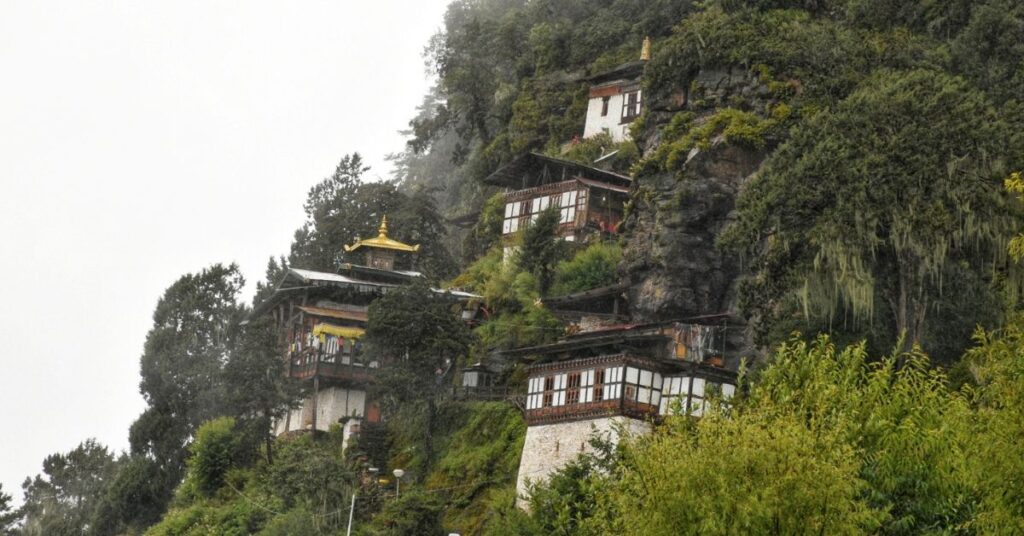
2. Kunzangdrak, one of the four great cliffs (Dra Zhi)
Kunzangdrak overlooks Tang Valley and is associated with Tertön Pema Lingpa. The name is traditionally connected with Pema Lingpa’s vision of Kuntu Zangpo, the primordial Buddha, while looking towards the cliff from his birthplace at Chel. The account is part of the site’s religious history.
Kunzangdrak is reached from the Jakar–Ura–Mongar highway. Published visitor descriptions give different walking times: some recent accounts describe a rough farm road reaching close to the monastery with a short walk of around 10 minutes, while other guides describe a longer uphill approach of up to about one and a half hours. These estimates may use different roadheads and access conditions. Confirm the current roadhead and walking time with local guides before departure, and do not assume the rough road is suitable for every vehicle.
Local accounts associate the construction of Kunzangdrak Monastery with Tertön Pema Lingpa in the late 15th century. The complex includes the Wangkhang, Oezerphug and Khandro Lhakhang, along with spaces associated with Pema Lingpa and his lineage. Where exact dates differ between accounts, they should be presented as traditional chronology rather than settled architectural dating.
Oezerphug is associated with Pema Lingpa’s son, Thugse Dawa Gyeltsen. A spring known as drupchhu is revered by pilgrims. Some local accounts attribute healing properties to the water, including claims about epilepsy and stroke; these are religious or traditional beliefs, not established medical treatments. Do not replace medical care with spring water, and do not drink untreated water.
Also Read: Drupchhu or Holy Spring Waters in Bhutan: Beliefs and Benefits
Khandro Lhakhang is associated in local tradition with Yeshe Tsogyal and with Pema Lingpa’s religious lineage. Stories about its construction by dakinis and the protection of the site by guardian deities are sacred narratives. Visitors should treat the shrine and its surroundings respectfully.
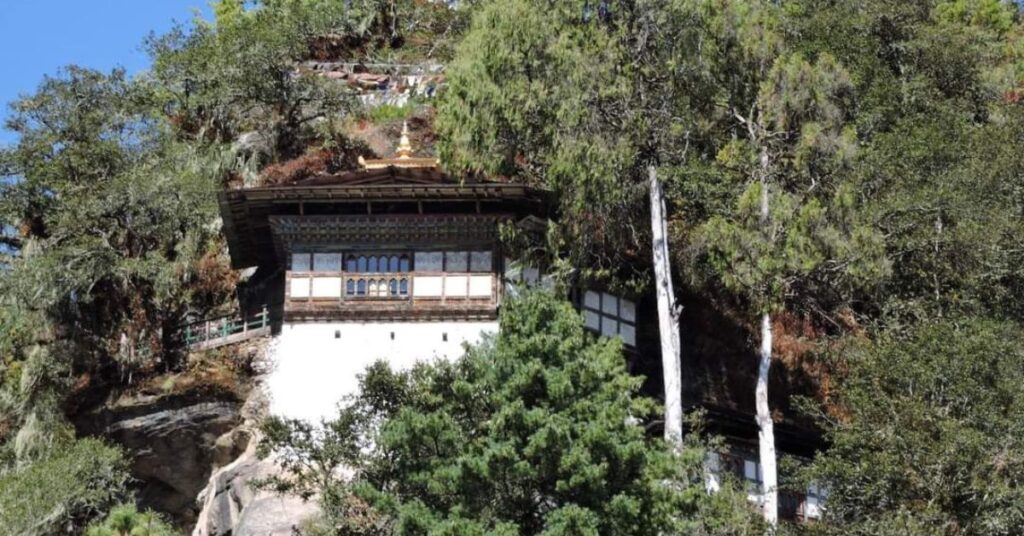
3. Shugdra, one of the four great cliffs (Dra Zhi)
Shugdra is one of Bumthang’s four sacred cliffs. The wider sacred landscape includes Drakar Namkha Dzong, Duedul Senge Dzong and Chungchen Khading Dzong. These names refer to places within the area; follow local guidance when visiting them.
The biography of King Sindhu Raja and local Buddhist accounts describe Guru Rinpoche appearing at Shugdra in a wrathful form, meditating on the cliff and subduing hostile spirits. The story also explains the sacred impressions and the transformation of local guardian spirits into protectors of the Dharma. This is a religious account, not a modern historical record.
Shugdra is in the upper Chhoekhor-toed valley under Kharsa village. Visitor descriptions commonly give an approximately 45-minute drive on a rough farm road from Chamkhar to the base, followed by an uphill walk through forest. The exact walking time varies with the roadhead and conditions. Check whether the farm road is passable and confirm the current trailhead locally before departure; do not assume an ordinary car can reach the base.
Shugdra has served as a retreat place for Buddhist masters. Local monastic histories associate the site with lamas from the Bhakha lineage and with practitioners who undertook meditation there. Confirm current retreat arrangements with the monastery; retreat areas are not ordinary visitor spaces.
The present Shugdra Lhakhang is dedicated to Guru Rinpoche. The sacred site is traditionally associated with Guru Rinpoche’s 8th-century visit, while the present lhakhang is attributed to Garpa Nado in the late 19th century. A statue of Guru Rinpoche is regarded as its principal relic, and the monastery continues to be associated with meditation and retreat practice.
Read More: Shugdra, a Cliff where the Guru meditated in the form of Blood-Drinking Wrathful Padma.
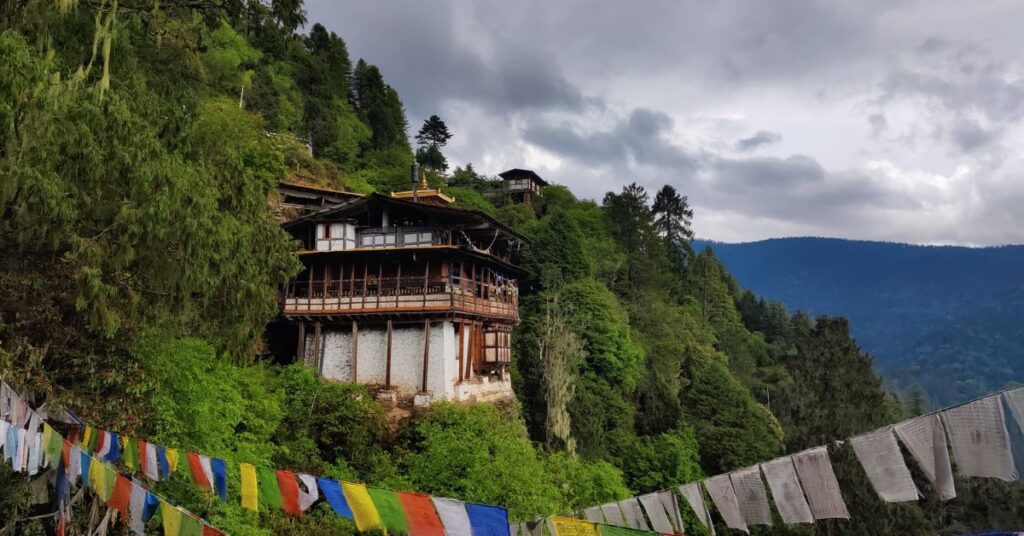
4. Thowadrak, one of the four great cliffs (Dra Zhi)
Thowadra, meaning “high cliff,” is in the northern part of Chutoed village under Tang Gewog. A rough road reaches the Murti Zam area and a new cantilever bridge was built in January 2026, but the road remains difficult. A Bhutan Broadcasting Service report of 7 September 2026 described an uphill hike of about two hours from the nearest road point; muddy, difficult stretches can make the road especially challenging in summer, and a four-wheel-drive vehicle may be needed. Confirm the roadhead, bridge access and trail locally before setting out. Older four-hour estimates may reflect a different roadhead or earlier access conditions.
A local Buddhist tradition says Guru Rinpoche left a wooden Garuda at Thowadra after subduing or expelling the Tibetan king Khikha Rathoe from Khenpajong. This story is part of the sacred history associated with the cliff and its connection to the hidden valley.
Local oral tradition says Gelongma Pelmo and her attendant meditated at Thowadra, and that she recovered from leprosy after her retreat. This is a religious healing narrative, not a medically verified cure or a substitute for treatment.
Thowadra is traditionally dated to 1238, when Lorepa Drangpa Wangchuk is said to have established a hermitage here. The site is also revered as a place blessed by Guru Rinpoche in the 8th century. A Nyingma monastic community was established in the late 18th century by Changchub Gyeltsen, and the lhakhang was later restored by Choeje Ngawang Trinley.
A spring at Thowadra is revered as drupchhu and associated with Guru Rinpoche and Gelongma Pelmo in local belief. The site also contains rocks identified by pilgrims as sacred seats and places associated with dakinis. These are devotional interpretations; do not assume the spring water is safe to drink or has medical properties.
Also Read: Drupchhu or Holy Spring Waters in Bhutan: Beliefs and Benefits
Local tradition associates bamboo around Thowadra with Tsari Ney in south-eastern Tibet. Some pilgrims carry a piece as a protective blessing. This is a devotional custom; do not remove bamboo or other natural material without permission, and respect conservation and local community guidance.
Read More: Thowadra, a High Cliff where Guru Rinpoche left a Wooden Garuda
Conclusion
Bumthang is often described as Bhutan’s spiritual heartland because of its many monasteries, temples and pilgrimage sites. The four cliffs—Choedrak, Kunzangdrak, Shugdra and Thowadra—each have a distinct history and approach. Visiting all four is a multi-day pilgrimage, not a single-day excursion: allow time for transfers, steep trails, changing weather and rest. Thowadra’s rough road and uphill walk make advance local coordination especially important. For a proposed route, see the dedicated Bumthang Dra Zhi Neykor journey and reconfirm access arrangements before travel.
Frequently Asked Questions
What does Dra Zhi mean?
Dra Zhi means the Four Cliffs. In this article, it refers to four sacred cliffs in Bumthang associated with Guru Rinpoche: Choedrak, Kunzangdrak, Shugdra and Thowadra.
Where are the four Dra Zhi cliffs located?
The four sites are in different parts of Bumthang: Choedrak in Chumey Valley, Kunzangdrak overlooking Tang Valley, Shugdra in upper Chhoekhor-toed valley near Kharsa village, and Thowadra in the northern part of Tang Valley.
Are the four Dra Zhi the same as Phajo Drugom Zhigpo’s four sacred cliffs?
No. The four Bumthang cliffs discussed here are Choedrak, Kunzangdrak, Shugdra and Thowadra. Phajo Drugom Zhigpo’s four cliffs are a separate group of sacred sites in other parts of Bhutan.
How do I reach Choedrak?
One route is a steep climb of about one hour from the motorable road near Tharpaling. Another approach is a roughly three-hour hike from Lamey Goenpa through forest and over a pass. Confirm the trailhead and current condition locally.
How do I reach Kunzangdrak?
Kunzangdrak is reached from the Jakar–Ura–Mongar highway, followed by an uphill walk from the current roadhead. Published estimates range from a short walk where the farm road is passable to about one and a half hours from the parking area. Confirm the roadhead and trail conditions with local guides.
How do I reach Shugdra?
Shugdra is reached by a rough farm road from Chamkhar towards Kharsa village, followed by an uphill forest walk. The drive and walking times vary with road conditions and the actual drop-off point; confirm local access before departure.
How do I reach Thowadra?
A rough road reaches the Murti Zam area, but the route can be muddy and difficult in summer. A September 2026 report described an uphill hike of about two hours from the nearest road point. Use a suitable four-wheel-drive vehicle where necessary and confirm the roadhead, bridge and trail conditions locally.
Can the four Dra Zhi be visited in one day?
No. The four sites are spread across Bumthang and each has its own approach. A multi-day itinerary is more realistic, with time for road transfers, steep walks, weather and rest.
Is the water at the sacred springs medicinal?
Some springs are revered as drupchhu and associated with religious blessings. Claims that the water cures epilepsy, stroke or other illnesses are not established medical facts. Do not use spring water as a substitute for medical care or assume it is safe to drink.
What should I know before visiting the four cliffs?
Wear sturdy footwear, carry water and weather-appropriate clothing, and arrange local guidance. Check farm-road conditions and trailheads before setting out, particularly for Thowadra. Respect monastery rules and ask permission before photographing inside temples or entering retreat areas.
EXPLORE THE SACRED SITES OF BUMTHANG
Plan Your Bumthang Dra Zhi Pilgrimage
Discover the four sacred meditation cliffs of Bumthang—Choedrak, Kunzangdrak, Shugdra and Thowadra—and their pilgrimage traditions. We can help you plan the journey around your interests, dates and walking ability.
