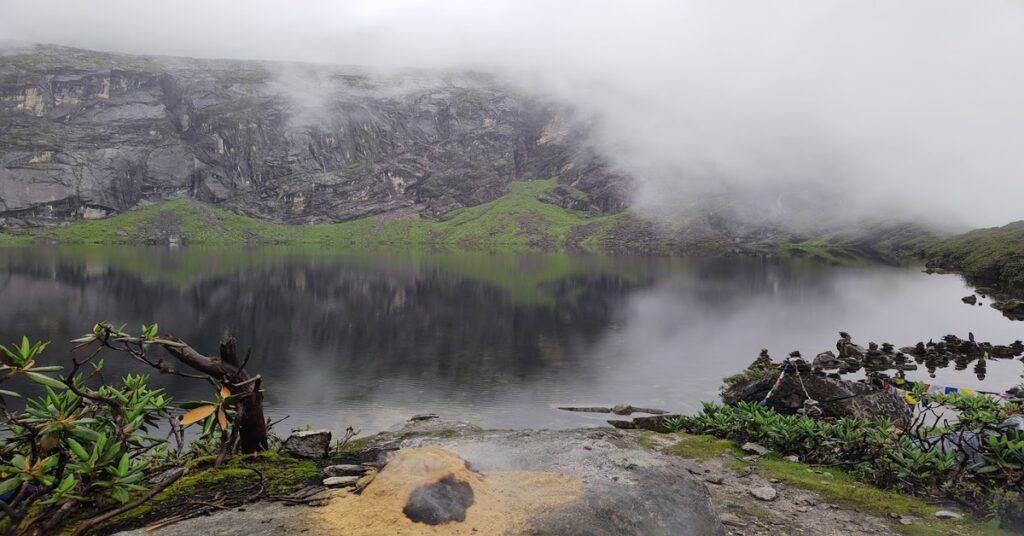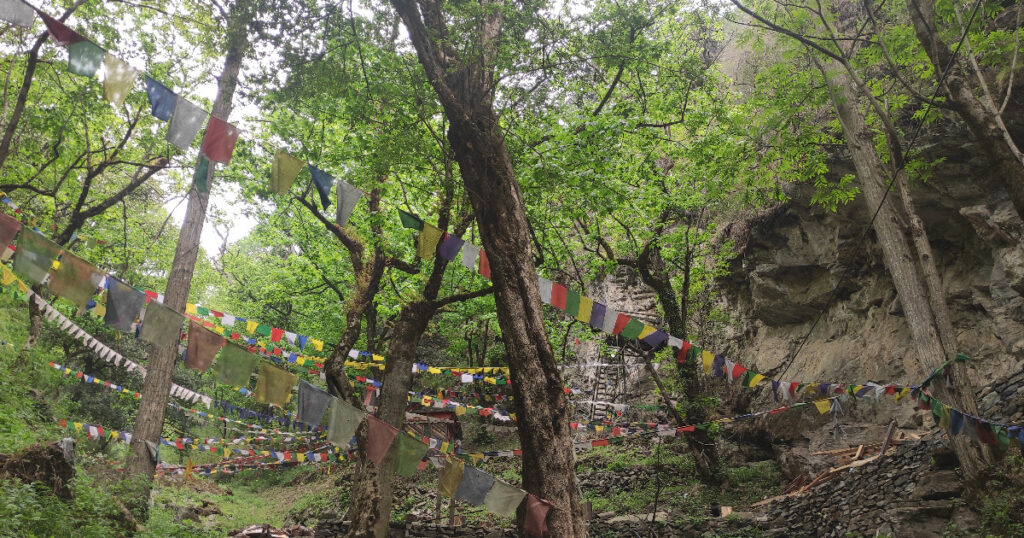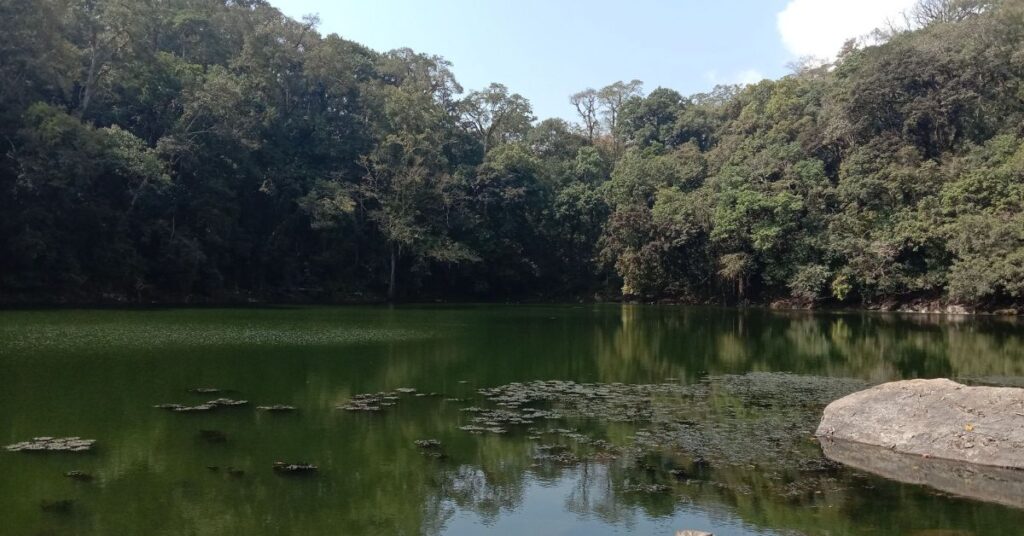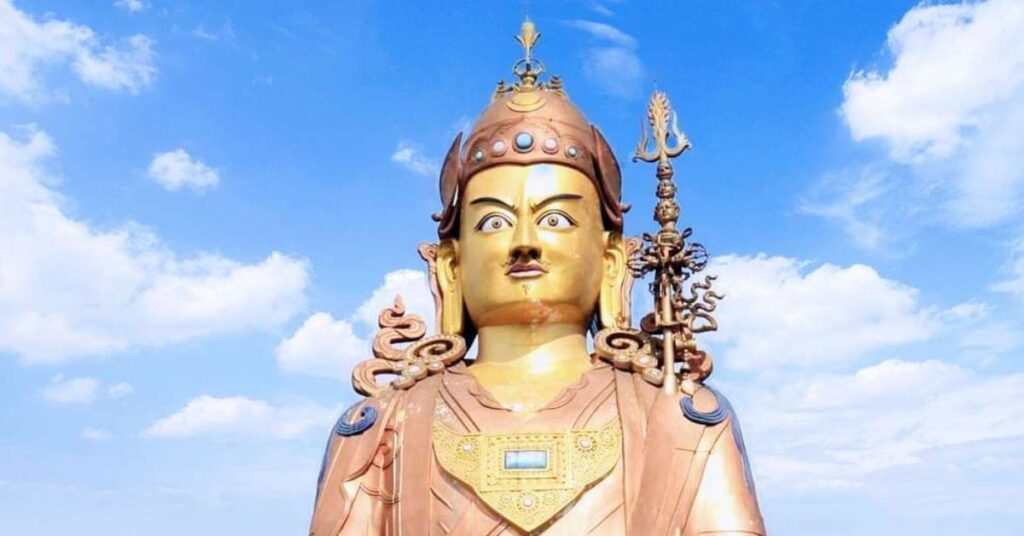
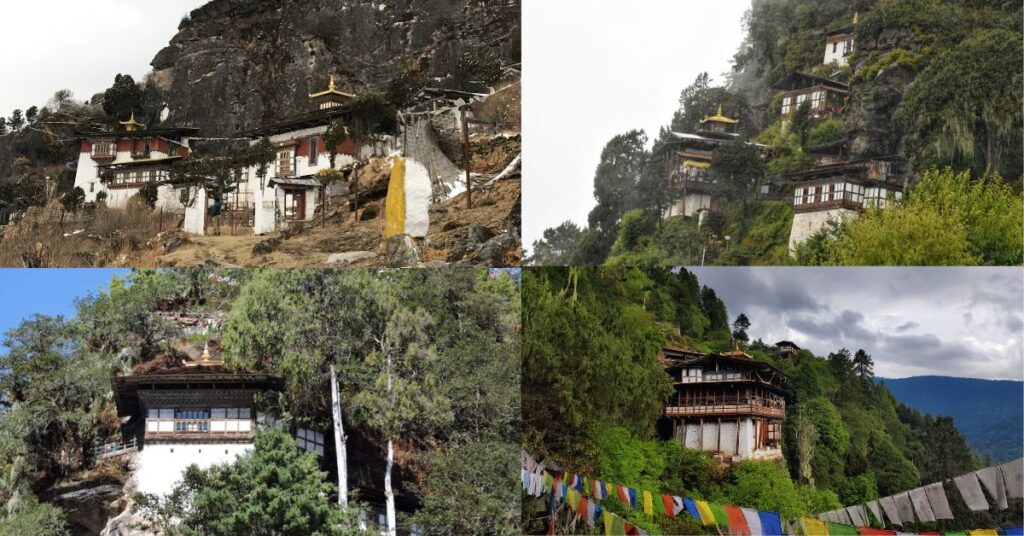
Dra Zhi are the four great meditation cliffs of Guru Rinpoche in Bumthang Dzongkhag, where he meditated before subduing Shelging Karpo, the local deity of Bumthang, who took the life force (sog) of King Sindhu Raja.
The Four Great Meditation Cliffs of Guru Rinpoche in Bumthang
The four great meditation cliffs (Dra Zhi) of Guru Rimpoche in Bumthang are:
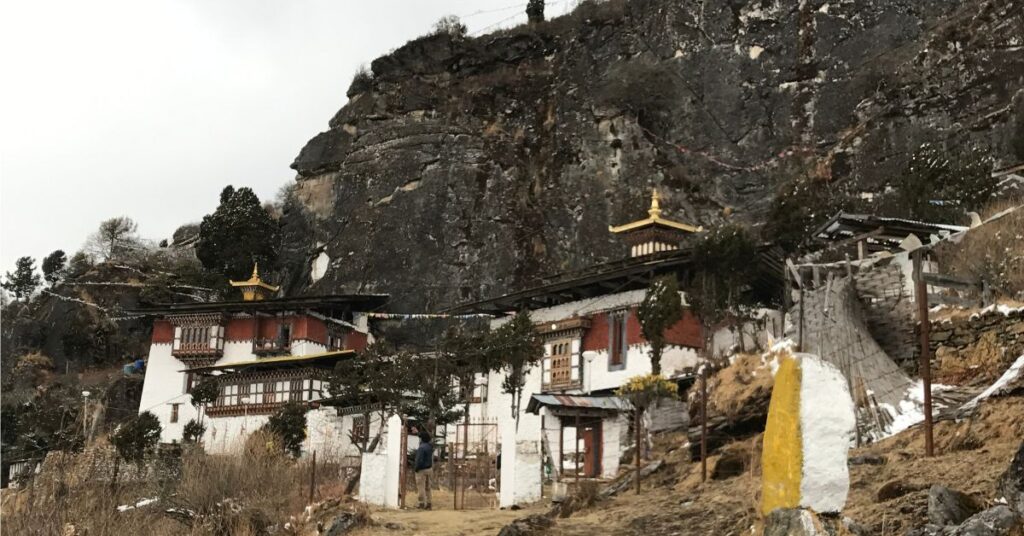
1. Choedrak, one of the four great cliffs (Dra Zhi)
Choedrak Monastery is one of the Dra Zhi located on the northern ridge dominating the whole Chumey valley at an altitude of 3,800 meters. Guru Rinpoche is said to have arrived at the sacred Choedra riding on a tigress and meditated there. Later, a monastery was built against the cliff by Gyalwa Lorepa in the 12th century.
The Choedrak monastery, or Choje Drak, is 37 kilometers from Chamkhar town, but a one-hour steep climb from the motorable road that ends at Tharpaling monastery. Choedrak Goenpa can also be reached via a three-hour hike through a deep forest and over a pass from Lamey Goenpa in Choekhor Valley.
The sacred site of Choedrak became popular only in the 18th century when the great Drukpa monk Ngawang Trinley from Punakha rebuilt the monastery. Though the site is Choje Drak, it is known as Choedra.
Several traditional Bhutanese structures are built around the meditation caves. Choedrak is mostly a hermitage used by religious masters and monks for retreats and solitary life.
The imprints of Guru Rinpoche and his tigress on the rocks at the holy site are evidence of his visit to Choedrak. Guru Rinpoche is said to have flown from Paro Taktsang on a tigress. The meditation cave also justifies his arrival and meditation at the site for the well-being of all sentient beings.
There are three stone thrones. The one at the top is said to be Sangay Yepamey, the middle is Chenrezig, and the bottom is Guru Padmasambhava. There’s a plain ground below the throne of Guru Rinpoche, where it is said that Khandroms have offered the songs as a gesture of gratitude for the Guru’s doctrine.
Read More: Choedrak, a sacred cliff where Guru Rinpoche came riding on a tigress from Paro Taktsang.
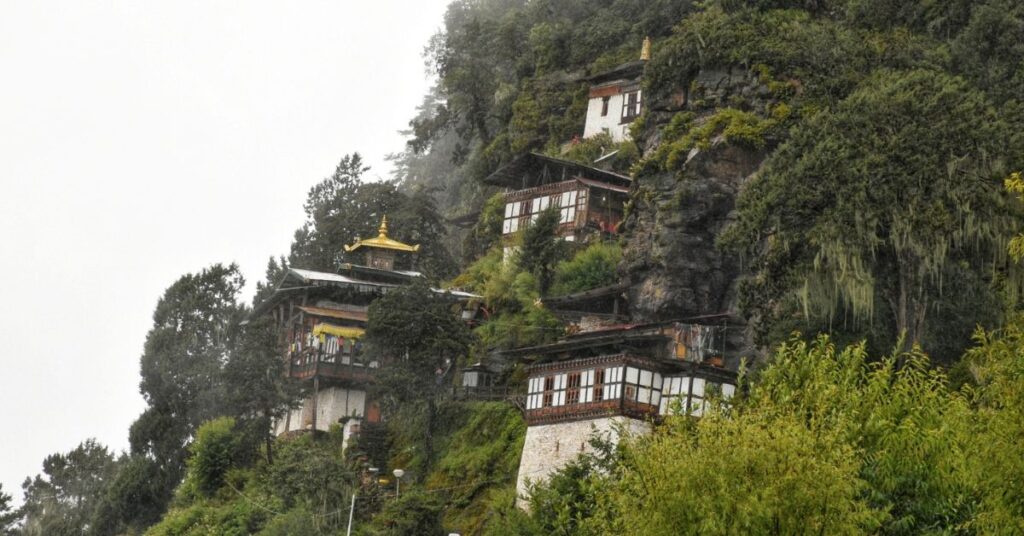
2. Kunzangdrak, one of the four great cliffs (Dra Zhi)
Kunzangdrak Monastery is another part of the Dra Zhi, located opposite Tang Valley at 3,350 meters above sea level. The name Kunzangdra was derived from the incident of Pema Lingpa seeing Kuntu Zangpo, one of the primordial Buddhas, while gazing up from his birthplace, Chel.
Kunzangdra Monastery is roughly 12 km from the Jakar-Ura-Mongar highway. Getting there on foot from the parking lot takes one and a half hours. The pilgrimage hike to the monastery is rated as moderate in difficulty.
According to Guru Rinpoche’s prophecy, Terton Pema Lingpa constructed the Kunzangdra monastery on the face of a cliff in 1488. The monastery has three temples, the Wangkhang, Oezerphug, and the Khandro Lhakhang, in addition to Pema Lingpa’s living quarters, which is now a Goenkhang.
The cave where Pema Lingpa meditated is in the middle of the main and oldest temple, Wangkhang, and has a life-like figure of himself and his golden footprint. Chenrezig, the Buddha of Compassion, is the main statue, sculpted by Pema Lingpa.
Oezerphug is the meditation cave of Pema Lingpa’s son, Thugse Dawa Gyeltsen (1499-1586), with a holy spring water (Drupchhu) supposed to cure epilepsy and stroke; and higher up from the main buildings is the Khandroma Lhakhang.
Also Read: Drupchhu or Holy Spring Waters in Bhutan: Beliefs and Benefits
Khandro Lhakhang was founded on the same site where Khandro Yeshey Tshogyal is said to have meditated. The Lhakhang was built by Pema Lingpa’s consort. Hundreds of thousands of Khandoms (Dakinis) built the base, which was then guarded by guardian deities under the guidance of Drasung Rahula.
Read More: Kunzangdra, a Cliff where Pema Lingpa saw Kuntu Zangpo, one of the Primordial Buddhas.
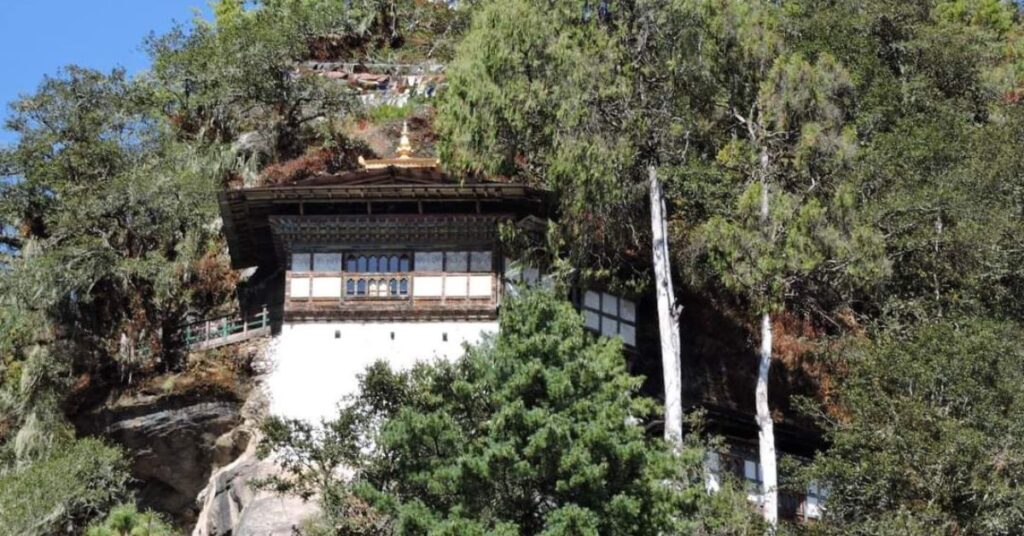
3. Shudrak, one of the four great cliffs (Dra Zhi)
Shuk Drak Goenpa is also one of the four cliffs in Bumthang. The sites of Shugdrak are further subdivided into three: Drakar Namkha Dzong at the upper end, Duedul Senge Dzong in the middle, and Chungchen Khading Dzong at the lower end.
According to the biography of King Sindhu Raja called The Clear Mirror: “Guru Rinpoche arrived at Shukdrak in the form of Blood Drinking Wrathful Padma, meditated on top of the cliff resembling a Kilaya, and subdued all the hostile demons. He left imprints of his body, hand, and foot on the rock, bound all the local guardian spirits through his powerful oaths, and transformed them into dharma protectors.”
Shugdra is located in Bumthang’s upper Chhoekor valley, 45 minutes via rough road above Thangbi Lhakhang, and takes an hour and a half by foot from Thangbi through a forested trail.
Many lamas chose Guru Rinpoche’s meditation cliff as a retreat site. The Bakha Trulku of Powo, Tibet, said to be the incarnation of the great master Vairocana and later of Dorji Lingpa and Pema Lingpa, has a specific link with Shugdrag. Rigdzin Khamsum Yongdröl, the eighth Bhakha Tulku and close friend of Bhutan’s first monarch, spent time in retreat here. After leaving Tibet for Bhutan in the early 1960s, the Tenth Bhakha Rinpoche also meditated there.
The Shugdra monastery is dedicated to Guru Rinpoche. Its statues and paintings date from the end of the 19th century. Pilgrims climb a series of staircases past a magnificent butter-lamp house to a rock shrine, where a monk shows the Guru Rinpoche’s stone footprint, handprint, and boot print.
Read More: Shugdra, a Cliff where the Guru meditated in the form of Blood-Drinking Wrathful Padma.
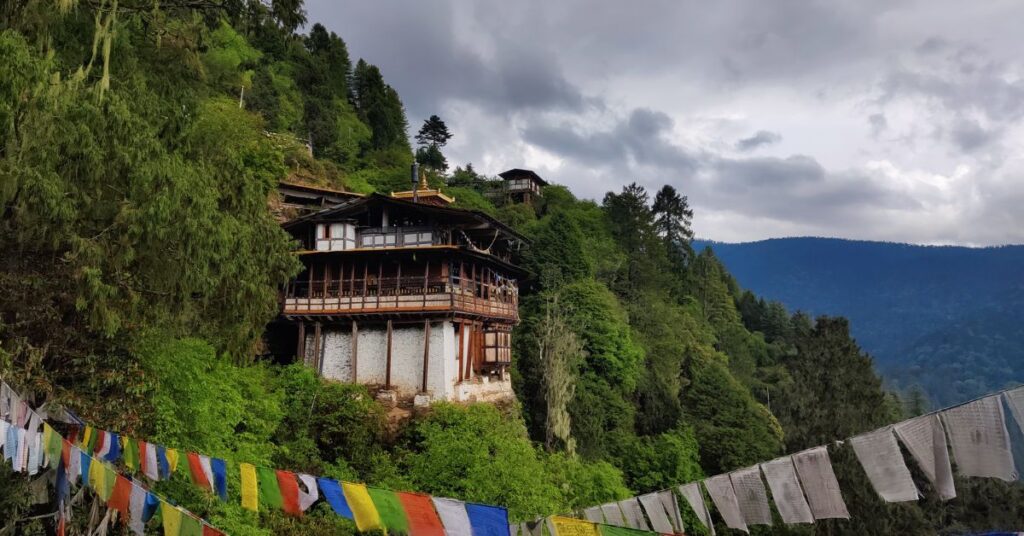
4. Thowadrak, one of the four great cliffs (Dra Zhi)
Thowadra is one of the Dra Zhi towards the north of the Tang Valley of Bumthang. This sacred cliff, which means “high cliff”, is located at an altitude of 3,400 meters, and it is an almost 3-hour walk from Chutoe, the last village towards Thowadrak.
Guru Rinpoche is said to have left a wooden Garuda after exiling the Tibetan king Khikha Rathoe from the Khenpajong valley at Thowadra monastery.
Legend has it that the leprosy-infected Kashmiri princess Gelongma Pelmo, daughter of the Kashmir King Triten Gyalpo, also lived in isolation in Thowadra. It is said that Gelongma Pelmo meditated there for a long time, and her leprosy was cured.
Later, a Lhakhang was built at the sacred site by Gyelwa Lorrepa Dragpa Wangchuk in 1238, who also established Choedrak Monastery in Chumey.
One can also see holy spring water blessed by Guru Rinpoche and Gelongma Pelmo coming out of the rock and revered as the Drupchhu by the pilgrims. Guru Rinpoche’s stone throne and stones are believed to be the Dakinis’ bathtub above the monastery under a cypress tree.
Also Read: Drupchhu or Holy Spring Waters in Bhutan: Beliefs and Benefits
The bamboo around Thowadra is said to be Tsari Nguma, believed to be brought from Tsari Ney of south-east Tibet. Pilgrims take bamboo from Thowadra Monastery to protect themselves from evil.
Read More: Thowadra, a High Cliff where Guru Rinpoche left a Wooden Garuda
Conclusion
Bumthang is the spiritual heartland of Bhutan and flaunts so many sacred sites. Dra Zhi are the four great meditation cliffs of Guru Rinpoche in Bumthang Dzongkhag, where he meditated before subduing Shelging Karpo, the local deity of Bumthang, who took the life force (sog) of King Sindhu Raja. You can visit the Four Great Meditation Cliffs of Guru Rinpoche in Bumthang with the Bhutan Pilgrimage Package.
Frequently Asked Questions
What is Dra Zhi?
Dra Zhi refers to the “Four Great Meditation Cliffs” of Guru Rinpoche (Padmasambhava) in Bumthang, central Bhutan. These four sacred cliffs—Choedrak, Shukdrak (Shugdra), Kunzangdrak, and Thowadrak—are revered pilgrimage sites where Guru Rinpoche meditated in the 8th century to subdue local deities and establish Buddhism in the region. Together, they form a spiritually significant circuit known for both religious merit and dramatic Himalayan scenery.
Where is Dra Zhi located?
Dra Zhi is located in Bumthang Dzongkhag (district) in central Bhutan, spread across the Chumey, Choekhor, and Tang valleys. Each cliff sits on a high ridge or mountainside, offering panoramic views of the surrounding valleys and forests. The sites are accessible via short to moderate hikes from nearby villages and monasteries in Bumthang.
What are the four cliffs of Dra Zhi?
The four cliffs that make up Dra Zhi are:
Choedrak – Located above Chumey valley at about 3,800 meters, known for its meditation cave and monastery.
Shukdrak (Shugdra) – Situated in Choekhor valley near Kharsa village, where Guru Rinpoche meditated in a wrathful form.
Kunzangdrak – Found in Tang valley, associated with deep meditation and blessings.
Thowadrak (Thowadra) – Also in Tang valley, famous for a wooden Garuda relic left by Guru Rinpoche.
Each site has its own temple or hermitage and unique spiritual stories tied to Guru Rinpoche’s visits.
Why is Dra Zhi important for pilgrims?
Dra Zhi is important because it marks places where Guru Rinpoche performed intense meditation, subdued negative forces, and blessed the land. In Bhutanese Buddhist tradition, visiting all four cliffs is considered highly meritorious and spiritually transformative. Pilgrims believe that completing the Dra Zhi circuit brings protection, purifies obstacles, and deepens one’s connection to the Dharma.
How do you visit Dra Zhi?
Visiting Dra Zhi typically involves traveling to Bumthang and then undertaking short treks or hikes to each cliff site from nearby villages or monasteries. Most travelers include Dra Zhi as part of a broader Bumthang pilgrimage or cultural tour, often combined with visits to Kurjey Lhakhang, Jambay Lhakhang, and other sacred sites. Local guides and tour operators in Bumthang can arrange transport, permits, and itineraries tailored to pilgrims and trekkers.
When is the best time to visit Dra Zhi?
The best time to visit Dra Zhi is during spring (March to May) and autumn (September to November), when weather is clear, trails are dry, and temperatures are comfortable for hiking. Winter visits are possible but can be cold, especially at higher elevations like Choedrak. Monsoon season (June to August) may bring rain and slippery paths, so extra caution is advised.
Can Dra Zhi be visited in one day?
Visiting all four cliffs of Dra Zhi in one day is challenging due to their spread across different valleys and the hiking time required for each site. Most pilgrims and tourists plan 2–3 days to complete the circuit comfortably, allowing time for prayer, meditation, and travel between locations. Some travelers choose to visit one or two cliffs per day depending on their schedule and fitness level.
Are there accommodation options near Dra Zhi?
Yes, accommodation options are available in nearby towns such as Chumey, Choekhor, and Tang, ranging from guesthouses to small hotels. Many pilgrims stay in Bumthang’s main town (Jakar) and make day trips to the cliffs. For a more immersive experience, some hermitages and monasteries near the cliffs may offer basic lodging for devotees, though facilities are simple.
What should pilgrims bring when visiting Dra Zhi?
Pilgrims should bring comfortable hiking shoes, warm clothing, water, snacks, and personal prayer items such as malas or prayer flags. A camera is recommended for capturing the scenic views, but respect for sacred spaces is essential. It’s also advisable to carry cash for small donations at temples and to hire local guides if unfamiliar with the trails.
Is Dra Zhi suitable for all travelers?
Dra Zhi is suitable for most travelers with moderate fitness levels, as the hikes involve uphill walking on mountain trails. Elderly pilgrims or those with mobility issues may find some sections challenging, especially at higher elevations like Choedrak. With proper planning, pacing, and local support, however, visitors of various ages and abilities can experience the spiritual and natural beauty of Dra Zhi.