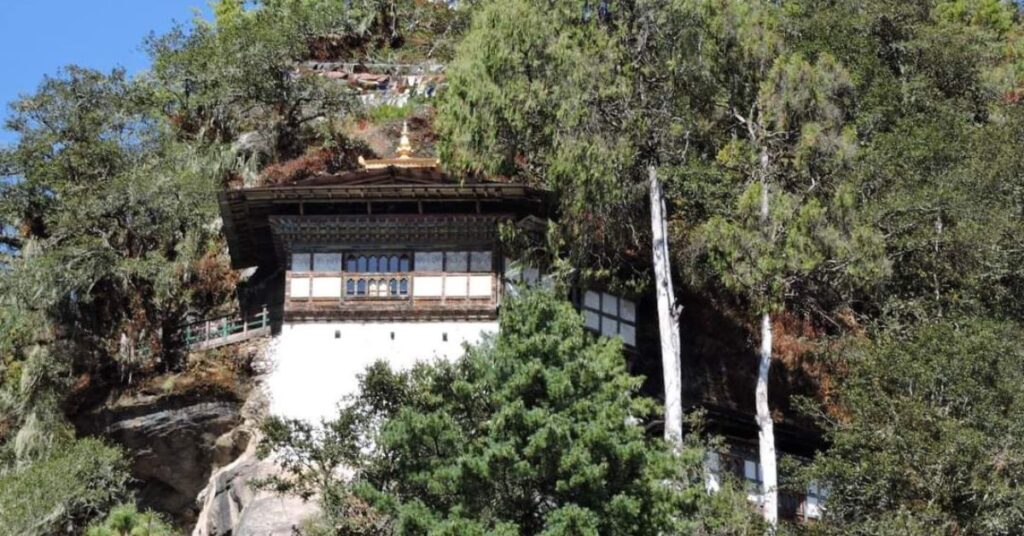
Shugdra (also spelled Shuk Drak Goenpa) is one of Guru Rimpoche’s four cliffs (Dra-Zhi) located in the upper Choekhor-toed valley under Kharsa village of Bumthang at an elevation of 2680 meters. Choedrak in Chumey, Kunzangdrak, and Thowadrak in Tang Valley are the other three cliffs in the Bumthang Dzongkhag of central Bhutan.
This sacred cliff, also known as the Chungchen Khading Dra (the cliff looks like a flying Garuda) or Chung Dra, was blessed by Guru Rinpoche and concealed numerous treasures. Later, Terton Pema Lingpa is believed to have discovered many treasures from the cliff.
Shugdra is a cliff where Guru Rinpoche visited and meditated to acquire the spiritual power to subdue Shelging Karpo. It is said to be strategically situated at the meeting point of the rivers flowing from three valleys. A private family manages the sacred site.
Shuk Drak Goenpa is one of the Four Cliffs (Dra Zhi) of Guru Rinpoche in Bumthang Valley. The other three cliffs are Choedrak in Chumey, Kunzangdrak, and Thowadrak in Tang Valley under the Bumthang Dzongkhag in central Bhutan.
How to Reach Shugdra
The sacred Shuk Drak cliff is a 45-minute drive on a farm road above Thangbi Mani Lhakhang from Chamkhar town to the base of the site and a 20-minute walk uphill through the dense forest. Shukdra is within a walking distance of 30 minutes from Kharsa Primary School.
Shugdrak Hike: The trek up to the temple is rather straightforward, and the view from the top is breathtaking. After passing Thangbi Goemba, the trail begins. It is 2 kilometers from Thangbi and takes around an hour.
Sacred Relics to See at Shugdra Goenpa
- Meditation Cave of Guru Rinpoche;
- Handprint, Footprint, and Boot Print of Guru Rinpoche;
- Self-Arisen Ah;
- Guru Rinpoche’s walking stick;
- Footprint and Holy Water of Khandro.
Also Read: Guru Rinpoche in Bhutan: His Visits to Bhutan and Sacred Sites
Historical Significance of Shuk Drak
While Guru Rinpoche was giving teachings on Sanga Dorji Thekpa to King Sindhu Raja and his family, there lived an evil spirit named Sinpo Gajed, who was torturing the people of the locality. Therefore, Guru and Khandro meditated in the cave of Drakmar Dorji Tsegpa, Vajra Piled Red Cave, to gain the power to tame him. Guru transformed into the ferocious Wangda Padma Thoedthreng Throwo Rolpaiku and subdued all of them, including their leader Sin Gyal Maha Raja Chhagja Zhi, who was buried face-up with marks (shuel) of the guru’s footprints over it. Thus, the site was known as Shuel Drak (cliff with marks). However, over the years, it was mispronounced as Shudrak.
The sites of Shugdrak are further subdivided into three: Drakar Namkha Dzong at the upper end, Duedul Singye Dzong in the middle, and Chungchen khading Dzong at the foothills, collectively known as Shugdrak.
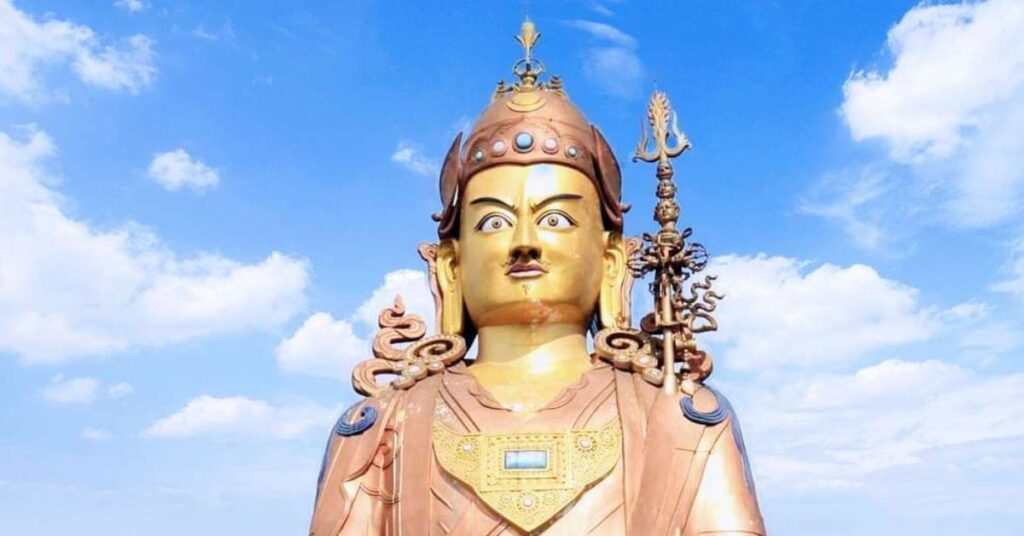
According to the biography of King Sindhu Raja called The Clear Mirror: “(Guru Rinpoche) arrived at Shukdrak in the form of Blood Drinking Wrathful Padma, meditated on top of the cliff resembling a Kilaya, and subdued all the hostile demons. He left imprints of his body, hand, and foot on the rock, bound all the local guardian spirits through his powerful oaths, and transformed them into dharma protectors.”
Many lamas chose Guru Rinpoche’s meditation cliff as a retreat site. Terton Pema Lingpa is said to have discovered many treasures from the cliff subsequently. However, it was made known only in the 19th century when Terton Rinchen Lingpa unveiled treasures from the sacred site.
Rigdzin Khamsum Yongdröl, the eighth Bhakha Tulku and close friend of Bhutan’s first monarch, spent time in retreat here. After leaving Tibet for Bhutan in the early 1960s, the Tenth Bhakha Rinpoche also meditated there.
Description of Shugdra
There are many stories about how Shugdra got its name. Shugdra is derived from Shugposhing (Juniper tree), Guru Rinpoche’s walking stick, which he left at the cliff to benefit Sentient creatures. As a result, it’s known as Shug-Juniper Tree and Drag-Cliff. As Guru Rinpoche sat and meditated on the cliff, some people called it Zhugdrak. The most well-known name is Chungchen Khading Dra, the cliff resembling a huge flying Garuda. As a result, locals refer to it as Chung Dra. Some people even call it Shuel Dra, the last cliff of the four to be blessed by Guru Rinpoche.
Also Read: Dra Zhi, the Four Great Meditation Cliffs of Guru Rinpoche in Bumthang
The sacred place features a meditation cave, Guru Rinpoche’s handprint, footprint, and body print. It also has Khandro’s footprint and holy water.
Also Read: Drupchhu or Holy Waters in Bhutan: Beliefs and Benefits
The Shuk Drak Goenpa is located in Bumthang’s upper Choekhor valley. The Shuk Drak Lhakhang was built by Garpa Nado in 1944 in the late 19th century. According to the oral tradition, Garpa Nado was herding cows when he ran into a young child who requested him to go to a cave, showed him the little statue of Guru Rinpoche, and then vanished. He chose to clear the trees surrounding the cave after being amazed by the blessing. He later constructed a small Lhakhang next to the cave where the Guru used to meditate.
Shuk Drak Goenpa
Shugdra Lhakhang is naturally formed from the hill, and the shape of the cave defines its design. A staircase naturally modified from the cliff leads to the Lhakhang. The Lhakhang is a two-story structure built in the middle of the cliff using mud plaster, stone masonry, and timber. A cliff edge forms part of the exterior wall of the Lhakhang. The main relic is the statue of Guru Rinpoche discovered by Garpa Nado.
Later, the Lhakhang was extended. However, the extended spaces of the Lhakhang were limited due to the initial structure and the available space. This has led to the irregular shape of the Shugdrak Goenpa Lhakhang.
Shuk Drak Goenpa Festival
To preserve the culture and traditions, the forefathers introduced special rituals. For example, the Zhithro ritual is performed annually on the 11th month, corresponding to the winter solstice, and Choetshog is performed annually on the 4th day of the 6th month, corresponding to the First Sermon of Lord Buddha.
Best Time to Visit Shudrak Goenpa
There is no perfect time for a pilgrimage. Shuk Drak Goenpa is considered a year-round destination. You don’t need to visit the sacred sites at a specific time to seek blessings. Nonetheless, spring and autumn are still regarded as the ideal seasons to travel to avoid the rainy season. The spring and fall seasons last from March to May and September to November, respectively. This is the time of year when flowers bloom, and the weather is pleasant.
If you go deep enough, the pilgrimage site can take up to two days. So, plan according to your time. You can visit the major pilgrimage sites of Bumthang with the Bhutan Pilgrimage Package.
Frequently Asked Questions
What is Shugdra Goenpa?
Shugdra Goenpa (also spelled Shuk Drak Goenpa) is a sacred Buddhist monastery and meditation cave site in Bumthang, Bhutan. It sits at an altitude of 2,680 metres in Kharsa village, in the upper Choekhor valley, and is revered as one of Guru Rinpoche’s four holy cliffs (Dra-Zhi) where he meditated to gain the power to subdue local deities and demons.
Why is Shugdra Goenpa significant?
Shugdra Goenpa is spiritually significant because Guru Rinpoche is believed to have meditated here in the fierce form of Blood-Drinking Wrathful Padma (Wangda Padma Thoedthreng) to tame the evil spirit Sinpo Gajed and the local deity Sheling Karpo. During this meditation, he left sacred imprints—footprints, handprints, and marks of his walking stick—on the rock, and concealed numerous terma (hidden treasures) later discovered by masters like Tertön Pema Lingpa.
Where is Shugdra Goenpa located?
Shugdra Goenpa is located in Kharsa village, in the upper Choekhor-toed valley of Bumthang District, Bhutan. The site is perched on a dramatic cliff known as Chungchen Khading Dra (“the cliff that looks like a flying Garuda”), strategically positioned at the confluence of rivers flowing from three valleys.
How do I reach Shuk drak Goenpa?
To reach Shugdra Goenpa, drive approximately 45 minutes from Chamkhar town (Bumthang’s main town) to the base of the site in Kharsa village. From there, it is a short but steep 20-minute uphill walk to the monastery and meditation cave. The route is well-trodden by pilgrims and offers scenic views of the valley.
What can I see at Shugdra Goenpa?
Visitors can see the main temple (Shugdra Lhakhang), built in 1944 by Garpa Nado, which houses a sacred statue of Padmasambhava (Guru Rinpoche) discovered by Garpa Nado. The site also features Guru Rinpoche’s footprint, handprint, and walking-stick imprint on the rock, as well as the footprint of Khandro Yeshe Tshogyal. Pilgrims often circumambulate the cliff and offer prayers at the meditation cave.
When is the best time to visit Shugdra Goenpa?
The best time to visit Shugdra Goenpa is during spring (March to May) and autumn (September to November), when the weather is clear, dry, and pleasant for trekking. These seasons also coincide with major festivals in Bumthang, making it an ideal time for pilgrims to combine their visit with cultural events. Winter visits are possible but can be cold, while summer months may bring rain and slippery trails.
Is Shugdra Goenpa suitable for all travelers?
Shugdra Goenpa is suitable for most travelers, including families and seniors, as the hike from the roadhead is short (20 minutes) though steep. The site is accessible to those with moderate fitness levels. Visitors should wear comfortable walking shoes and carry water. The spiritual atmosphere and sacred imprints make it a meaningful stop for pilgrims and culture enthusiasts alike.