
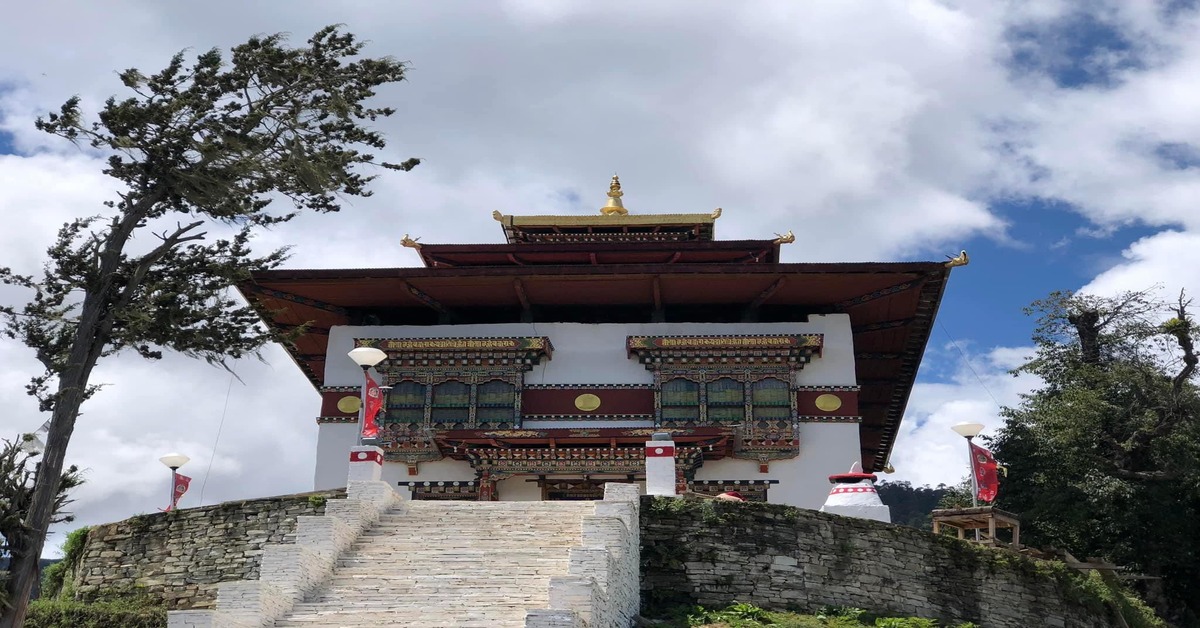
Ugyen Guru Lhakhang, also known as Pangbisa Guru Lhakhang, is a temple founded by Terton Sherab Mebar in the 14th century. The temple was built in accordance with Guru Rinpoche’s prophecy. It is located in the village of Pangbisa above the Paro Valley at 4,000 meters above sea level.
The temple is famous for the legend of Terton Sherab Mebar and Nub Tshona Patra. Pangbisa Ugyen Guru Lhakhang has a Phurpa Ku (three-sided ritual dagger statue) and a stone mongoose discovered from Nub Tshona Patra Lake. It also houses the spoken Guru statue, Terton’s head relic, and the spiritual globule, Pangbi-reb.
How to Reach Pangbisa Ugyen Guru Lhakhang
Ugyen Guru Lhakhang is on the forested hilltop in Pangbisa. It is accessible via a 17-kilometer winding road that begins at the Paro Bondey bridge along the road to Dungkar Dzong. If you hike from Ugyen Guru Goenzin Dratshang, you’ll come to another sacred site called Tseybum Ney (Tshebum Ney). Further up is the Pangkala, where people hike for vibrant ridge flowers and alpine scenery.
History of Pangbisa Ugyen Guru Lhakhang
Ugyen Guru Lhakhang was built by Pangbi Lam Terton Sherab Mebar in accordance with Guru Rinpoche’s prophecy in the 14th century. The Lhakhang was named Ugyen Guru Lhakhang, dedicated to Ugyen Guru Rinpoche, the second Buddha.
Description of Ugyen Guru Lhakhang
Ugyen Guru Goenzin Dratshang is a large rectangular building, oriented northeast toward the Paro valley. It is a bulky structure with large rabsel windows, a high two-tier jabzhi roof, and a single entrance facing northeast, covered by a porch. A gilded serpentine finial tops the structure, catching the rays of the rising sun. The typical dark-red khemar band runs along the exterior walls, interspersed with golden medallions depicting the “all-perfect ten,” a sort of stylized mantra.
Today, the temple serves as a Paro Pangbisa Ugyen Guru Goenzing Dratsang, a monastic school.
Spoken Statue of Guru Rinpoche
The spoken statue of Guru Rinpoche is the central figure of Pangbisa Ugyen Guru Lhakhang. Drubthob Tenzin Zangpo sculpted this Guru statue. The statue is believed to have been sculpted on the stone slab where Terton Sherab Mebar sat and meditated.
Legend has it that the Drupthob sculpted the body of the Guru statue but couldn’t sculpt a proportionate head even after several attempts. Just then, two beautiful women came by and handed over a head of the Guru proportionate to the body and fitted to the statue. However, the Guru’s head tilted more towards the left and was hollow inside. So, Drubthop tried to straighten the head and tried to drill it to insert a relic inside. On both occasions, the Guru statue spoke, “Leave it as it is. It is good enough.” Even these days, if we tap the Guru head, we can hear the hollow sound.
The women then disappeared mysteriously. It is believed that they were Khandro Yeshe Tsogyal and Lhacham Mendarava.
Head Relic (Kudung) of Terton Sherab Mebar
The sacred head relic of the founder, Terton Sherab Mebar, is another important relic of Pangbisa Ugyen Guru Lhakhang. It is put on public display for veneration during major religious events. Terton passed away in Baylangdra, Wangdue Phodrang. The body (Kudung) was brought to Pangbisa after much resistance from the people of Baylangdra. However, the Paro Penlop was able to take it to Paro Dzong as a national treasure. But the people of Pangbisa stole the head of Terton Sherab Mebar to Ugyen Guru Lhakhang. The body preserved in the Marchey of Paro Rinpung Dzong perished during the 1907 fire.
Pangbi-reb
Pangbireb, a spiritual globule believed to have medicinal properties, is another attraction of the Lhakhang. It is made of the powder collected from the head relic of Terton Sherab Mebar. The Reip is reputed to cure any form of internal infection, including cancer.
The temple also has six stones with his handprints. One is a chunk of gold he took from Pasakha. They were his last legacy before he left for Wangdue and passed away at Baylangdra.
Best Time to Visit Pangbisa Ugyen Guru Lhakhang
The best time to visit Ugyen Guru Lhakhang in Paro Pangbisa is during the major religious event. During this time, visitors will have an opportunity to receive the blessings of the preserved head relic (kudung) of the founder, Terton Sherab Mebar, as well as the spoken Guru statue. You can visit the major pilgrimage sites of Paro with the Bhutan Pilgrimage Package.
Frequently Asked Questions
What is Ugyen Guru Lhakhang?
Ugyen Guru Lhakhang, also known as Pangbisa Guru Lhakhang, is a 14th-century Buddhist temple in the village of Pangbisa, above the Paro Valley in Bhutan. Founded by the Terton Sherab Mebar, the temple is dedicated to Guru Rinpoche (Padmasambhava) and is revered as a pilgrimage site linked to Guru Rinpoche’s prophecies and hidden treasures.
Where is Ugyen Guru Lhakhang located?
The temple sits on a forested hilltop in Pangbisa, roughly 17–25 kilometers from Paro town and about 4,000 meters above sea level. It is accessed via a winding mountain road that starts near the Paro Bondey bridge on the route toward Dungkar Dzong.
Who founded Ugyen Guru Lhakhang and why?
Ugyen Guru Lhakhang was established in the 14th century by Pangbi Lam (Terton Sherab Mebar) in accordance with a prophecy by Guru Rinpoche.
What makes Ugyen Guru Lhakhang spiritually significant?
The temple is closely associated with Guru Rinpoche, who is regarded as the second Buddha in Bhutanese Buddhism. It is believed to house sacred relics, including the head relic of Terton Sherab Mebar, and has long been a site of meditation, treasure revelation, and local spiritual disputes between deities of the Haa and Paro valleys.
How do travelers reach Ugyen Guru Lhakhang?
Visitors typically drive from Paro town along the Dungkar Dzong road for about 17 kilometers on a winding mountain route. The final approach passes through forested hills, and the temple is visible from the Pangbisa village area. A local guide or driver familiar with the route is recommended.
Are there entry fees or permits required?
Domestic Bhutanese visitors generally do not require special permits beyond standard travel documentation. International tourists must have a valid Bhutan visa and be traveling with a licensed tour operator, as independent travel is not permitted for foreign visitors in Bhutan.
What should visitors wear and bring?
Modest, respectful clothing covering shoulders and knees is required inside the temple. Comfortable walking shoes, water, and a light jacket are advisable due to the high altitude and forested terrain. Photography inside the main shrine may be restricted, so always ask permission first.
Is Ugyen Guru Lhakhang suitable for families and elderly travelers?
The temple is accessible by road, making it feasible for most travelers, including families and seniors with moderate mobility. However, the high altitude and mountainous drive may be challenging for those with health conditions, so acclimatization and medical readiness are recommended.