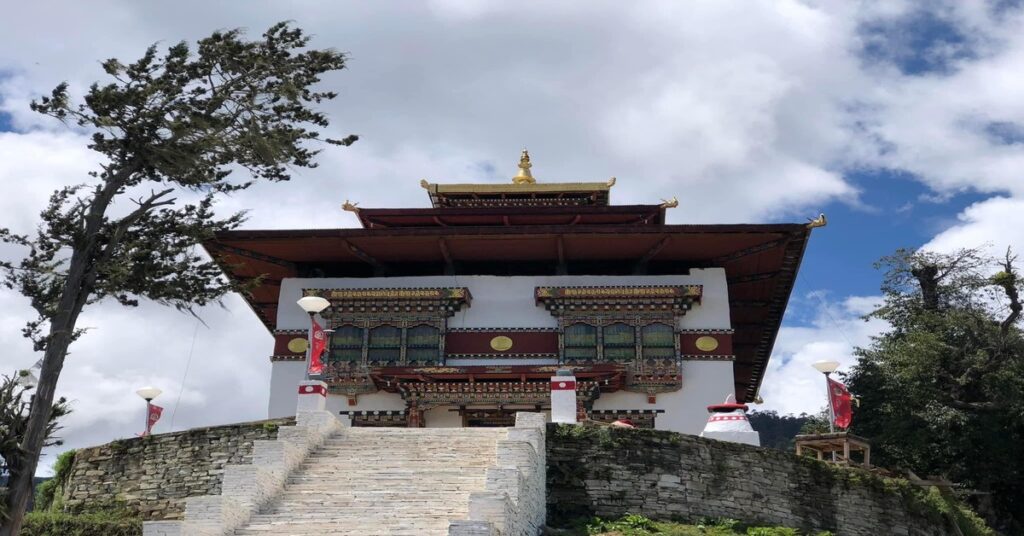
Ugyen Guru Lhakhang, also known as Pangbisa Guru Lhakhang, is a temple founded by Terton Sherab Mebar in the 14th century. The temple was built in accordance with Guru Rinpoche’s prophecy. It is located in the village of Pangbisa above the Paro Valley at 4,000 meters above sea level.
The temple is famous for the legend of Terton Sherab Mebar and Nub Tshona Patra. Pangbisa Ugyen Guru Lhakhang has a Phurpa Ku (three-sided ritual dagger statue) and a stone mongoose discovered from Nub Tshona Patra lake. It also houses the spoken Guru statue, Terton’s head relic, and the spiritual globule, Pangbi-reb.
How to Reach Pangbisa Ugyen Guru Lhakhang
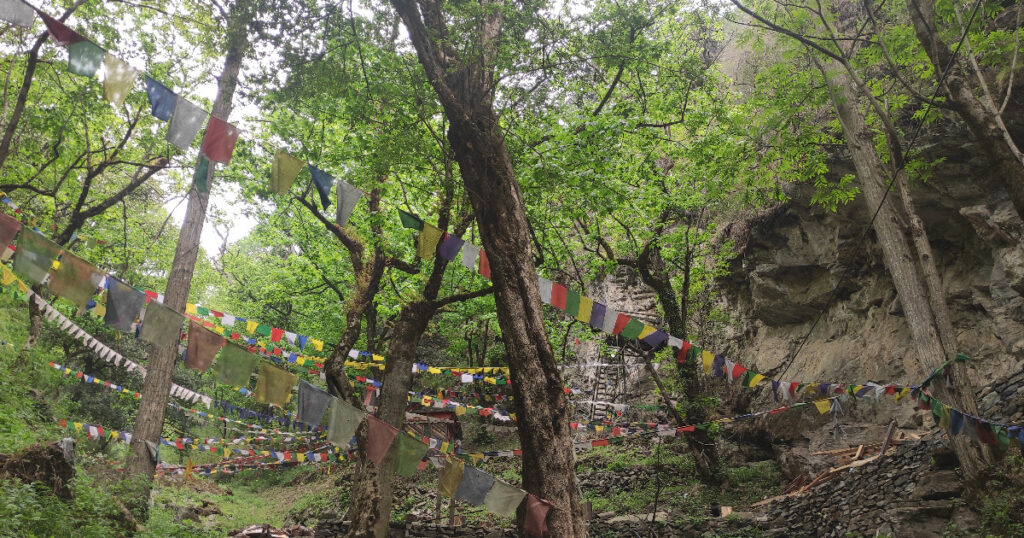
Ugyen Guru Lhakhang is on the forested hilltop in Pangbisa. It is accessible via a 17-kilometer winding road that begins at the Paro Bondey bridge along the road to Dungkar Dzong. If you hike from Ugyen Guru Goenzin Dratshang, you’ll come to another sacred site called Tseybum Ney (Tshebum Ney). Further up is the Pangkala, where people hike for vibrant ridge flowers and alpine scenery.
History of Pangbisa Ugyen Guru Lhakhang
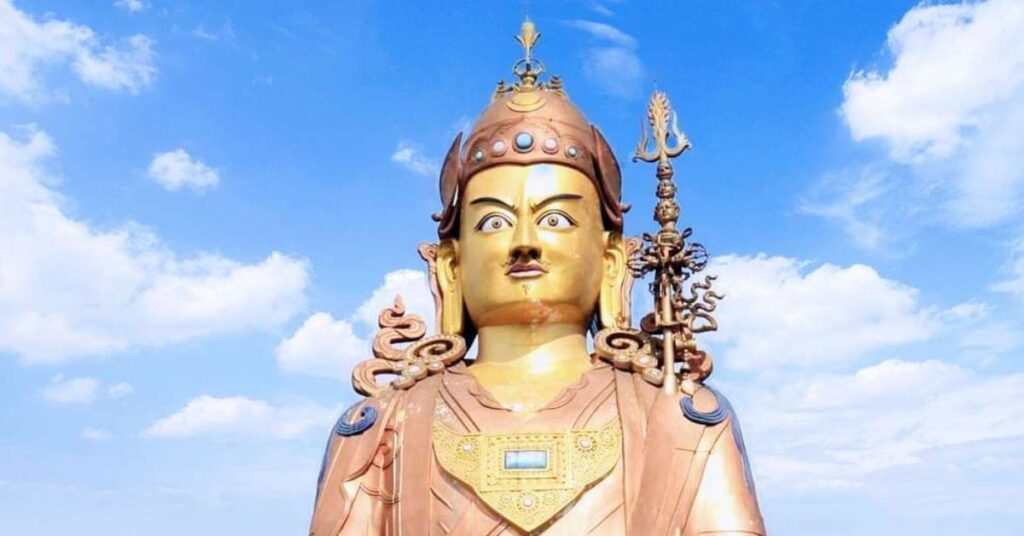
Ugyen Guru Lhakhang was built by Pangbi Lam in accordance with Guru Rinpoche’s prophecy in the 14th century. Terton Sherab Mebar was known as Pangbi Lam. The Lhakhang was named Ugyen Guru Lhakhang, dedicated to Ugyen Guru Rinpoche, the second Buddha.
Legend of Terton Sherab Mebar and Nub Tshona Patra
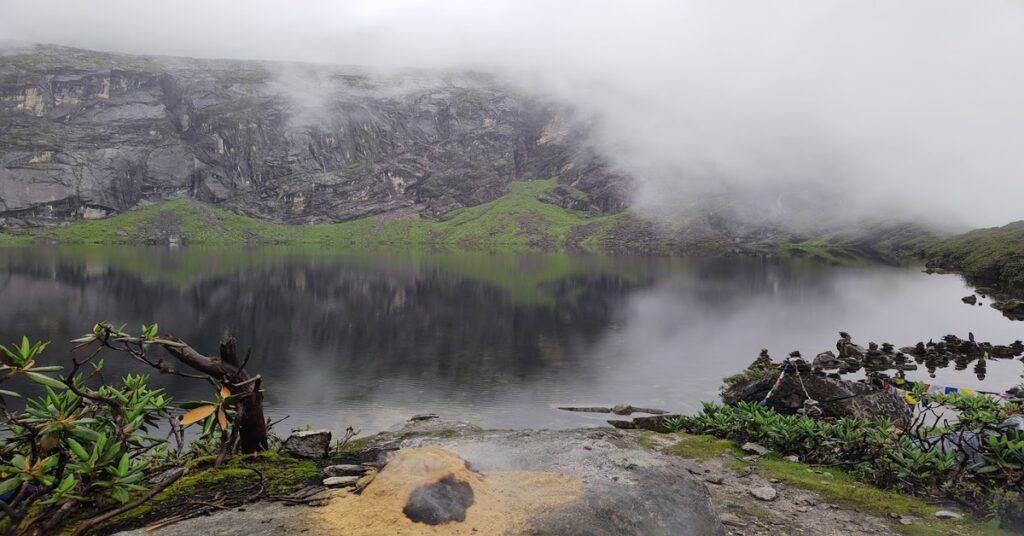
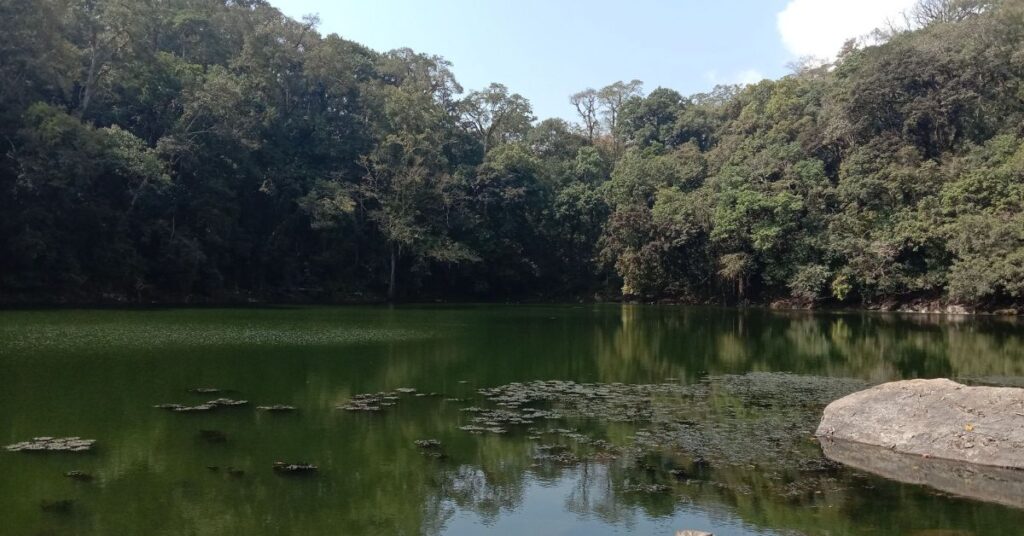
According to a legend, Terton Sherab Mebar had a vision of the treasures hidden in Nub Tshona Patra Lake, also known as Rigo Tsho. He set out on a mission to discover it with a group of carpenters from Paro. After reaching the lake, the Terton tasked the carpenters with recovering the religious instruments while he miraculously held all the lake in his mouth. However, extracting the golden pillar proved challenging. So, the Terton asked his carpenter to fell the pillar. As compensation, the carpenters were assured all gold fragments that fell off when chopping the pillar. The carpenters became greedy and began to axe the pillar so that large chunks of gold fell off the pillar.
The Terton wanted to stop the carpenters. However, he was unable to speak since his mouth was filled with the lake. His desperate attempt to communicate through hand signals was ignored. Finally, when the Terton opened his mouth to speak, the water gushed out and submerged all the carpenters. The lake then chased the Terton. Whenever the lake caught up with him, he dropped a treasure he had collected. Every time he dropped a treasure, a small lake formed, and the lake deity lagged.
Negotiation by Ap Chungdu
When the Terton was left with only one cymbal and a stone mongoose, Ap Chungdu, the guardian deity of the Haa Valley, intervened. Ap Chungdu negotiated and erected five border markers in the form of stacked stones, banning either from crossing the border demarcation. The border stones still exist today.
The cymbal (Relmo) Terton brought is presently kept as a sacred relic in Paro Rinpung Dzong. It is displayed during the Paro Tshechu festival, which takes place over five days during the second month of the Bhutanese lunar calendar. The Phurpa Ku (three-sided ritual dagger statue) and a stone mongoose are kept inside Pangbisa Ugyen Guru Lhakhang to this day as the sacred religious objects (Nangtens). Of many Nangtens, the following are of great significance to the temple.
Spoken Statue of Guru Rinpoche
The spoken statue of Guru Rinpoche is the central figure of Pangbisa Ugyen Guru Lhakhang. Drubthob Tenzin Zangpo sculpted this Guru statue. The statue is believed to have been sculpted on the stone slab where Terton Sherab Mebar sat and meditated.
Legend has it that the Drupthob sculpted the body of the Guru statue but couldn’t sculpt a proportionate head even after several attempts. Just then, two beautiful women came by and handed over a head of the Guru proportionate to the body and fitted to the statue. However, the Guru’s head tilted more towards the left and was hollow inside. So, Drubthop tried to straighten the head and tried to drill it to insert a relic inside. On both occasions, the Guru statue spoke, “Leave it as it is. It is good enough.” Even these days, if we tap the Guru head, we can hear the hollow sound.
The women then disappeared mysteriously. It is believed that they were Khandro Yeshe Tsogyal and Lhacham Mendarava.
Head Relic (Kudung) of Terton Sherab Mebar
The sacred head relic of the founder, Terton Sherab Mebar, is another important relic of Pangbisa Ugyen Guru Lhakhang. It is put on public display for veneration during major religious events. Terton passed away in Baylangdra, Wangdue Phodrang. The body (Kudung) was brought to Pangbisa after much resistance from the people of Baylangdra. However, the Paro Penlop was able to take it to Paro Dzong as a national treasure. But the people of Pangbisa stole the head of Terton Sherab Mebar to Ugyen Guru Lhakhang. The body preserved in the Marchey of Paro Rinpung Dzong perished during the 1907 fire.
Pangbi-reb
Pangbireb, a spiritual globule believed to have medicinal properties, is another attraction of the Lhakhang. It is made of the powder collected from the head relic of Terton Sherab Mebar. The Reip is reputed to cure any form of internal infection, including cancer.
The temple also has six stones with his handprints. One is a chunk of gold he took from Pasakha. They were his last legacy before he left for Wangdue and passed away at Baylangdra.
Description of Ugyen Guru Lhakhang
Ugyen Guru Goenzin Dratshang is a large rectangular building, oriented northeast toward the Paro valley. It is a bulky structure with large rabsel windows, a high two-tier jabzhi roof, and a single entrance facing northeast, covered by a porch. A gilded serpentine finial tops the structure, catching the rays of the rising sun. The typical dark-red khemar band runs along the exterior walls, interspersed with golden medallions depicting the “all-perfect ten,” a sort of stylized mantra.
Today, the temple serves as a Paro Pangbisa Ugyen Guru Goenzing Dratsang, a monastic school.
Best Time to Visit Pangbisa Ugyen Guru Lhakhang
The best time to visit Ugyen Guru Lhakhang in Paro Pangbisa is during the major religious event. During this time, visitors will have an opportunity to receive the blessings of the preserved head relic (kudung) of the founder, Terton Sherab Mebar, as well as the spoken Guru statue.
Frequently Asked Questions
Where is Ugyen Guru Lhakhang located?
The lhakhang is located in Pangbisa village, Paro district, Bhutan, surrounded by peaceful landscapes and traditional Bhutanese homes.
Why is Ugyen Guru Lhakhang important?
It is important because it is dedicated to Guru Rinpoche, who brought Buddhism to Bhutan. The temple is considered a powerful place for blessings, protection, and spiritual merit.
Who built Ugyen Guru Lhakhang?
Ugyen Guru Lhakhang was built by Pangbi Lam Terton Sherab Mebar in accordance with Guru Rinpoche’s prophecy in the 14th century.