
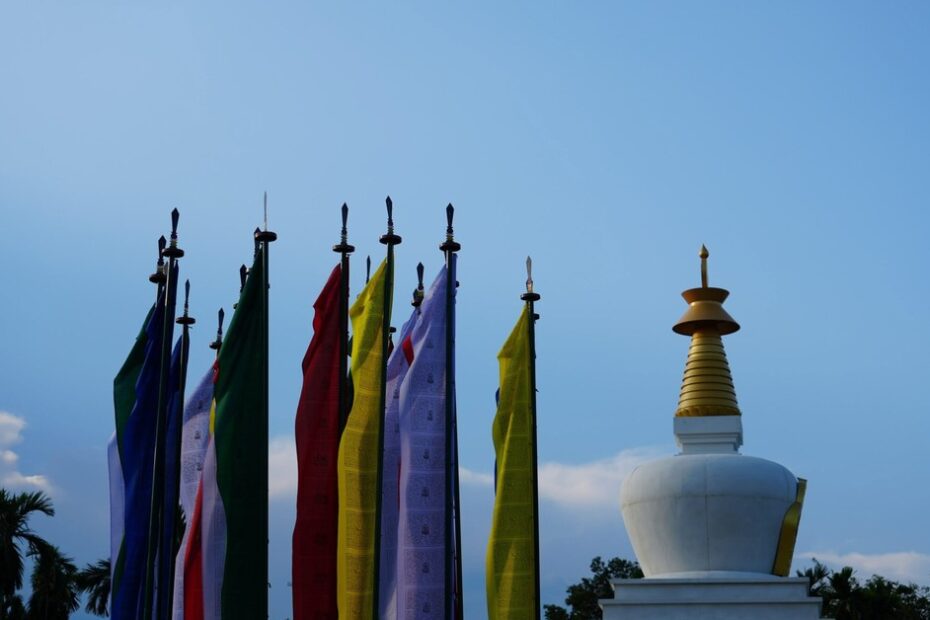
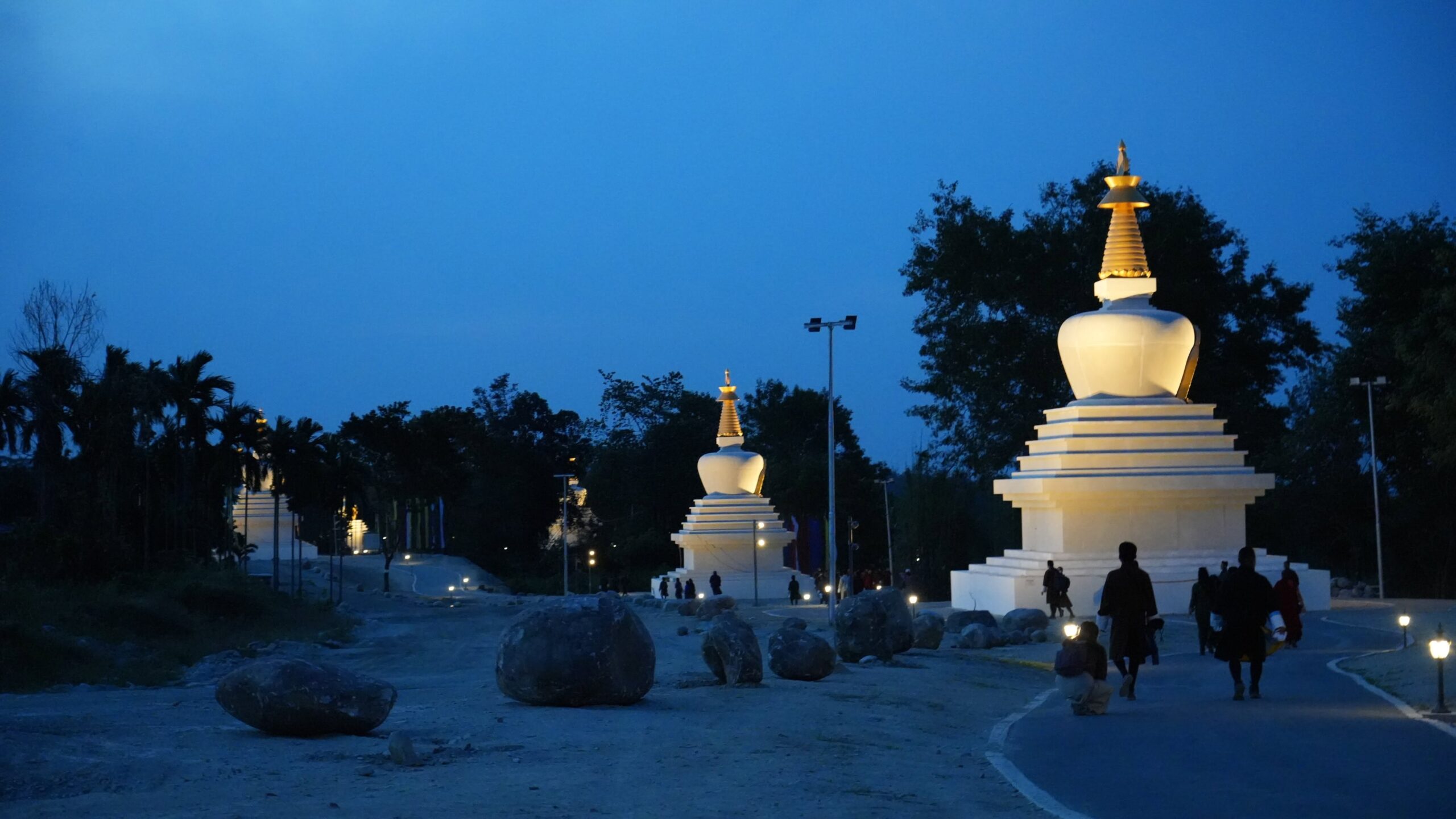
108 Stupas in Gelephu Mindfulness City, known as the 108 Jangchub Chortens, are among Bhutan’s most remarkable recent expressions of faith, unity and collective service. On 1 November 2026, an extraordinary national effort saw 108 sacred stupas, each standing 15 metres tall, raised together along the Mau Chhu (also referred to as the Aie River) in southern Bhutan.
Conceived under the vision of His Majesty King Jigme Khesar Namgyel Wangchuck, Project 108 brings together Buddhist symbolism, the Bhutanese tradition of zhabto (voluntary service), and a shared aspiration for peace and the wellbeing of all sentient beings.
Rather than standing together in one compact complex, the stupas form a long procession along the river corridor. Their scale and arrangement make Project 108 a distinctive spiritual landmark within the emerging Gelephu Mindfulness City (GMC), while the story of how they were raised is also a story of cooperation among thousands of Bhutanese people.
Location of the 108 Jangchub Chortens
The 108 Jangchub Chortens are located within Gelephu Mindfulness City in southern Bhutan, along the banks of the Mau Chhu, also identified in official reporting as the Aie River. The river corridor lies in the southern foothills close to the Bhutan–India border and the Indian state of Assam.
Each chorten is positioned approximately 108 metres from the next, measured centre to centre. Arranged in a single line, the 108 structures extend for about 11.7 kilometres, creating a spiritual procession that follows the river landscape rather than a cluster of monuments in one place. The Project 108 information describes the overall corridor as approximately 12 kilometres long.
The scale is striking: each structure rises 15 metres above the ground, and the full line brings together 108 sacred monuments across the landscape of GMC.
Background of Project 108
Project 108 is a Royal initiative conceived by His Majesty The King. The project was publicly announced on 21 February 2026, with the aspiration of raising 108 Jangchub Chortens together on an auspicious day. Preparations took place over several months, including clearing the sites, preparing foundations, arranging materials and coordinating volunteers across the 108 locations. As the official project account explains, the foundations and sites were prepared in advance so that the external structures could be raised together on the chosen day.
The project is more than a construction undertaking. In Buddhist tradition, the creation of a chorten is an act of devotion and merit, and a sacred structure is understood as a support for faith, reflection and the accumulation of virtue. The Project 108 initiative describes the chortens as sealed structures containing prayers, blessings and sacred texts, dedicated to the benefit of all beings.
His Majesty’s vision was also expressed through the collective nature of the work. In his address announcing the initiative, His Majesty emphasised what Bhutanese people can accomplish when they stand together. The project therefore carries both a spiritual meaning and a national message of unity, determination and shared responsibility.
Why 108? The spiritual significance
The number 108 holds deep significance across several Buddhist traditions. It is familiar to practitioners through the 108 beads of a prayer mala, the 108 volumes traditionally associated with the Kangyur, and devotional practices that involve reciting prayers or circumambulating sacred objects 108 times.
In Buddhist explanations, 108 is also associated with the defilements or afflictive emotions that obscure the mind and keep beings caught in samsara. The number can therefore serve as a reminder of the path of purification, wisdom and awakening. Its use in a sacred project is not simply numerical decoration; it gives the undertaking a recognisable spiritual framework.
In Project 108, the symbolism is made visible in the landscape: 108 chortens, each separated by 108 metres, forming one continuous line of prayer along the river. The repeated form invites visitors to reflect on the relationship between individual acts of devotion and a collective aspiration.
What is a Jangchub Chorten?
Jangchub Chorten may be understood as a Stupa of Enlightenment. In the Himalayan Buddhist tradition, chortens are sacred monuments that represent the enlightened mind and commemorate important events in the life of the Buddha. They are objects of veneration and supports for practices such as offering, prayer and circumambulation.
The Jangchub Chorten is associated with the Buddha’s enlightenment. Its form is not merely architectural: the proportions and components of a traditional stupa carry layers of Buddhist meaning. The Project 108 design uses a carefully articulated form whose elements are explained through symbols of compassion, wisdom, protection, the stages of awakening and the elements that support existence.
According to the project information, the structures are intended to contain prayers, blessings and sacred texts within their sealed cores. This makes each chorten a sacred receptacle as well as a visible monument.
The seven elements of the Jangchub Chorten
The official Project 108 design explains seven principal elements, read from the top down:
- Nyim-da – Moon, Sun and Flame: represents compassion, wisdom and their union.
- Dhug – The Parasol: symbolises spiritual protection from negative influences.
- Khorlo – The Thirteen Rings: represents the stages a practitioner passes through on the path to Buddhahood.
- Lhakhang – The Niche: holds an image of the Buddha, representing the presence of the enlightened mind.
- Bum-pa – The Dome: serves as a vessel for sacred relics and symbolises the pure body of the Buddha.
- Bangrim – The Stepped Base: represents the Four Noble Truths and the progressive path to liberation.
- Thri – The Pedestal: represents the earth element and the stable foundation of existence.
These explanations help visitors look beyond the physical size of the monuments and appreciate the spiritual ideas embedded in their design. The official Project 108 website provides an architectural illustration and further explanation of the individual components.
The historic raising on 1 November 2026
On 1 November 2026, all 108 chortens were raised on the same day in a coordinated effort across the river corridor. According to Akashvani / News On AIR’s report, the raising began at 3:00 am Bhutan time after traditional Buddhist prayers and rituals, with 58 sets of dungchen (long horns) sounding to mark the occasion. Teams worked simultaneously at the designated sites.
Official reporting described the participation of around 40,000 volunteers from across Bhutan. The event brought together people from different backgrounds and generations, alongside religious dignitaries and members of the Royal Family. The external structures were raised in a single day, following months of preparation at the individual sites. This distinction is important: the one-day achievement refers to raising the external structures, not completing every stage of the project’s preparation and religious observances.
The date was especially auspicious. 1 November 2026 coincided with Lhabab Düchen, the sacred day commemorating the Buddha’s descent from the heavenly realm, and the 18th Coronation Anniversary of His Majesty The King. The convergence of these occasions gave the ceremony a special place in Bhutan’s religious and national calendar.
The event was also attended by Buddhist masters and representatives from neighbouring countries. The Government of India’s Press Information Bureau reported that Stupa No. 76 was dedicated by His Majesty The King to the Prime Minister of India, recognising his support for Gelephu Mindfulness City.
Zhabto: the strength of collective service
One of the most meaningful aspects of Project 108 is the way it reflects zhabto, the Bhutanese tradition of voluntary labour offered for religious, community and public purposes. Across Bhutan, people have long come together to build and restore temples, monasteries, stupas, roads and other shared facilities. Such work is often understood not only as practical service but also as an act of devotion.
Project 108 brought this tradition to an extraordinary scale. The estimated 40,000 volunteers represented a broad cross-section of society. Their participation demonstrated how a large national undertaking can be carried forward through shared effort, coordination and a common spiritual intention.
For many participants, the significance of the day was not limited to seeing the stupas completed. It was also in being part of the work itself: preparing the sites, offering time and labour, supporting the teams and dedicating the merit of the undertaking for the wellbeing of others.
Visiting the 108 Stupas
The 108 Jangchub Chortens are a major spiritual landmark within Gelephu Mindfulness City and may become an important destination for Buddhist pilgrims, visitors and people interested in Bhutan’s living religious traditions. Their long riverside arrangement offers a different experience from visiting a single monastery or temple: the scale of the corridor encourages a slower approach and reflection on the meaning of the repeated sacred forms.
Visitors should remember that these are active sacred structures, not simply photo stops. When visiting, dress respectfully, speak quietly, follow any instructions from local authorities or custodians, and avoid touching or climbing on the monuments. If circumambulation is permitted, follow the customary direction and respect the space of people engaged in prayer.
Access note: The project’s public information describes the location and the overall corridor, but detailed visitor arrangements, access points, parking, walking routes and opening guidance should be confirmed locally before travelling. Gelephu Mindfulness City is developing, and visitors should not assume that every section of the river corridor is freely accessible or equipped with visitor facilities.
For travellers planning a wider spiritual visit to Gelephu, the 108 Jangchub Chortens can be considered alongside other sacred initiatives in the city. Read more about Ugyen Norlha Chorten, the symbolic gateway to Gelephu Mindfulness City, and Barchey Kuensel Chorten.
The 108 Stupas and the spiritual vision of Gelephu Mindfulness City
Gelephu Mindfulness City is envisioned as a new development model for Bhutan, bringing together economic opportunity, wellbeing, ecological responsibility and the country’s spiritual heritage. The 108 Jangchub Chortens give this vision a powerful religious expression. They place a large-scale sacred landscape within the wider development of a city intended to be shaped by mindfulness and harmony.
The project also signals that modern development and spiritual identity need not be separate. The chortens stand as a reminder that Bhutan’s future can draw strength from its Buddhist traditions, community values and relationship with the natural environment.
For Bhutanese people, the 108 Stupas will be remembered not only for their height or the distance they cover, but also for the collective effort that brought them into being. For pilgrims and visitors, they offer an opportunity to encounter a living expression of faith in a rapidly developing part of the country.
Explore Other Projects in Gelephu Mindfulness City
The 108 Jangchub Chortens are part of a wider landscape of spiritual, cultural and educational initiatives taking shape in Gelephu Mindfulness City. If you would like to learn about other projects, explore our published guides:
- Gelephu Chorten – a monumental stupa inspired by Jarung Khashor.
- Dorden Tashi Gomang Chorten – the planned monumental replica of Bodhgaya’s Mahabodhi Temple.
- Gelephu Maitreya Temple – a sacred temple dedicated to Maitreya, the future Buddha.
- Druk Ugyen Samye Ling – a spiritual centre inspired by the legacy of Samye Monastery.
- Drikung Kangyur Labyrinth – a space envisioned for walking meditation and contemplation.
- Kurukulle Centre – a living mandala dedicated to Jetsunma Kurukulle.
- Tara Retreat Center – a sacred place for spiritual practices centred on Tara.
- Kesang Do-ngag Shedrupling – an international Buddhist academy for higher Buddhist education.
- Gelephu Dzong (Shambhala Dzong) – a major dzong and Vajrayana centre envisioned for GMC.
- Spiritual Sites in Gelephu Mindfulness City – an overview of sacred landmarks and spiritual initiatives across the city.
These guides describe projects at different stages of development. Details, designs and timelines may change, so refer to the relevant project authorities for the latest official information.
Frequently Asked Questions
Where are the 108 Stupas located?
The 108 Jangchub Chortens are located within Gelephu Mindfulness City in southern Bhutan, along the Mau Chhu (Aie River) corridor.
How tall is each Jangchub Chorten?
Each of the 108 chortens stands approximately 15 metres tall.
How far apart are the 108 stupas?
The chortens are positioned approximately 108 metres apart, centre to centre, in a single line along the river corridor.
How long is the 108 Stupas corridor?
The line of chortens extends for approximately 11.7 kilometres, often described as an almost 12-kilometre spiritual corridor.
When were the 108 Stupas raised?
All 108 Jangchub Chortens were raised together on 1 November 2026, coinciding with Lhabab Düchen and the 18th Coronation Anniversary of His Majesty The King.
Who initiated Project 108?
Project 108 was conceived and led as a Royal initiative under the vision of His Majesty King Jigme Khesar Namgyel Wangchuck.
What does Jangchub Chorten mean?
Jangchub Chorten means Stupa of Enlightenment. It is a sacred Buddhist monument associated with the Buddha’s enlightenment and the enlightened mind.
Why are there 108 chortens?
The number 108 is sacred in Buddhist traditions and is associated with practices and teachings such as the 108 beads of a prayer mala and the 108 volumes of the Kangyur.
Can visitors visit all 108 Stupas?
The chortens form a long corridor of approximately 11.7 kilometres. Visitors should confirm current access arrangements, permitted routes and local guidance before travelling, as visitor facilities and access conditions may change during the development of Gelephu Mindfulness City.
Official information and further updates
For project details and official updates, refer to the Project 108 website and the Gelephu Mindfulness City website. You can also follow updates through the Gelephu Mindfulness City Facebook page and the Facebook page of His Majesty The King.