
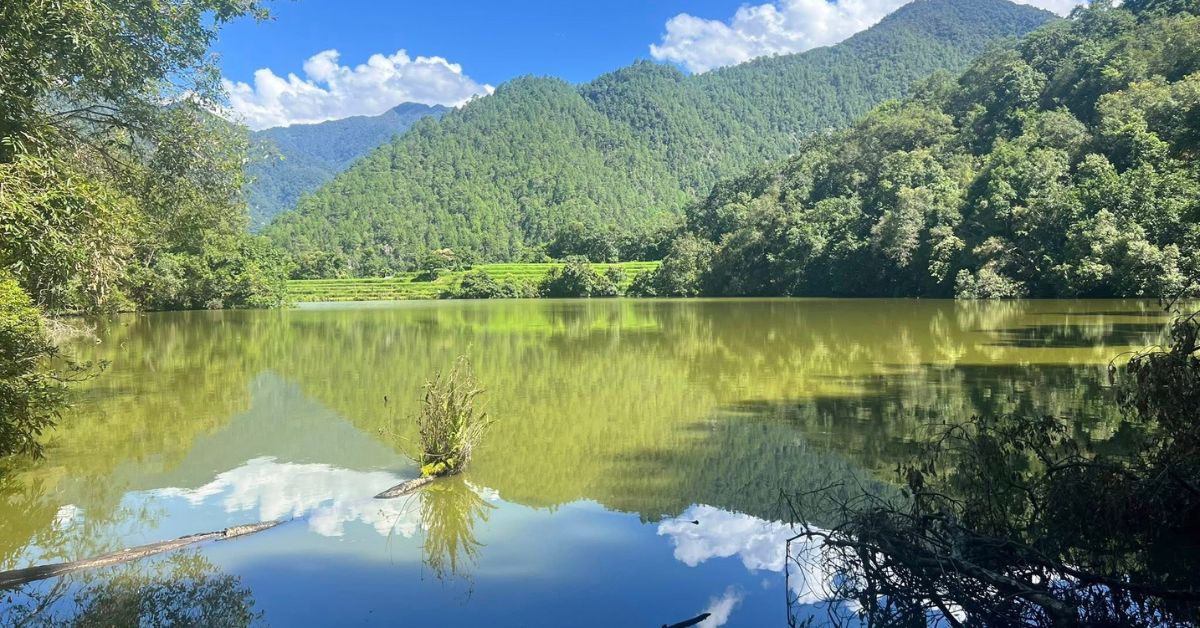
Athang Tsho, also known as Adha Tsho, is a sacred Tshomen lake that bestows blessings of wealth, beauty, and loyalty on devotees. It sits above Lopoka village on a plateau at the edge of several paddy fields, at an altitude of 1300 meters above sea level, in Athang Gewog, Wangdue Phodrang Dzongkhag.
The lake lies within Jigme Singye Wangchuck National Park and is an important habitat for the critically endangered White-bellied Heron and the Mountain Hawk-Eagle. It is also home to two fish species: Copper Mahseer and Common Carp.
How to Reach Athang Tsho
To reach Athang Tsho, drive to the Wangdue-Tsirang highway at Kamichu. From there, a farm road branches off to Athang, about a two-hour drive. Watch for a signboard as you descend from Laptsaka Pass to the Athang valley floor. Finally, after crossing the bridge, turn right at the junction and continue to the end of the road. Athang Tsho is a 10-minute walk from the parking lot.
Also Read: How to Reach Dangling Tsho, the Sacred Summer Abode of Meme Dangling
Athang Tsho hike and camping
The Athang Tsho hike is a 10-minute uphill walk through pristine broadleaf forest before the lake comes into view. This short trail is easy and surrounded by lush greenery and local birdsong.
For camping, Athang Tsho’s serene atmosphere offers a quiet, peaceful place to pitch a tent along the edges of local farmland. Because of its lower subtropical altitude, the climate is warm and pleasant. However, the campers must maintain high eco-tourism standards, leave no trace, avoid throwing anything into the water, and respect local religious sensitivities.
Also Read: Trek to Jo Bay Tsho, a Hidden Lake with a Golden Pillar in Haa
Athang Tsho History
Historically, the lake was located near Pelela Pass along the main mule track between Trongsa and Wangdue Phodrang. Traces of the lakebed remain there.
However, the lake’s deity (Tshomen) moved to a calm, peaceful area because commuters were increasingly disrupting it. Disguised as a young girl, Tshomen set out to find a peaceful sanctuary.
After an extensive search, she finally discovered Phagtakha Valley in the Athang Gewog. When she arrived, Tshomen sought shelter for the night in an old woman’s house. The old woman offered a room in her basement.
The next morning, a neighbor told the old woman that her paddy field had been flooded. She then rushed out of the house and, to her astonishment, found her rice fields covered by a huge lake, which we now call Athang Tsho. When the old woman went to check on the girl, she was gone. A small pool of water lay where her place had been in the basement. The old woman then realized the young girl was responsible.
Also Read: The History of Drakey Pangtsho, the Treasure Lake of Guru Rinpoche on the Lap of Jowo Drake
Legend of the White Horse
In her rage and grief over losing her fields and crops, the old woman tried to drain the lake but fell asleep on the shore from exhaustion. In her dream, a beautiful girl appeared from the lake and told her to stop feeling miserable. The girl begged the old woman to let her stay, saying she had found the place she longed for. In return, the girl offered a white horse that would lay a golden egg every month.
The girl instructed the old woman to feed the horse on time and collect the precious eggs in a container. She warned the old woman to keep the horse hidden and not to reveal it to anyone. The old woman agreed and accepted the offer.
When the old woman woke, she found a beautiful white horse standing beside her. She took the horse home and followed the instructions from her dream.
Slowly, the old woman grew wealthy, and people in the valley began talking about her mysterious fortune. However, the old woman revealed the secret when she accidentally said that she was in a hurry to feed her horse at one of the gatherings.
Also Read: Legend of Buli Tsho, a Promised Lake of Buli Moenmo Kuntu Zangmo
White Horse and Wangdzop of Wangdue Dzong
The Wangdzob (Governor) of Wangdue Phodrang Dzong also heard the unusual news of the old woman’s progressive success. He had sent a team of Chamberlains to investigate and instructed them to bring the mystical white horse if the news was true.
So, the chamberlains took the horse from the old woman. The men pushed and flogged the horse to the mountain, although it refused to move. It is said that the horse wept at the point where the Athang Tsho can last be seen, and that a small lake formed. The lake is still visible today.
From here, two myths emerge. One legend says that the horse was beheaded after it refused to move. A patch of land with unique reddish grass is believed to be the horse’s bloodstain after its hide was spread to dry. Two rocks are also said to be the mystical horse’s saddle and bridle.
The other version claims that the horse died of flogging and physical abuse. So, the Chamberlains took the saddle and bridle to Wangdzob as proof. Today, the saddle and sling are believed to be in Wangdue Dzong.
Also Read: Domendrel Tsho, where Gyalse Tenzin Rabgye offered Mandala Offerings.
Significance of Adha Tsho
Athang Tsho is significant as it is believed to be the Lhatsho of the Peling tradition. The Lhalung Sungtruel and Thukse Rinpoche lineage made a mandatory pilgrimage to Athang Lake until the late twentieth century. The second Gangteng Tulku is said to have discovered a pair of cymbals from the lake. Today, it is one of the sacred relics kept in the Goenkhang at Gangteng Monastery.
Locals credit the Tshomen with making Athang prosperous since ancient times, despite its very small population. Even today, devotees believe the sacred lake bestows blessings of wealth, beauty, and loyalty. When death or a pandemic is imminent, the lake is said to turn dark.
Also Read: Historical Significance of Mebar Tsho, the Burning Lake, where Pema Lingpa discovered Hidden Treasures.
Description of Athang Tsho
On your way to Athang Tsho, you’ll notice the site where the legendary horse collapsed and died from flogging and abuse. Here, the saddle and bridle rope have turned to stone, and there’s a patch of red grass representing the horse’s blood.
The lake covers 6 acres and is surrounded by broad-leaved forest to the east and west, and paddy fields to the north. This paddy field was submerged, creating Athang Tsho.
Just above the lake stands the house where the Tshomen sought shelter. The old woman’s descendants still live there today. Visit the house to see the small basement pool the Tshomen created.
Also Read: Nub Tshona Patra, the Treasure Lake of Terton Sherab Mebar
Best Time to Visit Athang Tsho
The best time to visit Athang Tsho (Lake Athang) is during the dry, pleasant months of autumn (September to November) and spring (March to May).
Also Read: The Best Time to Hike to Kabji-Hoka Tsho, a Lake with an Opening to Stop Overflowing
Frequently Asked Questions
What is Athang Tsho famous for?
Athang Tsho is famous for its natural beauty, spiritual significance, and connection to Bhutanese Buddhist traditions. Many believe it is a sacred lake, or Lhatsho, associated with the Peling tradition of Vajrayana Buddhism.
Where is Athang Tsho located?
Athang Tsho is located in Athang Gewog, Wangdue Phodrang District, Bhutan. The sacred lake lies above Lopoka village, near the Athang valley and surrounded by peaceful rural landscapes, paddy fields, and forested hills.
How do I reach Athang Tsho?
To reach Athang Tsho, travel along the Wangdue–Tsirang highway and take the farm road near Kamichu toward Athang Gewog. After reaching the lake area, visitors usually walk for approximately five minutes from the end of the motorable road.
How far is Athang Tsho from Thimphu?
Athang Tsho is approximately four hours by road from Thimphu, depending on weather, road conditions, and traffic. You can visit it as a long day trip, though staying overnight in the Wangdue or Athang area may offer a more relaxed experience.
Is Athang Tsho suitable for a day trip?
Yes, you can visit Athang Tsho on a day trip from Thimphu or nearby Wangdue Phodrang. However, travellers should start early, as the journey includes mountain and rural farm roads, and the lake has limited facilities.
Is there a hiking trail to Athang Tsho?
Athang Tsho is only a short walk (about five minutes) from where the road ends. The surrounding Athang valley also offers gentle walks, photography, and opportunities to explore Bhutanese villages and agricultural landscapes.
What is the legend of Athang Tsho?
According to local legend, the lake deity, known as a tshomen or lake woman, moved to Athang from another place where sacred values had been disrespected. This story underscores the lake’s spiritual importance to local communities.
What is the best time to visit Athang Tsho?
The best time to visit Athang Tsho is generally during spring and autumn, when the weather is more suitable for road travel and outdoor activities. Travellers should check local conditions before departure, especially during the monsoon and winter seasons.