
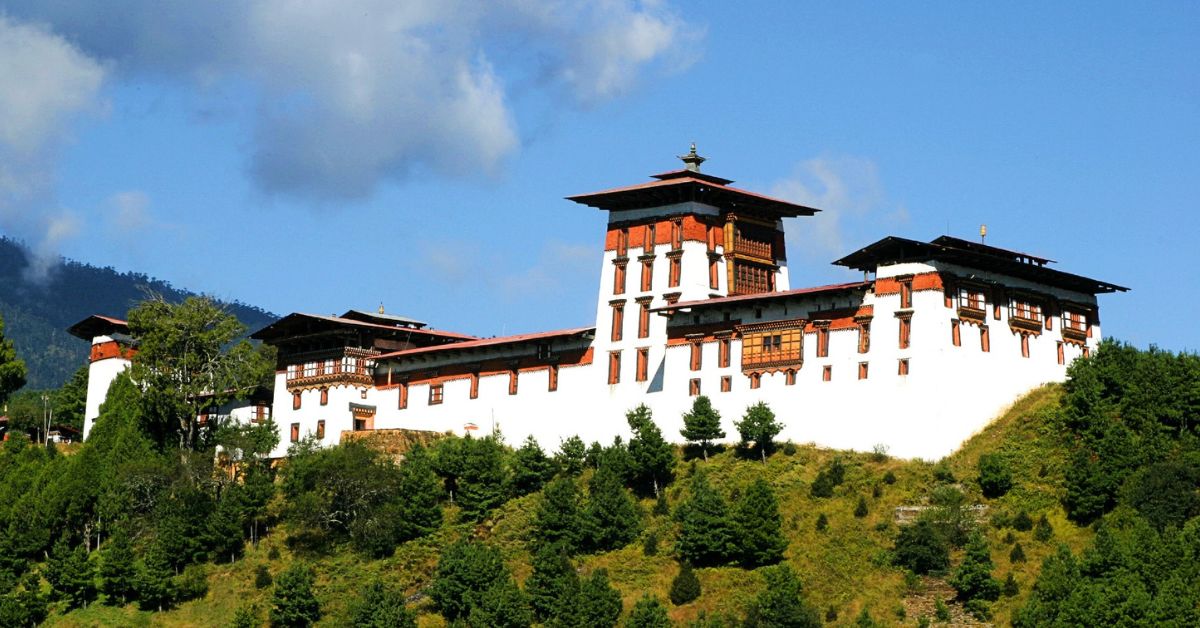
Jakar Dzong, also known as Jakar Yugyal Dzong or the Fortress of the White Bird, stands on a ridge above Jakar town in the Chamkhar Valley of Bumthang. The monastery is traditionally dated to 1549 and associated with Lam Ngagi Wangchuk, the great-grandfather of Zhabdrung Ngawang Namgyal. The white-bird legend remains part of the dzong’s identity and explains its memorable name.
Planning a visit to Jakar Dzong?
Jakar Dzong remains an active administrative and monastic centre. Contact Bhutan Pilgrimage for help planning your visit, checking access arrangements and exploring the sacred sites of Bumthang.
WhatsApp UsIts best-known architectural features are the approximately 50-metre-high Utse, or central tower, and the Chhu Dzong, a protected passage that provided access to the water source during a siege.
Jakar Dzong served as an important defensive fortress during the Tibetan invasions of the 17th century. Today, it continues to house district administration offices and the Bumthang monastic body. It is also the setting for the annual Jakar Tshechu, when the courtyard becomes a gathering place for people from across the valley.
Table of Contents
How to Reach Jakar Dzong
Jakar Yugyal Dzong stands about 2 kilometres from Chamkhar town. Visitors can drive towards the base of the ridge and continue on foot along the uphill stone approach, which takes around 15 minutes. The walk is short but moderately steep in places. The drive from Thimphu to Bumthang is a long journey, commonly taking around nine hours or more depending on road conditions, weather and stops.
Important Features and Sacred Images
- Images of Dolma (Tara), Chenrezi (Avalokiteshvara) and Mithukpa (Akshobhya) are associated with the sacred temples of the dzong;
- The approximately 50-metre-high Utse, or central tower;
- The protected Chhu Dzong passage leading to the water source;
- The two courtyards and the half-round Ta Dzong, or watchtower.
History of Jakar Dzong
The origins of Jakar Dzong are closely linked to Lam Ngagi Wangchuk, the great-grandfather of Zhabdrung Ngawang Namgyal.
Local tradition places the founding of the monastery in 1549, when Lam Ngagi Wangchuk established a small religious centre on the ridge. The story of the white bird is central to the site’s identity: its appearance and choice of resting place were taken as a sign that the hill was auspicious. The name Jakar is remembered through this “Fortress of the White Bird” tradition.
A related oral account says the first temple was built at a less strategic location on the eastern side of the valley. Lamas, astrologers and village elders later gathered to choose a stronger position. During their discussion, a white bird rose into the air and settled on the ridge above Chamkhar. They regarded this as an auspicious sign and selected the hill for the monastery that became Jakar Dzong.
The monastery gradually developed into a fortified dzong. During the 17th century, as Bhutan’s political and military structures took shape, the complex was enlarged and strengthened. The present fortress is commonly dated to 1667, although the dzong continued to undergo repairs and renovations in later periods.
Tibetan Invasions and the Dzong’s Role
Local accounts remember three major Tibetan attacks on Jakar Dzong during the 17th century.
Jakar Dzong was an important defensive stronghold during the conflicts of the 17th century. Local historical accounts describe three major Tibetan incursions and remember the fortress as a key point in protecting the eastern region. The stories also explain the victory names associated with the dzong.
One account describes an early attack by forces sent by the ruler of Tsang, Phuntsho Namgyel, against Zhabdrung Ngawang Namgyal. Jakar Dzong was damaged during the conflict, but the Bhutanese forces prevailed. The victory is associated with the name Yuelay Namgyal Dzong.
Another local account recalls an attack after a Bumthang chieftain fled to Tibet and returned with an army. The defenders are said to have sought help from the protecting deities, Choe Chong Chamdal Sum. In the story, a gun mounted at a dzong window turned towards the enemy camp and fired, killing two commanders and causing the Tibetan troops to retreat. The victory is remembered in the name Jakar Thobgyal Dzong; thob means “to obtain” and gyal means “victory”.
In the third major conflict described in local historical accounts, Tibetan forces advanced from several directions during the reign of the third Druk Desi, Minjur Tempa. Drongmedpa Thinley Jamtsho initially led the Bhutanese forces, and Lam Ngawang Rabten later arrived with additional troops. The Bhutanese victory is associated with the name Yugyal Dzong. Over time, the names Jakar and Yugyal came together as Jakar Yugyal Dzong, the Victorious Fortress of the White Bird.
Renovations of Jakar Dzong
Jakar Dzong was expanded and renovated over several periods. Its history is associated with Yab Tenpai Nyima, Desi Minjur Tempa and Gyalsey Tenzin Rabgye. The dzong suffered severe damage in the 1897 earthquake and was subsequently restored under the leadership of Ugyen Wangchuck, who later became the First King of Bhutan.
Description of Jakar Yugyal Dzong
The principal sacred images traditionally associated with the dzong include Dolma, Chenrezi and Mithukpa.
Jakar Dzong is approached by a stone-paved staircase leading into its courtyards, which are framed by administrative and monastic buildings. The fortress has two courtyards and an outer wall extending for more than 1,500 metres. Its most distinctive features are the approximately 50-metre-high Utse and the protected Chhu Dzong water-supply passage.
The Utse, or central tower, rises approximately 50 metres and is attached to the eastern wall. Unlike the central towers of many other dzongs, it stands against the outer wall and cannot be circumambulated. The upper floor houses the Gonkhang, or protector temple; access to interior spaces depends on local arrangements.
The Chhu Dzong is another remarkable feature. It is a sheltered passage formed by two parallel stone walls, leading from the dzong towards a nearby spring. This protected route helped secure access to water during a siege, an important advantage for the people sheltering inside the fortress.
At the western end of the fortress is a second courtyard, slightly larger than the first and also surrounded by administrative buildings. Beyond it stands the distinctive half-round Ta Dzong, or watchtower.
Jakar Tshechu Festival
Jakar Tshechu is an annual religious festival held at Jakar Dzong during the ninth month of the Bhutanese lunar calendar. The programme includes sacred mask dances (cham), folk songs and traditional dances. The exact Gregorian dates vary each year. The tentative festival calendar for 2027 lists 6–9 November; check for confirmation before arranging your journey. The festival is a wonderful opportunity to see the courtyard filled with local people in their finest traditional dress.
Best Time to Visit Jakar Dzong
March to May and September to November are generally pleasant periods for exploring Bumthang. Autumn is especially popular because several important festivals take place across the valley. If you plan your visit around Jakar Tshechu, check the festival dates for that year and allow time for the other temples and sacred sites nearby.
Visitor Information and Etiquette
Jakar Dzong is not simply a historic monument; it continues to serve as an administrative centre and a home for the monastic community. The areas available to visitors may therefore change depending on religious activities and official work. Follow local guidance and do not enter restricted rooms or temples.
Dress modestly, covering your shoulders and knees. Remove your shoes before entering temples and maintain a quiet, respectful manner in sacred spaces. Ask before taking photographs, especially inside temples or during religious activities. The stone approach and stairways are uneven and steep in places, so wear comfortable footwear and take care when walking.
Other Sacred Sites to Explore in Bumthang
If you are exploring Bumthang, you can combine Jakar Dzong with nearby sacred places. Discover Kurjey Lhakhang, Jambay Lhakhang, Tamzhing Lhakhang, Thangbi Lhakhang and Mebar Tsho. These places offer a fuller sense of the sacred landscape of the Choekhor Valley.
Conclusion
Jakar Dzong began as a monastery associated with Lam Ngagi Wangchuk and grew into one of the important defensive and administrative centres of central and eastern Bhutan. Its distinctive Utse, protected water passage and commanding position above the Chamkhar Valley make it one of Bumthang’s most recognisable landmarks.
Frequently Asked Questions
What is Jakar Dzong?
Jakar Dzong, also known as Jakar Yugyal Dzong or the Fortress of the White Bird, is the historic fortress and monastic centre overlooking Jakar town and the Chamkhar Valley in Bumthang.
Why is Jakar Dzong called the Fortress of the White Bird?
Local tradition says that a white bird settled on the ridge while a site for a monastery was being chosen. The bird was regarded as an auspicious sign, and the ridge became the site of Jakar Dzong.
Who founded Jakar Dzong and when?
The monastery at the site is traditionally dated to 1549 and associated with Lam Ngagi Wangchuk, the great-grandfather of Zhabdrung Ngawang Namgyal. The fortress was expanded and strengthened in later periods.
How long does it take to walk up to Jakar Dzong?
From the base of the ridge, the uphill walk along the stone approach takes around 15 minutes. The path is short but moderately steep and uneven in places, so wear comfortable footwear.
Can visitors enter Jakar Dzong?
Visitors may be able to explore designated areas, but Jakar Dzong remains an active administrative and monastic centre. Access to particular buildings and temples can vary, so check locally and follow your guide’s instructions.
When is Jakar Tshechu held?
Jakar Tshechu is held annually at Jakar Dzong during the ninth month of the Bhutanese lunar calendar. The Gregorian dates change each year. The tentative 2027 festival calendar lists 6–9 November; confirm dates before making travel arrangements.
What are the main architectural features of Jakar Dzong?
Its distinctive features include the approximately 50-metre-high central tower or Utse, the protected Chhu Dzong water-supply passage, two courtyards and a half-round Ta Dzong watchtower.
Explore Bumthang
Make your Bumthang pilgrimage more meaningful
Combine Jakar Dzong with the valley’s ancient temples, monasteries and sacred sites. Contact Bhutan Pilgrimage for help planning your route and local arrangements.
Plan Your Bumthang Visit