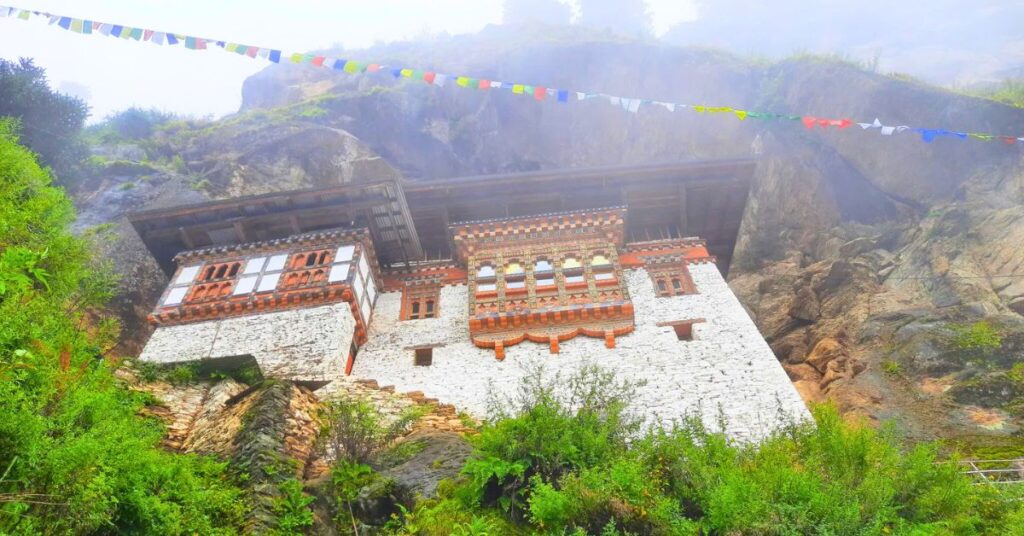
RaGoe Ney is a sacred place blessed by Guru Rinpoche in the 8th century, where the Guru Sungjoen Statue, brought by a goat and a vulture from Punakha, was destined. The Ragoe Monastery is located in Doteng Gewog under Paro Dzongkhag at about 2839 meters above sea level.
Later, Drupthob Thongtong Gyalpo built Ragoe Guru Lhakhang in the 15th century on the sacred site. There are many sacred objects to see, including the holy waters and sacred meditation caves. You can contact Lam Karma Dawa at 17495398.
How to Reach Ragoe Ney
The Ragoey Ney temple is in Doteng Gewog, Paro. The Monastery is a 45-minute drive from Paro town to the base and an hour’s hike uphill. A motorable road to Chhukhor Chorten connects it at the temple’s base. The distance is around 13 km.
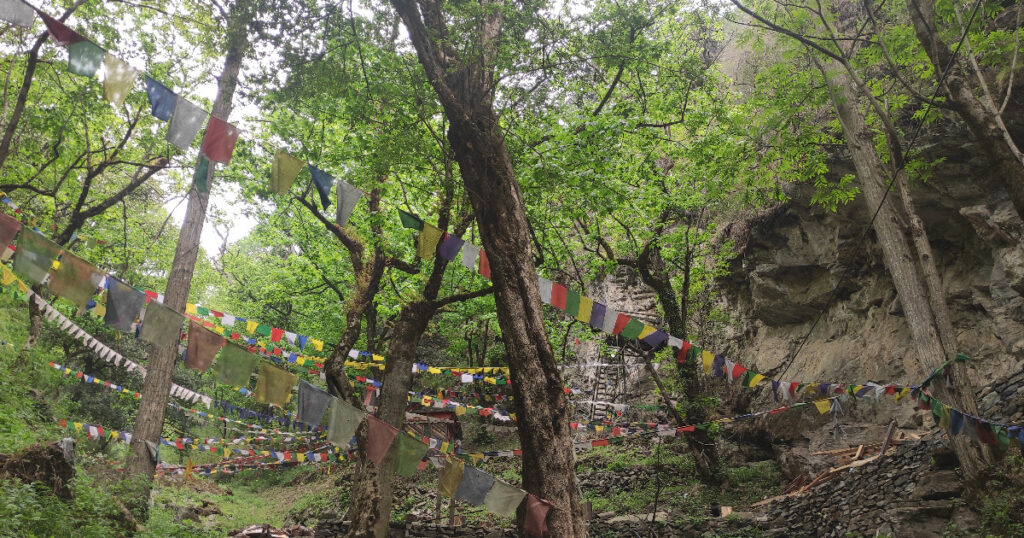
From the base, it is an easy trail even for passive hikers. You have to ascend 319m through pine, hemlock, and oak forests for a distance of 2 km. Pilgrims will be blessed with many self-arisen sacred objects on the trail as they hike from Chhukhor Choeten to Ragay ney.
At a leisurely pace, it’s an hour’s hike uphill from the base to the monastery. You can also come from Sangchoker or Taktsang Monastery in one day.
If you get time, you can hike to Bumdra Monastery on the refreshing trail within 2 hours from Ragoe Monastery.
Sacred Relics to See at Dop Ragoe Ney
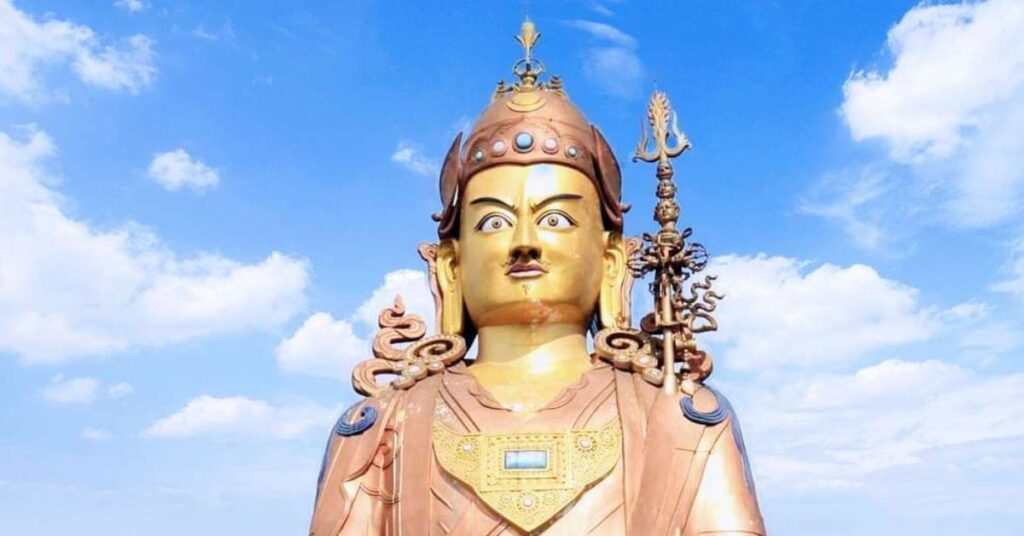
- A statue of Guru Sungjoen (A self-spoken statue of Guru Rinpoche);
- A footprint of Guru Rinpoche;
- Guru Rinpoche’s lotus hat;
- A walking stick of Guru Rinpoche;
- Footprints of Dakinis
- Meditation cave of Namkhai Nyingpo;
- The body of a mountain goat;
- The body of a vulture;
- Selwa Tshel crematorium;
- The footprint of Balaha (Guru Padmasambhava’s horse);
Also Read: Guru Rinpoche in Bhutan: His Visits to Bhutan and Sacred Sites
Historical Significance of Ragoe Ney
Ragoe Ney is a sacred site blessed by Guru Rinpoche. It is believed that Guru Rimpoche came from Taktsang and meditated at Ragay in the 8th century. The sacred cliff of Ragoed is described in the text of the holy site as ‘the black cliff facing the south, has the shape of a crescent with a hat-like shape on top, the base similar to that of a beautiful lotus’. The site is revered as the second ‘copper paradise’ of Guru Rinpoche, owing to the landscape’s features that match every sacred description of the paradise.
There is an interesting story behind this sacred site. One day, a man left his home to look for his cattle in the forest, and soon after, his wife gave birth to a baby boy. As he neared the Ragay Ney site, he heard sounds of some wild animals fighting. But as he moved closer, all those sounds turned into melodies of ritual musical instruments. Wondering what was happening, he moved closer to check and coincided with the opening of the sacred door to the holy site. He went inside, and the door closed again. When he came out of shock and thought of his wife and the baby back home, the cave door reopened.
When he returned to his village, he saw an old man plowing his field. He asked the old man who he was. As the conversation went on, he recognized the man was none other than the infant son he had left behind.
Why was the RaGoe temple built?
Long ago, leprosy was rampant in the hamlets of Paro, causing suffering and taking many lives. To cure leprosy, residents from all of the villages performed sacrifices. They prayed to Jowo Drake, the protector deity of Paro, and Ap Chundu, the protector deity of Haa, but in vain.
Unable to help the people of Paro, these two deities pleaded with Drubthob Thangthong Gyalpo for assistance. The Drubthob discovered that an alarming formation of a sleeping tortoise on the mountain ridge above the hamlet of Paro caused the epidemic. The tortoise faced RaGoe with its right foot and Phug Shar with its left foot. Drubthob constructed the temple of Selma in the sleeping tortoise’s mouth in a day by holding the sun with a rope to subdue evil and as a cure for leprosy.
Why was the Temple named RaGoe?
In the 17th century, Drubthob Phuentsa Dewa, who was a Jinzop of Zhabdrung Rinpoche, sculpted the copper statue of Guru Rinpoche at Thang Zo in Punakha to be placed as the sacred relic at Goen Tshephu Ney. However, when the people attempted to carry the statue to the Ney, they could not move it. So, they decided to carry the statue by dismantling it into parts. But then, the statue said that its main site is in Paro Ragoe, not Punakha Goen Tshephu.
People carried the copper statue of Guru Rinpoche to Paro Jela Dzong and couldn’t decide on the statue’s final destination in Paro. They waited there. Then a vulture came and carried the statue to the site below present-day Ragoe Monastery and placed it on a big flat rock there. From there, a goat carried the statue to the present site. That is how the Lhakhang is named “RaGoe,” after a goat and a vulture carried the copper statue of Guru Rinpoche to his prophesied location.
While maneuvering their way along the rocky path, the statue is believed to have spoken for the second time: ‘Turn to the right’, ‘Turn to the left’, to avoid getting hit on the rocks. Sculptured by Pentsa Dewa in Punakha Dzong, the other two statues of Guru Rinpoche who spoke are those of Goen Tshephu Ney and Paro Taktsang.
Description of Ragoe Ney
When you walk five minutes from ChhuKhor Chorten towards the Ragoe Ney, you will come across a huge rock, a cypress tree, and a tiny water pond at the base of the rock.
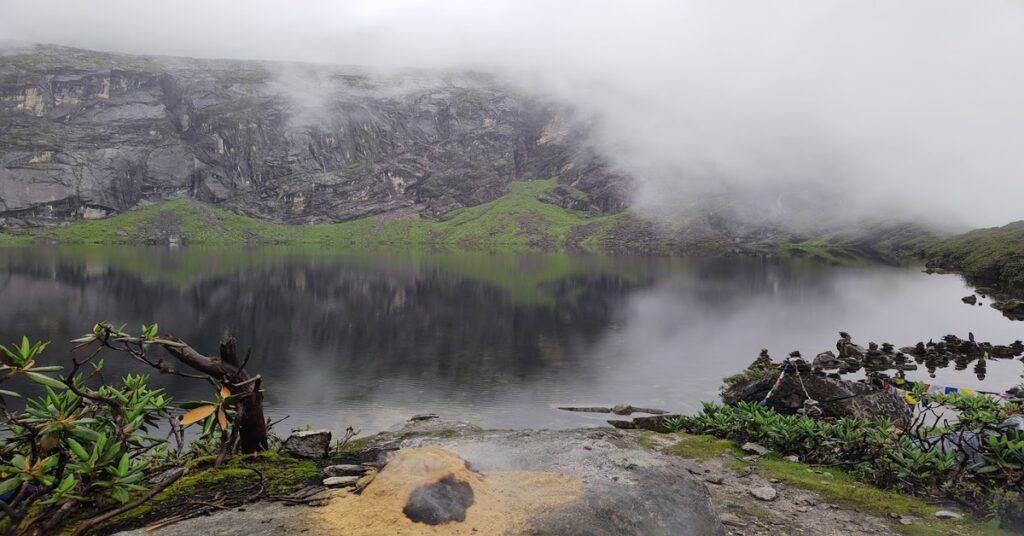
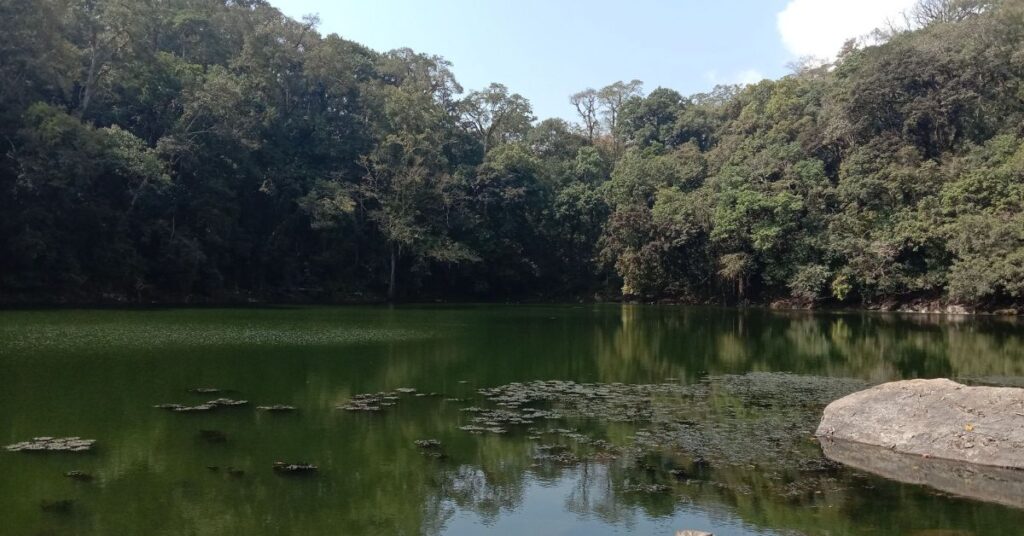
According to history, the rock represents Guru Rinpoche’s lotus hat, the cypress represents his walking stick, and the water pond means a lake that is home to a serpent. Legend has it that when Guru Rinpoche first arrived at this location, he pierced the ground with his walking stick, causing the serpent to emerge from the lake. Guru then covered the lake with his hat, leaving a small area uncovered where the serpent attempted to escape, but before it could, Guru subdued it. Pilgrims can still clearly see the tamed serpent and the small area of the uncovered lake.
The cliffs to the left of the temple are thought to represent Terdha Gyalpo, the guardian deity of RaGoe, whereas Jachung (Garuda) is located at the top of the cliff. There are two holy water sources: one to the right of the temple is thought to be the Drupchhu of Bumdra that has made its way to RaGoe, while the other to the left is believed to be the water gushing from the protective deity’s nose (Shang Chhu).
Also Read: Drupchhu or Holy Spring Waters in Bhutan: Beliefs and Benefits
Near the temple, we can see the meditation site of Guru Rinpoche, the meditation site of his consorts, the skin of an ogress subdued by Guru Rinpoche, and the footprints of Dakinis. In front of the temple, on the cliff face, are the impressions of Guru Rinpoche’s riding steed (Tachog Bhalaha), a stupa of enlightenment, and others.
Ragoe Guru Lhakhang
The Sacred Ragoe Guru Lhakhang is in Atsho-Phunum village at the top of Dotey Gewog. Ragoe is bordered to the north by Chumphu Nye and to the east by the revered temples of Chidue Gonpa and Selchhu Phug.
Ragoe Guru Lhakhang is a traditional Bhutanese-style building built against the cliff face. The main Relic of the Ragoe monastery is Guru Sungjoen, a self-spoken statue of Guru Rinpoche brought from Punakha by a Goat and a Vulture. It is believed to have spoken twice. Several sculptures can be found on the altar, including those of Chana Dorji, Jetsun Milarepa, Zhabdrung Ngawang Namgyal, and Terton Pema Lingpa with Guru Tshokhor Sum, which includes Guru Rinpoche, Khandro Mandharava, and Khandro Yeshey Tshogyel in the center.
The temple wall has the paintings of Tshelha Nam Sum/Trinity of longevity or long life, Guru Rinpoche, Chenrigzi/Bhuddhisattva of compassion, and the Sixteen Arhats.
Lopen Tshewang Tenzin built the temple on top of the Guru’s meditation cave after he had a vision of Guru Padmasambhava while meditating in the cave underneath. Lopen Tshewang Tenzin became a Drubthob and later attained rainbow light (Jaale Drup) there. The main image in the temple is Ugyen Dorji Gur, and others are Buddha Shakyamuni, Guru Dragmar, Vajradhara, Arya Avalokiteshvara, Zhabdrung Ngawang Namgyel, Kuenkhen Pema Karpo, Je Sherab Gyeltshen, and Jow Drakyepa.
Best Time to Visit the Ragay Monastery
Dop Ragoe Ney is always open to all. However, weekdays are best for getting the most time and attention. Auspicious days are typically the best times for pilgrimage, but there isn’t a single best time. So, enjoy your pilgrimage to one of the many legacies of Guru Rinpoche. You can visit major pilgrimage sites in Paro with the Bhutan Pilgrimage Package.
Frequently Asked Questions
What is Ragoe Ney?
Ragoe Ney is a sacred Buddhist pilgrimage site in Doteng Gewog, Paro Dzongkhag, blessed by Guru Rinpoche in the 8th century. The monastery sits at around 2,800–2,840 meters above sea level and is renowned for the self-spoken statue of Guru Sungjoen, which tradition says was brought from Punakha by a goat and a vulture.
Where is Ragoe Ney located?
Ragoe Ney (Ragoe Monastery or Ragoe Guru Lhakhang) is in Atsho-Phunum village at the top of Doteng Gewog under Paro Dzongkhag. It lies about 13 km from Paro town, with a motorable road reaching Chhukhor Chorten near the temple base.
How do I get to Ragoe Ney from Paro?
From Paro town, drive roughly 45 minutes (about 13 km) to the base near Chhukhor Chorten. From there, follow an easy 2 km uphill trail through pine, hemlock, and oak forest, ascending around 319 meters to the monastery. The hike typically takes about an hour at a leisurely pace.
Is there vehicle access all the way to Ragoe Ney?
Vehicles can go up to Chhukhor Chorten at the base of the monastery. The final approach to Ragoe Guru Lhakhang is on foot via a well-defined trail, which is considered easy and suitable for most pilgrims and casual hikers.
What are the main sacred objects at Ragoe Ney?
Visitors can venerate several holy relics, including the self-spoken statue of Guru Sungjoen, Guru Rinpoche’s footprint, his walking stick, and the footprint of Balaha (Guru Padmasambhava’s horse). The site also features holy waters and sacred meditation caves linked to Guru Rinpoche’s 8th-century meditation.
Who founded Ragoe Monastery?
While the site was blessed by Guru Rinpoche in the 8th century, the Ragoe Guru Lhakhang was built by Drupthob Thongtong Gyalpo in the 15th century on this sacred ground. The monastery has since served as an important pilgrimage destination in Paro.
How difficult is the hike to Ragoe Ney?
The hike is considered easy to moderate: about 2 km uphill with an elevation gain of roughly 319 meters through forested trails. Most visitors, including families and older pilgrims, can complete it comfortably in around an hour at a relaxed pace.
Are there facilities or accommodation at Ragoe Ney?
Ragoe Ney is primarily a pilgrimage monastery with basic facilities for worship and rest. For overnight stays, most visitors base themselves in Paro town and make a day trip to the site, combining it with other nearby sacred places.
What should I wear or bring for a visit to Ragoe Ney?
Dress modestly and comfortably for a short forest hike: sturdy shoes, layered clothing, and rain protection depending on the season. Carry water, a small snack, and offerings if you plan to pray or make donations at the temple.
Is Ragoe Ney suitable for families and older pilgrims?
Yes. The trail is short, well-trodden, and not technically demanding, making it suitable for families, seniors, and passive hikers. The combination of a short drive and an easy uphill walk makes it a popular half-day pilgrimage from Paro.