
The Lotus-Born Trail, also written Lotus Born Trail and sometimes called the Padmasambhava Trail, is a developing pilgrimage and cultural heritage route in Bhutan. Planned to cover approximately 150–200 kilometres, it connects Gelephu Mindfulness City in southern Bhutan with Kurjey Lhakhang in Bumthang, passing through the landscapes and communities associated with Guru Rinpoche’s sacred journey. The route rises from subtropical lowlands towards the forests and high valleys of central Bhutan.
If you are exploring pilgrimage beyond this developing route, our Bhutan Pilgrimage Guide introduces sacred destinations and pilgrimage traditions across the country.
Planning a Visit to the Lotus-Born Trail?
Ask us about the trail’s current access, available itinerary, local guide arrangements and how to include Guru Rinpoche’s sacred places in your Bhutan pilgrimage.
The route is inspired by Bhutanese Buddhist accounts of Guru Rinpoche, also known as Padmasambhava or Ugyen Guru Rinpoche. It is presented as a way to connect places associated with his journey, meditation and blessings. The project’s published itinerary describes a seven-day journey and an eight-day variation, but the full route is still under development. This guide distinguishes the project’s proposed route from confirmed visitor access and explains what pilgrims should check before making plans.
Table of Contents
Spiritual Significance of the Lotus-Born Trail
Guru Rinpoche is revered in Bhutan as the Second Buddha and as a master central to the spread of Vajrayana Buddhism. His image is found in temples, monasteries and homes throughout the country. Bhutanese religious biographies and local oral traditions associate him with visits to sacred places, meditation, the subduing of obstructing forces and the blessing of landscapes that later became important pilgrimage destinations.
The Lotus-Born Trail brings this sacred geography into a single proposed walking route. Its purpose is not simply to create a long-distance trek. It is presented as a form of neykor — a pilgrimage circuit in which walking between sacred places becomes part of religious reflection and devotion. For a wider account of the traditions surrounding the Guru’s visits, read our guide to Guru Rinpoche in Bhutan and his sacred pilgrimage sites.
The route also connects a new spiritual vision with older centres of Buddhist practice. At the southern end, Gelephu Mindfulness City is developing as a place where mindfulness, conservation and spiritual heritage form part of its wider vision. The 108 Jangchub Chortens in Gelephu are among the sacred landmarks associated with this emerging spiritual landscape. At the northern end, Kurjey Lhakhang in Bumthang is one of Bhutan’s most revered religious sites.
Meaning of the Name Lotus-Born
Padmasambhava is a Sanskrit name commonly translated as “Lotus-Born”. Bhutanese devotees know him as Guru Rinpoche, meaning “Precious Master”, and also as Ugyen Guru Rinpoche. Traditional biographies describe his miraculous appearance as an eight-year-old child seated on a lotus in Lake Dhanakosha in the land of Oddiyana. The location of Oddiyana is interpreted differently in historical and religious scholarship, and the traditional account is best understood within its Buddhist context.
The route’s name appears in several forms, including Lotus-Born Trail, Lotus Born Trail and Padmasambhava Trail. The destination is also written as Kurje or Kurjey. These spelling variations are common in English-language writing about Bhutanese sacred places.
The Sacred Route: From Gelephu to Kurje
The project’s published account describes the trail as beginning in the southern plains around Gelephu and continuing north through Nabji Korphu and central Bhutan before reaching Kurjey Lhakhang in Bumthang. The route is intended to link sacred sites and communities associated with Guru Rinpoche, while passing through a changing sequence of landscapes — from subtropical forest and warm lowland settlements to temperate woodland, rhododendron forest and higher mountain terrain.
There are different traditional accounts of Guru Rinpoche’s journeys into Bhutan. The Lotus-Born Trail project presents an entry through the southern plains of present-day Gelephu, followed by a journey through Nabji Korphu. Other Bhutanese religious narratives place his first visit in the context of his journey from Nepal to Bumthang at the invitation of King Sindhu Raja, with Nabji Korphu forming an important part of the sacred story. Our guide to Nabji Lhakhang and the stone pillar of oath explores this local tradition.
These accounts should not be treated as a modern surveyed travel record. The detailed routes of Guru Rinpoche are preserved through religious biographies, treasure traditions and oral histories, and they can differ in chronology and geography. The trail is therefore best understood as a devotional route inspired by these traditions rather than proof of one historically verified itinerary.
At Kurjey, local Buddhist tradition holds that Guru Rinpoche meditated in a cave, subdued the local deity Shelging Karpo and left the imprint of his body on the rock. The name Kurjey is associated with this body imprint. The temple complex that visitors see today developed over different historical periods.
Lotus-Born Trail at a Glance
- Planned length: approximately 150–200 kilometres, according to the official trail website. The final distance may depend on the completed route and itinerary.
- Start and finish: Gelephu Mindfulness City in Sarpang to Kurjey Lhakhang in Bumthang.
- Published itineraries: a seven-day journey and an eight-day variation.
- Route highlights: Ritey Lhakhang, Nabji Korphu, Kudrak Nye, Ugyen Drak, Ngangdag La, Tharpaling and Kurjey Lhakhang.
- Landscape: subtropical lowlands, forest paths, village settlements, rhododendron woodland and high mountain terrain.
- Elevation: the project’s planning information describes trekking elevations of approximately 1,000–3,000 metres. Conditions and individual pass heights should be confirmed against the final route plan.
- Difficulty: described by the project as moderate, but several consecutive days of walking, changing elevation and remote sections require good fitness and preparation.
- Best seasons: spring and autumn, subject to the route’s operational status and local weather.
These figures are planning information published by the trail project, not a guarantee that every section is currently open or that all facilities are operating. Check the official Lotus-Born Trail website and confirm the current itinerary before making travel arrangements.
The Seven-Day Journey
The following stages follow the seven-day itinerary published by the Lotus-Born Trail project. The descriptions below explain the sequence of the proposed journey; they should not be taken as confirmation of current trail access, walking times, accommodation or campsite availability.
1. Border Crossing to Ritey
The published itinerary begins with border formalities and the first section of the pilgrimage towards Ritey. This is the transition from the Gelephu area into the trail landscape. Confirm the designated starting point, transport arrangements and overnight plan with the project team or an accredited local guide.
2. Ritey Lhakhang to Nabji
From Ritey Lhakhang, the route continues towards Nabji. The project describes this section as a gateway to the trail, where forest biodiversity and local traditions are part of the experience. Nabji is also important in Bhutanese religious narratives connected with Guru Rinpoche and the reconciliation between King Sindhu Raja and King Nawoche.
3. Nabji to Kudrak Nye
The next stage leads towards Kudrak Nye. The trail project describes the site as an eighth-century temple associated with a sacred image of Guru Rinpoche. The surrounding forest is also noted for golden langurs. Visitors should follow local guidance around the temple and avoid disturbing wildlife or entering areas that are not open to the public.
4. Kudrak Nye to Namther
This stage is described as passing Ugyen Drak and the settlements of Monpa communities. The project presents the area as an opportunity to learn about local spiritual practice and community life. As with other rural sections, the experience will depend on the final trail alignment, local arrangements and the availability of community hosts.
5. Namther to Ngangdag
The route continues through temperate forest towards Ngangdag, gradually entering higher terrain. Walkers should expect changing temperatures and conditions as the landscape rises away from the southern valleys. Keep a steady pace and follow the guide’s advice on rest, hydration and the next day’s crossing.
6. Ngangdag to Chumey Domkhar
This section crosses Ngangdag La before descending through rhododendron woodland towards Chumey Domkhar in Bumthang. Pass conditions can change with weather, and snow, rain or strong winds may affect safe passage. Do not attempt the crossing without a guide and confirmation that the route is suitable on the day.
7. Domkhar to Kurje
The final stage leads towards Tharpaling Monastery and then to Kurjey Lhakhang in the Choekhor Valley. The arrival at Kurjey marks the spiritual culmination of the proposed journey. Pilgrims may wish to allow time for prayers and a respectful visit to the temple complex rather than treating the destination simply as the end of a trek.
The Eight-Day Variation via Pey Nye La and Zhuri
The project also describes an eight-day option. The first five days follow the same general route towards Ngangdag, after which the itinerary takes a higher route through Pey Nye La and Zhuri before reaching Kurjey.
- Day 6 — Ngangdag to Pey Nye La: an ascent towards high-altitude lakes and grazing areas used by yak herders. This section is more exposed to mountain weather, so local advice on conditions is essential.
- Day 7 — Pey Nye La to Zhuri: a descent towards Zhuri village and its temple. The project mentions opportunities to experience local culture and performances, subject to arrangements in the village.
- Day 8 — Zhuri to Kurjey: the final approach through the Choekhor Valley to the Kurjey temple complex in Bumthang.
The higher variation should not automatically be considered suitable for every walker. Ask for the actual elevation profile, daily distances, expected walking hours, overnight arrangements and contingency plan before choosing between the itineraries.
Sacred Sites at the Start and End of the Trail
Gelephu Mindfulness City: The southern starting point places the trail within the wider vision for Gelephu Mindfulness City. The area is developing new spiritual and cultural landmarks alongside its broader plans. The 108 Jangchub Chortens offer a useful introduction to one of the city’s Buddhist projects. Their development and visitor access should be checked separately from the trail itself.
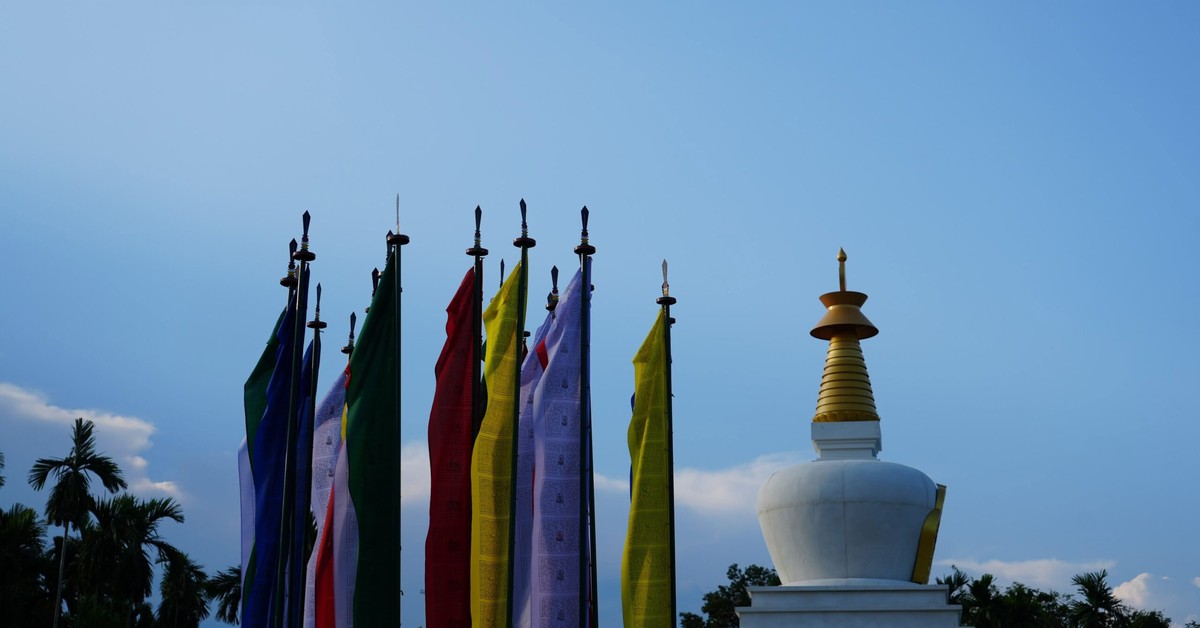
Nabji Lhakhang: Local tradition associates Nabji with Guru Rinpoche’s visit and his role in bringing peace between King Sindhu Raja and King Nawoche. A stone pillar known as Nado is revered as a marker of the oath associated with their reconciliation. The story is an important part of the sacred identity of Nabji and the surrounding area. Read more in our guide to Nabji Lhakhang and its stone pillar of oath.
Kurjey Lhakhang: The destination is a temple complex associated with Guru Rinpoche’s meditation and the body imprint preserved in rock. The site has great importance in Bhutanese Buddhist tradition and is a major pilgrimage destination in Bumthang. For its history, religious significance and visitor information, see our guide to Kurjey, the cave of the red cliff.

At both ends of the journey, take time to listen to local caretakers and guides. They can explain the religious meaning of the places and the customs observed by pilgrims. Do not touch sacred objects, paintings or rock imprints unless permission is given.
Current Status and Access
The Lotus-Born Trail is a developing project. Its official website publishes route descriptions, itineraries and planning information, but this should not be taken as confirmation that the entire 150–200 km route is ready for independent or organised public trekking.
The trail was publicly launched during the fourth phase of the Gelephu Mindfulness City volunteer programme in late December 2025. Work has continued in stages. In a report dated 6 September 2026, Bhutan Broadcasting Service described volunteers working on a 25-kilometre section between Ritay and Jigmeling as part of trail restoration and development. This indicates that at least some sections were still being worked on during 2026. The report can be read on the BBS website.
Some travel operators have advertised departures, while other travel coverage has referred to a later opening. An advertised itinerary or departure date is not, by itself, proof that the complete route, campsites, bridges and support facilities are operational. As of 26 November 2026, we have not found a clear public announcement confirming that the full trail is open from end to end or giving a definitive full-route opening date.
Before committing to the journey, contact the Lotus-Born Trail project or a Department of Tourism-certified Bhutanese guide or tour operator. Ask which sections are open, whether the proposed route is walkable throughout, where overnight stays are possible, and what arrangements exist for transport, food, luggage, emergency support and river crossings. We recommend confirming these details again shortly before departure.
You may also contact Bhutan Pilgrimage on WhatsApp for help identifying the information to confirm before planning.
Best Time to Walk the Lotus-Born Trail
The project identifies spring (March–May) and autumn (September–November) as the most favourable seasons for the journey. Weather differs considerably between the warm southern plains and the higher valleys of central Bhutan, so conditions at the start of the route may be very different from those near Bumthang.
- Spring (March–May): generally a good period for walking, with warmer days, seasonal flowers and often clear views. Higher sections can still be cold, particularly in the mornings and evenings.
- Autumn (September–November): usually the preferred trekking season after the main monsoon rains. Skies are often clearer, although early snowfall and cold conditions are possible at higher elevations late in the season.
- Summer (June–August): monsoon rain can make forest paths slippery, raise streams and increase the risk of landslides or travel disruption. Check conditions carefully before considering any section.
- Winter (December–February): lower areas may be accessible, but higher sections can be very cold and exposed to snow, frost and strong winds. Do not assume the high route is passable.
These are broad seasonal guidelines, not a guarantee of suitable trail conditions. The final decision should be based on current weather, local advice and confirmation that the route is open.
Pilgrimage Preparation and Safety
Although the project describes the route as moderate, a multi-day walk across changing elevations should not be underestimated. Remote sections, variable weather and limited facilities mean that preparation is important even for experienced walkers.
- Build fitness in advance: begin preparing two to three months before the planned journey. Include regular walks, uphill training and longer hikes carrying a daypack.
- Wear suitable footwear: use well-fitted trekking boots or trail shoes with reliable grip, and break them in before departure.
- Pack for changing weather: carry layered clothing, a warm fleece or down jacket, rain protection, waterproof trousers, a hat and gloves for colder sections.
- Carry water and sun protection: take a reusable water bottle, sunscreen, sunglasses and lip balm. Follow your guide’s advice on safe drinking water and refilling points.
- Bring personal essentials: pack prescribed medicines, a basic first-aid kit, a headlamp, a power bank and enough cash for rural areas where card payments and ATMs may be unavailable.
- Respect altitude: ascend gradually, take rest breaks and tell your guide promptly if you develop a headache, nausea, dizziness or unusual breathlessness. Severe or worsening symptoms require stopping the ascent and seeking medical help.
- Prepare for temple visits: bring modest clothing that covers shoulders and knees. Follow local instructions about footwear, photography and offerings.
- Check accessibility honestly: several consecutive days of walking, uneven paths and higher passes may not suit people with limited mobility or certain health concerns. Seek professional advice if unsure.
Older pilgrims and visitors who prefer gentler journeys may find a series of shorter visits more suitable than a continuous highland trek. Our pilgrimage guidance for elders introduces alternatives for travellers who wish to experience Bhutan’s sacred places at a more comfortable pace.
Permits, Guides and Sustainable Development Fee
Guides and trekking arrangements: Bhutan’s Department of Tourism states that treks must be undertaken with an accredited tour operator or guide. A certified guide is also required for travel beyond designated border-town areas. The guide or operator should confirm the appropriate trekking arrangements, local permissions and safety support for the Lotus-Born Trail. The current rules are outlined in the official Bhutan Travel visitor FAQs.
Visas and entry permits: visitors who are not Indian nationals generally require a visa to enter Bhutan; Indian nationals travel using the applicable permit arrangements. Requirements differ for some nationalities and can change, so check the official immigration process before booking. Do not assume that a trail itinerary replaces national entry requirements.
Sustainable Development Fee (SDF): as of 26 November 2026, the official tourism information lists the effective rate for most adult visitors from countries other than India as USD 100 per person per night. The Royal Government announced on 1 November 2026 that the 50% waiver on the USD 200 SDF would continue until 31 December 2029. Indian nationals pay Nu. 1,200 per person per night. Children aged six to under twelve pay the applicable reduced rate, while children under six are exempt. Special concessions may apply to certain nationalities, so check the latest official information for your circumstances.
Special site permissions: access requirements may differ between locations along the route. Ask the project team or your guide whether any site-specific permission, opening arrangement or local introduction is needed. Confirm all fees directly rather than relying on old itineraries or third-party summaries.
Official updates: Department of Tourism announcements and Bhutan Travel FAQs.
The Pilgrim’s Pledge and Trail Etiquette
The Lotus-Born Trail project invites pilgrims to approach the journey with reverence, humility and mindfulness. The idea is to walk with care, respect the sacred landscape and leave the places visited as undisturbed as possible. For many Bhutanese devotees, the intention behind a pilgrimage matters as much as the distance travelled.
In practice, this means keeping a quiet manner around temples and villages, asking before photographing people or religious activities, following the instructions of caretakers, and not disturbing prayer flags, offerings, sacred objects or wildlife. Carry all rubbish out, avoid single-use plastics where possible and respect private land and community spaces. If a local ceremony is taking place, observe from an appropriate place and do not interrupt it for photographs.
Other Sacred Places to Explore
If you are extending your stay in Bumthang or central Bhutan, consider visiting other important religious sites. These destinations are not all part of the Lotus-Born Trail itinerary, but they can add context to a wider pilgrimage through the spiritual heartland of Bhutan.
Jambay Lhakhang: one of Bhutan’s oldest temples, traditionally associated with the 7th-century temple-building activities of the Tibetan king Songtsen Gampo.
Tamzhing Lhakhang: an important temple associated with Terton Pema Lingpa and the living religious heritage of the Choekhor Valley.
Thangbi Lhakhang: a historic temple in Bumthang known for its religious traditions and the annual Thangbi Mewang fire-blessing festival.
Paro Taktsang: the Tiger’s Nest, one of Bhutan’s best-known sacred sites, traditionally associated with Guru Rinpoche’s meditation in the Paro valley.
The 108 Jangchub Chortens in Gelephu: a major new Buddhist landmark in the southern setting of Gelephu Mindfulness City.
A Meaningful Pilgrimage on the Lotus-Born Trail
The Lotus-Born Trail offers a compelling way to bring together Bhutan’s southern landscapes, central valleys and sacred Buddhist heritage. Its proposed journey from Gelephu to Kurjey follows a story that remains important in the religious life of the country. As the route develops, it may offer pilgrims an opportunity to experience the landscape through mindful walking, encounters with local communities and visits to places associated with Guru Rinpoche.
For now, the most important step is to distinguish the published itinerary from the sections that are actually ready for visitors. Confirm access, accommodation, guide arrangements and current conditions before setting out. A pilgrimage is best undertaken with patience and respect, allowing time to understand the traditions of each place rather than rushing to complete the route.
Frequently Asked Questions
What is the Lotus-Born Trail in Bhutan?
The Lotus-Born Trail is a developing pilgrimage and cultural heritage route inspired by Guru Rinpoche’s traditional journey through Bhutan. It is planned to connect Gelephu Mindfulness City in the south with Kurjey Lhakhang in Bumthang, over approximately 150–200 kilometres.
Why is it called the Lotus-Born Trail?
Lotus-Born is the common translation of Padmasambhava, the Sanskrit name of Guru Rinpoche. Traditional biographies describe his miraculous appearance on a lotus in Lake Dhanakosha in Oddiyana.
Where does the Lotus-Born Trail start and end?
The published route begins in the Gelephu Mindfulness City area in southern Bhutan and ends at Kurjey Lhakhang in Bumthang, passing through Nabji Korphu and other sacred and rural locations.
How long is the Lotus-Born Trail?
The official trail website describes a planned route of approximately 150–200 kilometres. The final distance may depend on the completed route and the itinerary used.
How many days does the Lotus-Born Trail take?
The project publishes a seven-day itinerary and an eight-day variation via Pey Nye La and Zhuri. These are planning itineraries and should not be taken as confirmation that all sections and facilities are currently operational.
Is the Lotus-Born Trail open to visitors now?
The full route should not be assumed to be open. BBS reported on 6 September 2026 that volunteers were working on a 25-kilometre section between Ritay and Jigmeling. Confirm the current condition and access to every section with the trail project or a certified local operator before travelling.
What is the best time to walk the Lotus-Born Trail?
The project identifies spring (March–May) and autumn (September–November) as the preferred seasons. Weather varies between the southern lowlands and higher sections, so confirm local conditions and route access before departure.
How difficult is the Lotus-Born Trail?
The project describes the route as moderate trekking, with planning information indicating elevations of approximately 1,000–3,000 metres. It involves several consecutive days of walking and changing terrain, so good fitness and preparation are important.
Do I need a guide for the Lotus-Born Trail?
Yes. Bhutan’s Department of Tourism states that treks must be undertaken with an accredited tour operator or guide. Confirm the appropriate trekking guide and logistics before starting.
How much is the Sustainable Development Fee in Bhutan?
As of 26 November 2026, the effective SDF for most adult international visitors is USD 100 per person per night, with the 50% waiver extended until 31 December 2029. Indian nationals pay Nu. 1,200 per person per night. Reduced rates and exemptions apply to eligible children, and some nationality-specific concessions may differ.
Is the Lotus-Born Trail suitable for elderly pilgrims?
The route involves several days of walking, changing elevations and remote sections. It may not suit visitors with limited mobility or those who prefer a gentler pilgrimage. Shorter visits to sacred places can be considered as an alternative.
How is the Lotus-Born Trail different from the Trans Bhutan Trail?
The Trans Bhutan Trail is a separate long-distance route across Bhutan. The Lotus-Born Trail is a shorter proposed pilgrimage route focused on places associated with Guru Rinpoche, from Gelephu to Kurjey Lhakhang.
Include the Lotus-Born Trail in Your Bhutan Pilgrimage
Explore the sacred route from Gelephu to Kurjey and plan your journey with clear information about access, local arrangements and other places associated with Guru Rinpoche.
