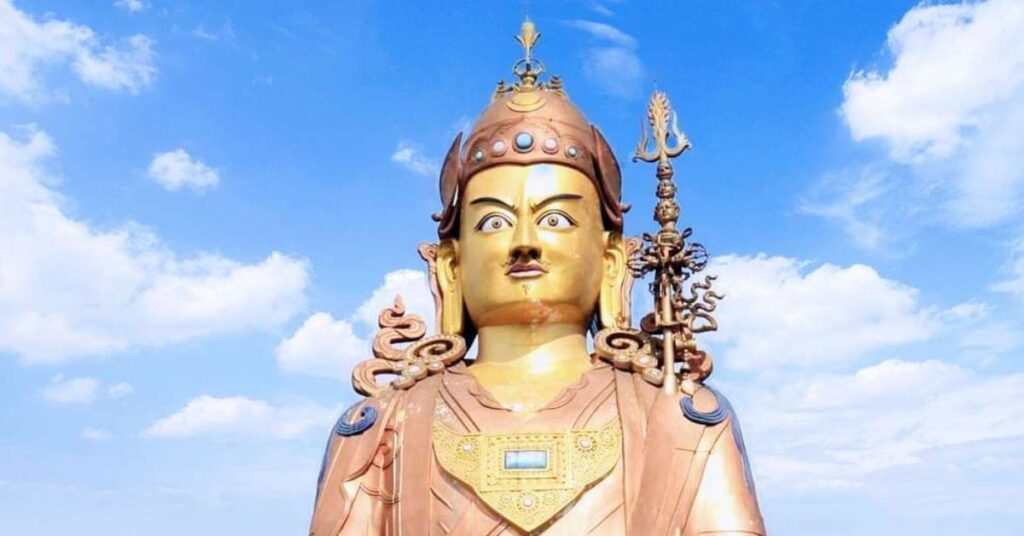
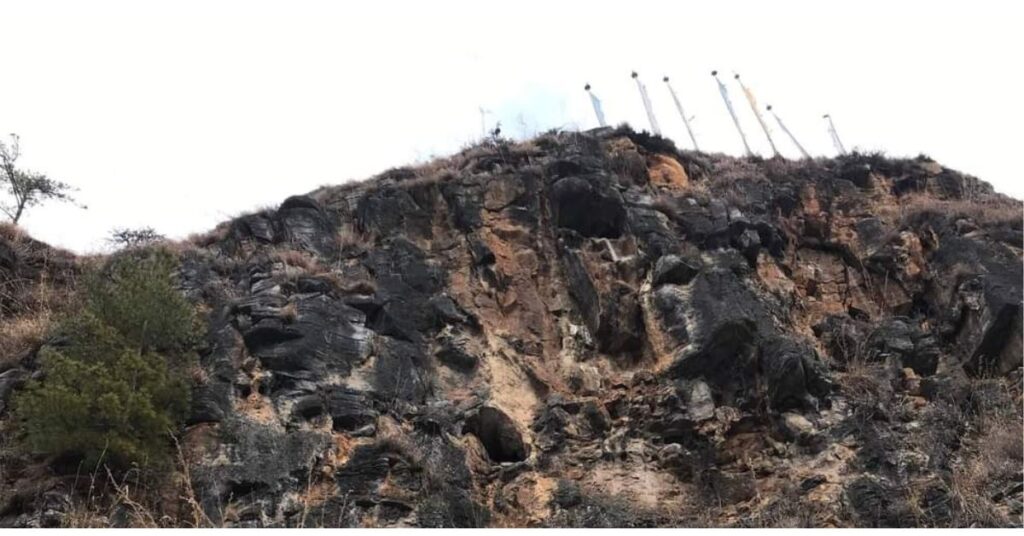
Namthong Karpo is a sacred cave where Guru Rinpoche meditated and subdued a sickle-faced demon. It is located southeast of the more famous Paro Rinpung Dzong at an elevation of about 2,500 meters above sea level in Paro Dzongkhag.
Though the place is holy, it is the least explored due to an unresolved mystery that claims to cause infection with “Dza,” which causes epileptic-like symptoms if the victim does not visit again.
How to Reach Namthong Karpo and Zuri Lhakhang
You can reach the sacred cave of Namthong Karpo from Rinpung Dzong and the Paro College of Education. It’s only a few minutes’ walk from Zuri Dzong, a sacred site of glowing Vajra guarded by Rahula, Buddhism’s all-powerful protector deity. It takes only 5 minutes to get there from the Zuri Lhakhang.
Trek to Zuri Dzong: The Zuri Dzong hike is considered one of the best moderate-level treks. It is 1.9 km long and takes around 30 minutes. The trek from Gonsaka Lhakhang takes about one hour to complete. If you wish for a relatively easier trekking expedition, the hike can start from Ta Dzong. The hike is approximately 1.5 hours from the National Museum Watch Tower and an hour from Uma Paro Resort.
Sacred Relics to See at Namthong Karpo and Zuri Lhakhang
- A cave of Guru Rinpoche;
- Naturally arising wish-granting tree;
- A footprint of Guru Rinpoche/Buddha;
- Longevity vase;
- Guru Rinpoche’s hearth;
- Magical weapon, symbolic cake (thug gtor) of body, speech, and mind.
Also Read: Guru Rinpoche in Bhutan: His Visits to Bhutan and Sacred Sites
Historical Significance of Namthong Karpo and Zuri Lhakhang
The hilltop is shaped like Guru Rimpoche’s essence, the self-arising syllable “Hung.” Guru Rinpoche is said to have seen a dazzling sky while looking up from a deep underground cave and called the place Namthong Karpo. Namthong roughly translates to “seeing the sky”, and Karpo means “white/bright.” Guru Padmasambhava meditated for three months and destroyed the sickle-faced demon that was rumored to be present there.
As prophesied, Yung Toen Dorji, a disciple of Zuri Jampa Singye with supernatural abilities, arrived in Paro in the 6th Rabjung and established Goenpa in Namthong Karpo cave. During his stay at the sacred location, he uncovered a self-embossed statue of Chanag Dorji and built a Chorten out of sandalwood. After the death of his master, Zuri Jampa Singye, he renamed the temple Zuri Lhakhang.
Lhasey Tshangma also stayed at Namthong Karpo for several months, took a consort, and had a son, whose descendants are now popularly known as Padro Gedung Chojay. Namthong Karpo is claimed to be home to undiscovered treasures that will be unearthed when the time comes.
Description of Namthong Karpo Cave
After reaching the holy site, visitors can see the shapes of sacred items. Outside the main cave, there are images of deities and self-arisen images. A naturally formed conch rises above the cave, and to the left, depending on the degree of one’s faith and yearning, a variety of deities of various kinds can be seen.
On the hill above the route leading to the cave on the left, it is said that there are artifacts of the magical weapon, a symbolic cake (Thugtor) of body, speech, and mind. You’ll find an oven-shaped natural rock that’s said to symbolize Guru Rinpoche’s hearth and the location of a blessed water spring on top of a hill if you climb a little higher. The holy water has dried up, so just the hearth remains now.
As one enters the cave, probably with a torch, one can find the natural inscriptions on the hard and patterned rocks. The cave grants one’s wishes if one prays with dedication. The naturally emerging wish-granting tree, Buddha’s footprint, longevity vase, Guru Rinpoche’s head form, and several unnamed images are notable inscriptions in the cave.
A hole exists where a man can fit on the left of the long-life vase. According to local tradition, A cat was tossed through this hole and emerged in the Rinpung Dzong’s courtyard. If a person can pass through the hole, it is stated that their past incarnations’ evil acts and blasphemies will be purged, and they will be reincarnated in Guru Rinpoche’s Copper-Colored Mountain. There are even accounts of a few lucky persons who entered the hole and made it out.
Zuri Dzong or Zuri Lhakhang
Zuri Dzong is a five-story fortress built in 1352. To get to the dzong, you must cross a little bridge. The building is surrounded by big cypress trees and is protected by double walls.
There is a local story about how the cypress tree came here. A man had committed to take responsibility for collecting wood for the construction of Paro Dzong during the reign of Zhabdrung Ngawang Namgyel in the 17th century. He was chopping the trees and rolling them down to the Dzong construction site. Upon reaching the courtyard of Zuri Dzong, a lady stopped him for a cup of tea. As he started drinking the tea, the trees began standing independently and rooted themselves in the courtyard of Zuri Dzong.
Zuri Dzong has thick walls and narrow slits in and around the fort through which soldiers could shoot arrows. The top floor was used for storage as well as to target attackers with cannonballs. In the event of an attack on the Rinpung Dzong, the towering cypress trees in front of the Lhakhang are said to be used as a springboard for shooting boulders. Later, the Zuri Lhakhang was used as a water tower beside Ta-Dzong.
The upper chapel has a fine collection of murals, one dedicated to the protector Zaa Rahulla.
Best Time to Visit Namthong Karpo
As long as one desires to obtain Buddha Dharma, there is no optimal time to begin a pilgrimage. If you are not on pilgrimage, go for the Zuri Dzong hike. It will be a once-in-a-lifetime opportunity to visit such a sacred site, as Guru Rinpoche himself sanctified it. Only the privileged will have the chance to visit once in their lives. You can visit major pilgrimage sites in Paro with the Bhutan Pilgrimage Package.
Frequently Asked Questions
What is Namthong Karpo?
Namthong Karpo is a sacred meditation cave in Paro, Bhutan, where Guru Rinpoche (Padmasambhava) meditated in the 8th century and subdued a sickle-faced demon. The name translates to “seeing the white/bright sky,” reflecting Guru Rinpoche’s vision of a dazzling sky from within the cave. It lies at about 2,500 meters above sea level, southeast of Paro’s Rinpung Dzong, and is closely linked with Zuri Dzong and Zuri Lhakhang.
Where is Namthong Karpo located?
Namthong Karpo is in Paro Dzongkhag, a short walk from Zuri Lhakhang and Zuri Dzong, above the Paro valley. It is accessible via trails starting near the National Museum of Bhutan or Goensakha (Gönsaka) Lhakhang. The site sits in a forested ridge offering views over Paro town and the valley below.
How do you reach Namthong Karpo?
Visitors typically drive or walk up from Paro town toward the National Museum, then follow a well-marked uphill trail to Goensakha Lhakhang and onward to Zuri Lhakhang. From Zuri Lhakhang, Namthong Karpo cave is just a few minutes’ walk away. The entire hike from the museum area takes about 45–60 minutes one way, depending on pace.
How long is the Namthong Karpo hike?
The main hiking section from Goensakha Lhakhang to Namthong Karpo and Zuri Dzong is roughly 1.9 kilometers and takes around 30–40 minutes at a steady pace. Including the approach from the National Museum or Paro town, the full round-trip usually takes 2–3 hours with time for rest and exploration.
Is the Namthong Karpo trail difficult?
The trail is considered easy to moderate, with a steady uphill climb on a clear path through pine forest. It is suitable for most fitness levels and is often recommended as an acclimatization hike for visitors adjusting to Bhutan’s altitude. Proper walking shoes and water are advisable, especially in wet or muddy seasons.
What can you see at Namthong Karpo?
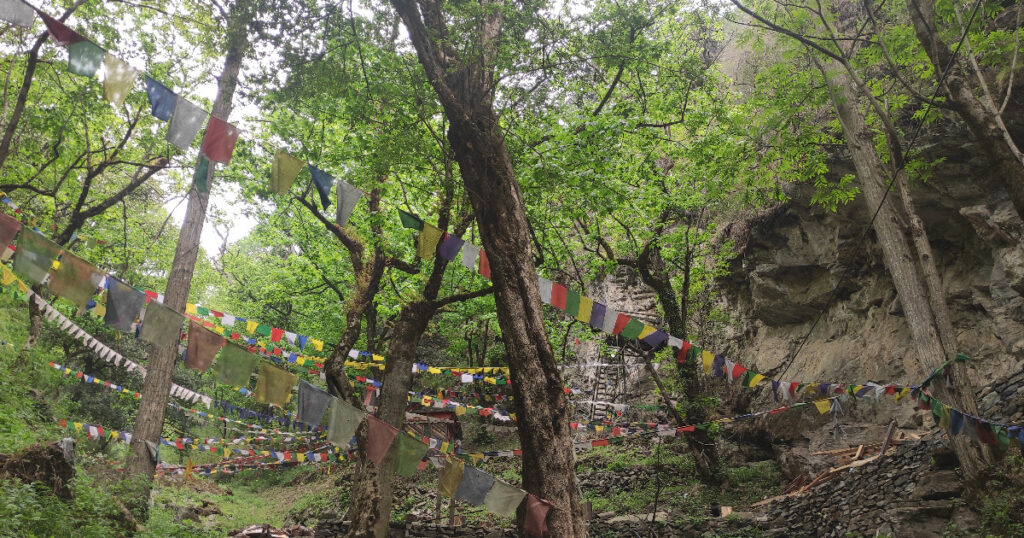
At Namthong Karpo, visitors see a small sacred cave embedded in a rocky cliff, traditionally used by Guru Rinpoche for meditation. The site is spiritually significant, with prayer flags, offerings, and a serene atmosphere. Nearby Zuri Dzong and Zuri Lhakhang add historical and religious context to the visit.
Why is Namthong Karpo important for pilgrims?
Namthong Karpo is revered as one of Guru Rinpoche’s key meditation sites in Paro, where he performed powerful spiritual acts, including subduing a demon. Pilgrims visit to receive blessings, accumulate merit, and connect with the sacred energy of the cave. It is often included in Guru Rinpoche pilgrimage circuits around Paro.
What is the best time to visit Namthong Karpo?
The best times to visit are during spring (March–May) and autumn (September–November), when weather is clear, trails are dry, and views over Paro valley are at their best. Winter visits are possible but can be cold, while monsoon season (June–August) may make the trail slippery.
Are there facilities near Namthong Karpo?
There are no major facilities directly at the cave, but basic rest spots and prayer areas exist along the trail. Nearby Zuri Lhakhang and Goensakha Lhakhang offer spiritual sites to explore. Visitors should carry water, snacks, and dress appropriately for changing mountain weather.
Can Namthong Karpo be combined with other sights in Paro?
Yes, Namthong Karpo is often combined with visits to Zuri Dzong, Zuri Lhakhang, Goensakha Lhakhang, and the National Museum of Bhutan. Many travelers include it as part of a half-day cultural and spiritual hike above Paro town before heading to other major sites like Taktsang (Tiger’s Nest) or Rinpung Dzong.