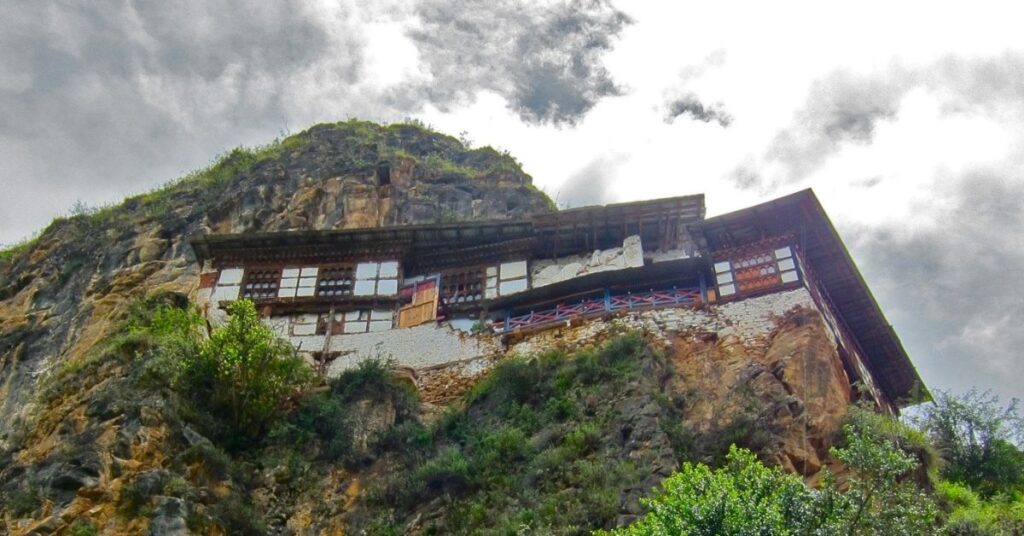
Dra Karpo is a sacred cliff where Guru Rinpoche broke and dispelled an evil spirit in the 8th century. This holy cliff, also known as the mini-Taktsang, is situated in Shaba Deyangkha of Dogar Gewog, under Paro Dzongkhag, at an elevation of 2,663 meters above sea level.
The Drakarpo Lhakhang is built on a natural rock outcropping that resembles the back of a garuda, a Buddhist mythical bird, where Guru Rinpoche is said to have meditated. Paro Drakarpo is roughly 4 kilometers uphill from Dhenka village in Shaba, Paro, and the Drakarpo hike takes about 2 hours.
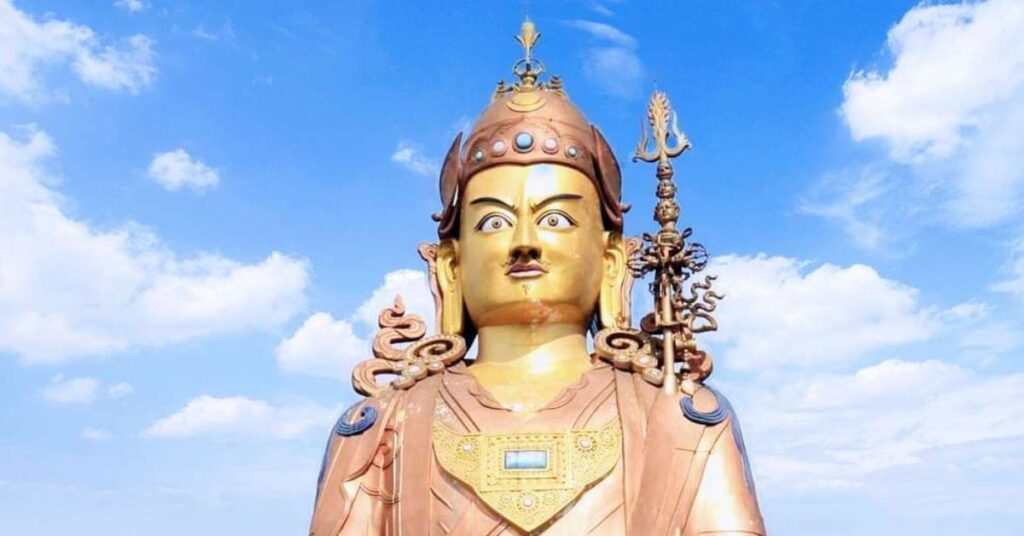
Guru Drupkhang houses the main Nangten, Guru Sunjoen (a 12-foot self-spoken statue of Guru Rinpoche), which was revealed as a terma in Bumthang.
How to Reach Drakarpo
Aside from its religious significance, a trek to the Drakarpo monastery provides a spectacular view of the surrounding valleys. Paro Drakarpo is roughly 4 kilometers uphill from Dhenka village in Shaba, Paro. Take the rough road from the Shaba town diversion. The road has become bumpy and risky for commuters.
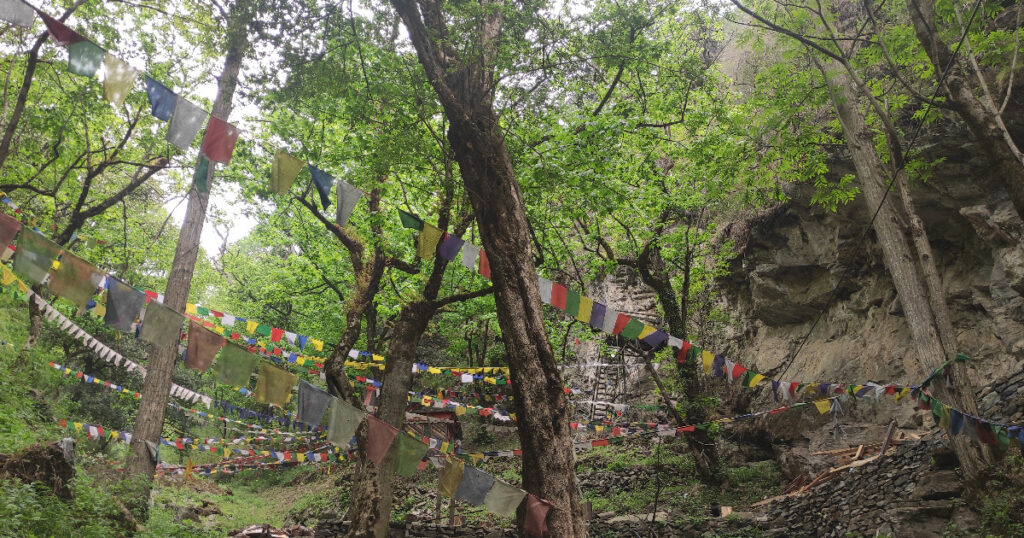
The Drakarpo hike takes about 2 hours. Start your day early in the morning. Hike along the path of the fluttering prayer flags, soak in the wispy mist that envelops the valley, and revel in the golden sunrise. The trail echoes softly with the footsteps of fellow dedicated pilgrims, all fueled by the murmur of prayers and the strength of their physicality for the pilgrimage to the sacred site of Guru Rinpoche.
Sacred Relics to See at Dra Karpo
- A sacred cliff with three lamps that can burn for an eon represents the enduring teachings of Guru Rimpoche.
- A boot of Guru Rinpoche;
- A footprint of Guru Rinpoche;
- A footprint of Choje Drukpa Kunley;
- The Dakinis’ field of accumulation;
- A long life vase of amrita;
- A throne of Guru Rinpoche;
- A parasol of Guru Rinpoche;
- A rock which the Guru broke and took out the demon of Drakarpo;
- A Kilaya mandala;
- A naturally arisen letter OM;
- A place to receive the blessing of fertility;
- A wonderful seal of Guru Rinpoche along with a clear mirror;
- 108 golden mandala offerings;
- A route for the purification of negativity;
- Entrance to the wish-granting tree housed inside the cave;
- Guru Rinpoche’s Tse Bum.
Also Read: Guru Rinpoche’s Visits to Bhutan and His Sacred Sites
Historical Significance of Drakarpo
Paro Dra Karpo is a sacred place of pilgrimage blessed by Guru Padmasambhava on his second visit to Bhutan. It is believed that Guru Rinpoche flew to Drakarpo from Paro Taktsang and meditated there. When he arrived at Drakarpo, he split a rock into two pieces, revealing an evil spirit hidden therein. The site came to be known as ‘Dra Karp’, meaning ‘the split cliff’, which has now become ‘Dra Karpo’, a corrupt form of the original word. The split rock can be seen in the monastery’s altar room, which was shifted from the mountainside to its current site.
On one face of the split, he dug out a cave (Drupkhang) to meditate there; he pasted the chippings of the stone on the cave wall to create a mandala, a visual guide for meditation. The shape of the large stone lumps on the opposite rock wall suggests that Guru Rinpoche excavated them by hand and placed the stones there. The rock lumps resemble mud applied to the cliff wall, with many finger impressions visible. The stone lumps are said to contain 48 peaceful and 52 wrathful deities.
Many prominent Buddhist saints, including Khandro Yeshey Tshogyal, Machig Lhabdron, Namkhai Nyingpo, Drupthob Thangthong Gyalpo, Lam Drukpa Kinley, Phajo Drugom Zhigpo, Vairochana, and others, also meditated at Dra Karpo.
From here, Guru Rinpoche is said to have flown to the sacred site of Dzongdrakha in Paro, just above Shaba, in the 8th century.
Description of Dra Karpo Ney
According to a thirteen-folio namthar titled “Brag bkag po’i gnas yig bkod pa rgya mtsho’i sprin phub zhes bya ba bzhugs so”, Dra Karpo Hill is described in three parts: the summit of the cliff resembles Mount Tisi, the base resembles Mount Tsari, and the middle portion of the cliff resembles Lapchi. These are the three holiest mountains and are associated with the body, speech, and mind aspects of Chakrasamvara and Vajravarahi.
A cave is seen just below the monastery, where one must pass through a narrow opening between the rocks to determine one’s virtue. Within the cave, one can see the Guru’s imprint and pictures of an immoral and devout person. At the temple’s doorstep, the protruding rock is believed to be the trunk of Paksam Joenshing (wish-fulfilling tree), and its root is under the temple. Besides this, we can see an impression of Guru Rinpoche’s boot and an impression of Tara’s genitalia. The cliff on the right facing the temple is called the ‘Golden Mandala’.
The devotees, while making a circumambulation around the site, can see many images on the rocks believed to have appeared miraculously owing to the blessing of Guru Rinpoche: Mani syllable, ritual dagger, seat of Guru Rinpoche, foot impression of Guru Rinpoche, rosary of Guru Rinpoche, etc.
Other sacred images are the foot impressions of Guru Rinpoche, Lama Drukpa Kuenley, and Ngawang Choejey. A little walk away from this site, you will find the walking stick of Guru Rinpoche, a sacred site of one hundred thousand Dakinis, a sacred crematory, the seal of Guru Rinpoche, and many more.
Drakarpo Lhakhang
The main Drakarpo lhakhang is built on a natural rock outcropping where Guru Rinpoche is said to have meditated in the 8th century, regarded as the “mini-Taktsang.” The temple is believed to have been built on the back of a garuda, a Buddhist mythical bird, as the hill looks like the back of a bird. Guru Drupkhang houses the main Nangten, Guru Sunjoen (a 12-foot self-spoken statue of Guru Rinpoche) on the left, which was revealed as a terma in Bumthang and then brought to this location.
It also contains statues of Guru Pema Jugney, Guru Nangsi Zilnon, the two consorts of Guru Khandro Yeshey Tshogyal and Lhacham Mandarava, and a self-arisen stone representing the forms of the Risum Gonpo (Lords of the Three Families: Avalokiteshvara, Manjushri, and Vajrapani) and Guru Rinpoche’s traditional shoe, a revered relic in stone form, as well as Daaka Tsan.
To reach the monastery’s main altar room, one must first pass through a smoky kitchen filled with massive ancient kitchenware, then travel a dangerous wooden corridor with thin wooden rails, and finally climb a flight of stairs with an amazing view of the valley below.
Drupkhang of First Namkhai Nyingpo
The Drupkhang of the first Namkhai Nyingpo is situated on the top face of the cliff, accessible by a steel pathway. Inside the cave, Guru Padmasambhava meditated alongside the first Namkhai Nyingpo. The cave contains body imprints of Guru Rinpoche, the first Namkhai Nyingpo, and the head of the cow that offered milk to Guru Rinpoche.
Additional sacred items found within the cave include a mandala, Guru Rinpoche’s handprint, a torma, a Norbu, a python’s tail, a Kilaya, and a stone hook where Guru Rinpoche restrained Namkhai Nyingpo, who had intended to fly before the appropriate time. At the top of the cave, Machig Labdron is believed to have sacrificed her entire body by performing a Chod ritual. We can see petrified stones believed to be her twenty-eight spine bones.
Drakarpo Kora in Paro
People of all ages come to circumambulate the hill in peace. The route is completely paved with stone slabs. Even the most heinous sins, such as murdering one’s parents, are said to be forgiven if one circumambulates the mountain 108 times. On healthy legs, the journey takes four days to complete. If you don’t have time to devote four days, there is a shorter version of 13 rounds. On fresh legs, even a single round would take roughly 25 minutes.
Also Read: Gomphu Kora and Chorten Kora in Trashiyangtse
Best Time to Visit Dra Karpo
Drakarpo Paro is ideal for a weekend retreat. While doing the ‘kora,’ one can camp or rent a house in the area. The trek to Dra Karpo Ney can also be a half-day hike with a picnic lunch overlooking the picturesque valley and settlements below. You can visit the major pilgrimage sites of Paro with the Bhutan Pilgrimage Package.
Frequently Asked Questions
What is Dra Karpo?
Dra Karpo, meaning “Split Rock” or “White Cliff,” is a sacred pilgrimage site in Paro, Bhutan, centered around a monastery perched on a rocky hilltop. It is revered as one of the holiest meditation places associated with Guru Rinpoche (Padmasambhava), who is believed to have meditated in its caves and left sacred imprints.
Where is Drakarpo located?
Dra Karpo is located in Shaba Deyangkha, Dogar Gewog, Paro Dzongkhag, at an elevation of about 2,650–2,663 meters above sea level. It sits roughly 10 kilometers north of Paro town and about 5 kilometers from Shaba, accessible via a short drive followed by a brief hike.
Why is Dra Karpo significant for pilgrims?
Dra Karpo is famous for the belief that circumambulating (walking around) the sacred ridge 108 times can cleanse even the gravest sins, including acts as severe as harming one’s parents. This practice, known as the 108-kora, draws pilgrims seeking spiritual purification, merit accumulation, and the fulfillment of aspirations.
Why is Drakarpo important?
Drakarpo is believed to be the sacred site where Guru Rinpoche meditated and broke a rock to remove an evil spirit in the 8th century. The site is famous for its circumambulation, known as the Drakarpo Kora.
What can visitors see and do at Dra Karpo?
Visitors can explore the meditation cave sanctified by Guru Rinpoche, view sacred relics and body imprints, and walk the kora path around the holy ridge. The site also features small hermitages and temples built against the rock, where elderly residents recite mantras and support pilgrims.
How long does the 108-kora take?
One full circle of the Dra Karpo kora typically takes 15–20 minutes. Completing all 108 rounds usually requires three to four days of continuous walking, often undertaken by devout pilgrims during auspicious periods or personal retreats.
What is the best time to visit Drakarpo?
The best time to visit is during the dry seasons of spring (March to May) and autumn (September to November), when trails are clear and weather is pleasant. Winter visits are possible but can be cold, while monsoon months may make the path slippery.
How do you reach Dra Karpo from Paro town?
From Paro town, drive about 7 kilometers to Shaba, then continue another 5 kilometers on a dirt road toward the trailhead. From there, a short uphill walk leads to the monastery and the start of the kora path.
Is Drakarpo suitable for casual tourists?
Yes, Drakarpo is suitable for casual visitors interested in culture and spirituality, even if they do not complete the full 108-kora. The short hike, cave visit, and valley views offer a meaningful experience without requiring a multi-day commitment.
Are there facilities for visitors at Drakarpo?
Basic facilities are available, including small teahouses and resting spots near the monastery, but amenities are limited compared to major tourist sites. Pilgrims undertaking the 108-kora often bring their own supplies and stay in simple lodging or tents during their retreat.
What should I pack for the Drakarpo Kora pilgrimage?
Visitors should wear modest, comfortable clothing suitable for hiking and respect the sacred nature of the site. Bring water, snacks, sun protection, and sturdy shoes; pilgrims doing multiple kora rounds may also carry prayer beads, a walking stick, and overnight gear.
How can I participate in the Drakarpo Kora pilgrimage?
You are free to participate in the Drakarpo Kora pilgrimage. You can do it anytime. Once at Drakarpo, you can circumambulate the hill, known as the Drakarpo Kora. The route is completely paved with stone slabs. Even the most heinous sins, such as murdering one’s parents, are said to be forgiven if one circumambulates the mountain 108 times. On healthy legs, the journey takes four days to complete 108 Koras. If you don’t have time to devote four days, there is a shorter version of 13 rounds. On fresh legs, even a single round would take roughly 25 minutes.