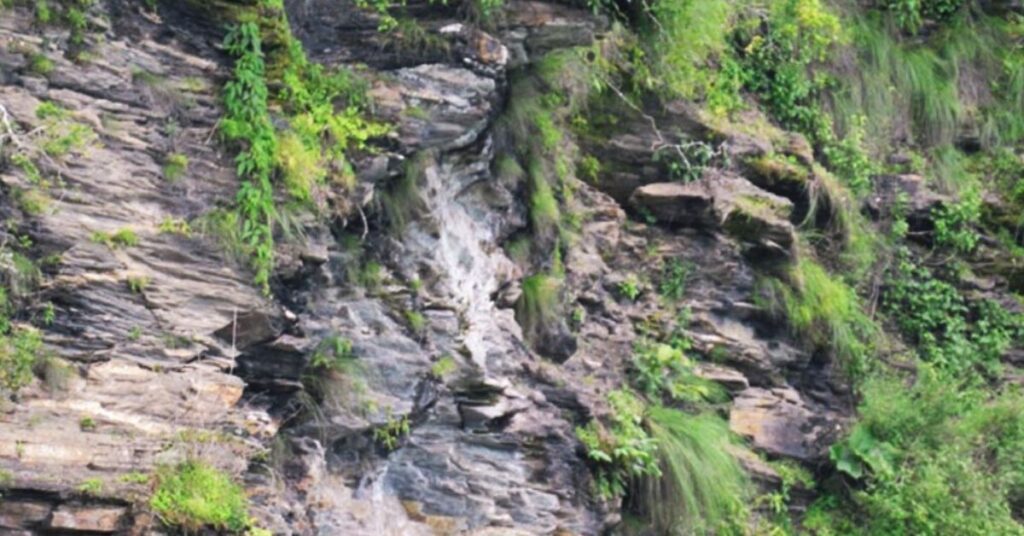
Tha Namkhai Dzong is a holy site of Guru Rinpoche that resembles a frontier sky fortress, featuring a religious bell hanging from a cliff and an Urn (Thro). It is located in Lajab Gewog under Dagana Dzongkhag at an elevation of 1560 meters above sea level.
Tha Namkhai Dzong is believed to contain treasure or Ter, and a prophecy states that an accomplished religious master would rediscover it. The site is challenging to reach, with a narrow, bumpy road that is unsuitable for small vehicles.
How to Reach Tha Namkhai Dzong
This sacred site can be approached from either Burichhu in Tsirang on foot or by driving through Drujeygang-Tsangkha-Larjab gewogs in Dagana. Even though it’s a hard climb from Burichhu, many people would rather walk than drive through the forests on a narrow, steep route. The trip is a visual feast with its twisting Tsirang-Thimphu roadway, turquoise Sunkosh, and small cottages scattered throughout. The journey to this remarkable site involves a trek through the beautiful Bhutanese landscape, adding to the sense of adventure and discovery.
Sacred Relics to See at Tha Namkhai Dzong
- A religious bell hanging from a cliff;
- The clapper in the shape of a peepal leaf;
- An Urn or Thro;
- Khandu Chhag Phuelsa;
- Treasure box;
- Secret weapon (phallus) of Guru Rinpoche.
Also Read: Guru Rinpoche in Bhutan: His Visits to Bhutan and Sacred Sites
Historical Significance of Tha Namkhai Dzong
Tha Namkhai Dzong is a sacred site blessed by Guru Rimpoche in the 8th century. According to legend, a fortunate cow herder from the village mistakenly entered the meditation cave of Guru Rinpoche while looking for his cattle. At a feast with celestial beings, he was instructed not to tell anybody about the “dzong.” After coming out of the cave, the man, who had lost track of time and place, to his surprise, discovered that three generations had already passed.
At present, Guru Rinpoche’s meditation cave is inaccessible. It is said that the protective deities closed the sacred sites. No one dares to climb the cliff. A man from a nearby valley gave it a try a few years ago. He found himself stranded in the center of the cliff. Since then, a series of misfortunes followed him.
The Treasure or Ter
According to local beliefs, the entire cliff of Tha Namkhai Dzong is said to contain treasure, or Ter. It is believed that the key to the Ter fell into Demi Tsho, a lake located in the Sunkosh River near Burichhu, when Guru Rinpoche was flying from Tha Namkhai Dzong to Dakini or Khandom Ney in Tsirang Toed. There, he prophesied that an accomplished religious master would be able to rediscover the treasure in the future.
The verse of his prophecy goes, “Under the frog-shaped stone is the hidden treasure; in Tanabji, there is a turquoise, and the key is in the lake.”
Biographies of prominent Buddhist saints such as Drubthob Thangtong Gyalpo, Gangteng Tulku Gyalse Pema Thinley, and Zhabdrung Jigme Chogyal record their visits to this sacred site.
Another legend has it that when Daga Trashiyangtse Dzong was being constructed, the megalith known as the Frontier Sky Fortress emitted telepathic messages to the builders stating that the Dzong would collapse if it were built any higher than it currently stands. Even today, the golden cupola of the Dzong is said to be level with the tip of the megalith.
Description of Tha Namkhai Dzong
Tha Namkhai Dzong is the same height as the Dakini’s site above the ruins of Tsirangtoed in Tsirang. It is part of the three-sister pillars, including Do Namkhai Kaw and Do Kelpai Goenthem, positioned in different locations as part of a larger tripod across Dagana.
Tha Namkhai Dzong was named the Frontier Sky Fortress since the mountain where the cave of Guru Rinpoche is believed to be located appears to be a fortress suspended from the sky. Situated at an archery range from the nearest footpath, the Tha Namkhai Dzong is a holy site with a religious bell hanging from a cliff. One can also see an Urn (ཁྲོ།) just above the bell.
However, finding the bell with the naked eye can be challenging, so the Dagana District Administration has placed a pair of binoculars at the site to help devotees locate it easily.
The bell and urn, or Thro, can be seen once a pair of binoculars is in position and focused. It is said that the rock that holds a bell looks like a frog. From the other side of the river, the clapper in the shape of a peepal leaf can be spotted hanging from the cliff. It is said that only those who were fortunate or had a deep devotion to Guru Rinpoche could easily locate and hear the sound of the religious bell. Some visitors would have to recite the Baza Guru prayers several times before hearing the bell’s sound. However, sometimes even when the clapper oscillates, people cannot hear the sound of the bell.
Other Sacred Sites
On the return journey from the Tha Namkhai Dzong, devotees are greeted with two more pilgrimage sites in Thasa village. They are called Zhabjethang, named after a footprint left by Guru Rinpoche, and Khandro Chhag Phuelsa, a place where Dakinis prostrated to a treasure box. Here, you can see the body prints of seven Dakinis left while prostrating to a treasure box. There is the skull of an elephant and Guru Rinpoche’s secret weapon (phallus) below Zhabjethang. Visitors can also marvel at the footprints of different animals on rocks and stones.
Tha Namkhai Dzong is the same height as the Dakini’s site above the ruins of Tsirangtoed in Tsirang. The Dzong is one of the three-sister pillars (Do Namkhai Kaw and Do Kelpai Goenthem) that spread across Dagana Dzongkhag in a tripod position.
Accommodation at Tha Namkhai Dzong
There are no accommodations available at present. However, with increased visitors to the sacred site, the Dagana District Culture sector plans to construct a new Lhakhang and encourage homestays in Thasa village in collaboration with the Laja Gewog Administration.
Best Time to Visit Tha Namkhai Dzong
The best time to visit Tha Namkhai Dzong is during the dry season, typically between October and December. The weather is generally more favorable for trekking and exploring the area during this period, allowing visitors to fully appreciate the history and sacredness of the site. Since the road beyond Thasa village is narrow and bumpy, it is unsuitable for small vehicles, especially during the monsoon season.
The Tanabji community conducts the annual Tshechu on the 10th day of the 2nd month of the Bhutanese calendar. This time of the year is apt for devotees to visit and witness the vibrant celebration of tradition and culture. You can also visit the major pilgrimage sites of Dagana with the Bhutan Pilgrimage Package.
Frequently Asked Questions
What is Tha Namkhai Dzong?
Tha Namkhai Dzong, meaning “The Frontier Sky Fortress,” is a sacred cliffside pilgrimage site in Lajab Gewog, Dagana. Unlike conventional dzongs, it is not an architectural fortress but a natural rock formation revered for its spiritual significance and deep ties to Bhutanese Buddhist legends.
Where is Tha Namkhai Dzong located?
Tha Namkhai Dzong is situated in Lajab Gewog of Dagana Dzongkhag, in southern Bhutan. It lies above the remote Thasa chiwog, near the Sunkosh River, and is accessible via footpaths from the Tsirang–Wangdue Phodrang highway.
Why is Tha Namkhai Dzong famous?
Tha Namkhai Dzong is famous for its association with Guru Rinpoche and local legends that describe it as a hidden treasure site (Ter). It is also known for the sacred bell said to hang on the sheer cliff face, visible only through binoculars installed for pilgrims.
What is the legend behind Tha Namkhai Dzong?
According to local belief, during the construction of Daga Trashiyangtse Dzong in the 17th century, the Tha Namkhai Dzong megalith sent telepathic warnings to builders not to raise the fortress higher than its tip. This ensured the spiritual balance of the district, and the dzong’s golden cupola remains level with the rock’s peak to this day.
How do pilgrims reach Tha Namkhai Dzong?
Reaching Tha Namkhai Dzong involves traveling to Dagana and then proceeding toward Lajab Gewog. From the nearest road point in Burichhu along the Tsirang–Wangdue highway, it requires about an hour’s walk along a steep footpath to Thasa chiwog at the base of the sacred cliff.
What is the spiritual significance of Tha Namkhai Dzong?
For locals and pilgrims, Tha Namkhai Dzong symbolizes divine protection for Dagana, acts as a guardian of the district’s spiritual balance, and serves as a merit-making pilgrimage destination. It is considered sacred and renowned locally as Paro’s Taktsang.
Are there other megaliths near Tha Namkhai Dzong?
Yes. Tha Namkhai Dzong is one of Dagana’s trio of mysterious megaliths. The others are Do Namkhai Kaw (“Sky Pillar Rock”) and Do Kelpai Genthey (“Rock of Ancient Steps”), all linked by legends tied to the building of Daga Trashiyangtse Dzong.
What is Dagana famous for?
Dagana is well known for the three stone Megaliths, known as “Sky Pillar Rock” (Do Namkhai Kaw), “The Rock of Ancient Steps” (Do Kelpai Genthey), and “The Frontier Sky Fortress” (Tha Namkhai Dzong).