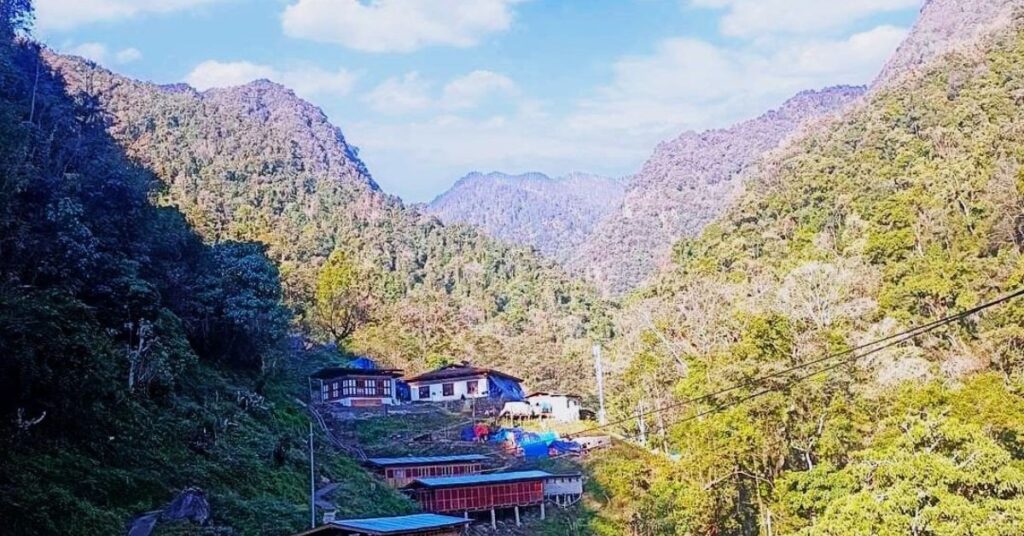
Chubu Tshachu is a hot spring discovered by Guru Rinpoche in the 8th century. It is located at the foot of the spire-shaped hill, the abode of the Tsachu Deity, Ap Khachhep, at an elevation of 1737 meters above sea level in Wolathang of Toedwang Gewog under Punakha Dzongkhag.
Chubu Tshachu is one of the most well-known hot springs in Bhutan. It is supposed to have derived from its geographical position at the confluence of two rivers, the Pho Chhu and the Mo Chhu. Chubu (Chhu- water, Bu-centre) means “Water in the Centre”.
The most popular hot springs in Bhutan are the Chubu hot spring and Koma hot Spring in Punakha; the Duenmang hot spring in Zhemgang; the Khempajong Nye hot spring in Lhuntse; the Gasa hot spring in Gasa; and the Gelephu hot spring in Sarpang.
Also Read: Hot Springs in Bhutan: Bhutanese Beliefs and Benefits
How to Reach Chubu Tshachu
The Chubu hot spring is located approximately 30 km away from the suspension bridge in Punakha. Drive to Khuruthang Town and cross the Khuruthang bridge over Phochu-Mochu, turn left towards the distant hills along the Phochu river bank until you reach another bridge over the same river that takes you to the other side. The place where this Phochu bridge is located is known as Samdingkha.
The distance from Khuruthang to Samdingkha is about 13 km. To go to Tsachu from Khuruthang, take a taxi, preferably a Bolero jeep. There are a few Boleros at the Samdingkha Parking Lot, but hire is not guaranteed on the spot.
The road from Samdingkha to Chuba Tsachu is rough and tough along the hillside facing the meandering Phochu below. Cross the Phochu bridge at Samdingkha and drive up the road for a short distance till it forks into two ways. Turn right towards the river view. The road climbs steadily, but at times takes a dip too. There are no reliable road signs at road junctions. The road snakes along the hill range that faces the Phochu River. Towards the journey’s end, the road turns inward away from the Phochu River and enters the small valley known as Tsaphu. The last village is called Nepdingkha, also now referred to as Tsaphu village.
Also Read: How to Trek to Dur Hot Spring in Bumthang
Trek Route of Chubu Tshachu
- Start from Khuruthang Town, Punakha;
- Khuruthang Town to Samdhingkha: About 13 KM and 1 ½ hours’ drive by car;
- Samdhingkha to Chubu Tshachu: the distance is about 17 kilometers and will take 2 and a half hours to 3 hours.
The Origin of Chubu Tshachu
Even today, the origin of Chubu Tshachu is not well documented. However, history has it that Guru Rinpoche discovered the hot spring during his visit to Bhutan.
Also Read: Guru Rinpoche in Bhutan: His Visits to Bhutan and Sacred Sites
According to legend, Dralay Gyelpo, the site’s current local deity, volunteered to provide all of the timber needed for the construction of Punakha Dzong by Zhabdrung Ngawang Namgyel in 1627.
He provided the timber through the Pho Chu River but was distressed because Zhabdrung Ngawang Namgyel had not provided any details about the timber’s sufficiency. He inspected the Dzong site with great trepidation, but all the wood was stacked on the river’s path in a lake called Lhamochey, so he stopped sending timber.
Meanwhile, Zhabdrung sent Dralay Gyelpo a message chastising him for failing to deliver the timber on time and warning him not to reveal himself publicly. Since then, Dralay Gyelpo has lived at the hot spring site, becoming its local deity and remaining concealed from the public.
In the region, he is now known as Khachaep Dralay Gyelpo. The figure of this Deity, with his face half black and half white, can still be seen in the Goenkhang of Ngyerchu Lhakhang today.
Also Read: The Origin of Gasa Tshachu
Description of Chubu Tsachu
There are 10 hot springs in the country. The Chuboog hot spring in Punakha, the Duenmang hot spring in Zhemgang, and the Gasa hot spring in Gasa are Bhutan’s three most popular hot springs.
The hot spring complex has a well-paved, easy-to-walk concrete footpath from the starting point (entrance to the complex) that forks 2 ways to the two different pool sites.
There are two hot water ponds at the Tshachu site. The upper pool (Gongma) with a temperature of 39.9°C is categorized as a warm spring. This pond is divided into 4 open compartments formed by timber beam dividers at the pool surface level of a single large pool.
The lower pool, known as Wogma, with a temperature of 43.5 °C, is categorized as a hot spring. This pond is under one roof with two different pools. One small pool and another larger pool are divided into 9 open compartments.
All pools are properly roofed, and the surrounding floors are concreted. The pools have wooden floors, and the larger two have wood-paneled sides to conserve heat and provide health comfort.
There are compartments for bathing before entering the pool to soak in the Tshachu. One must scoop water from the pools in buckets or jugs and carry it to the bathing room. Quite convenient actually, since bathing cum changing compartments are under the same hall that houses the respective pool.
Also Read: Description of Gelephu Tshachu
Therapeutic Values or Ethnopharmacological Benefits of Chubu Tshachu
Chubu Tshachu, like all the country’s hot springs, is also renowned for its soothing and curative properties for ailments.
The upper pool is thought to heal serous fluid associated with cold disorders, which include urinary tract infections and sexually transmitted infections (STIs). It is also helpful to those suffering from chronic stomach aches, skin diseases, and other diseases related to evil afflictions.
The lower pools are known for treating stomach ailments, muscle sprains, diabetes, and some forms of phlegm diseases. It also helps heal indigestion, cold disorders, and increased mucus because of suppressed wind and weak, painful eyes.
Also Read: Therapeutic Values or Ethnopharmacological Benefits of Duenmang Tshachu
Accommodation at Chubu Tsachu
Chubu Tsachu has six bathrooms, one bathing pool, six local stores, and ten guesthouses. There are 2 sets of male- and female-designated toilets between the tent accommodations and hot spring pools.
Also Read: Accommodation at Koma Tshachu
Contact details of Chubu Tshachu
If you’re planning a family trip to Chubu Tshachu or with your friends, here’s the contact number of the hot spring focal person. Please contact the focal person at 17648950 before you plan to stay and relax in the Tshachu. Chubu Tshachu’s price depends on your duration of stay and the pool.
Best Time to Visit Chubu Tshachu
The best time to visit Chubu Hot Spring is during the winter months from October to early March. You can visit Hot Springs in Bhutan with the Bhutan Pilgrimage Package.
Places to Explore in Punakha
Punakha Dzong: Also known as Pungtang Dewa Chhenbi Punakha Phodrang, which translates to “the palace of great happiness or bliss,” it is the administrative center of the Punakha District, constructed in 1637 by Ngawang Namgyal.
Chimi Lhakhang: Also known as the fertility temple, it is a Buddhist monastery in Punakha constructed on the site where Drukpa Kunley subdued a demoness. The monastery was founded in 1499 by Lam Ngawang Chogyal.
Goen Tshephu Ney: It is a sacred cave of longevity in Punakha, considered the third Draphu Maratika. Guru Rinpoche meditated in the cave for three months and visualized Buddha Amitayus, the “Buddha of Long Life”.
Kabji-Hoka Tsho: It is a sacred lake in Punakha with an opening in the lake created by the lake’s deity after a demon threatened to flood the area. The hike to Kabji-Hoka Tsho is considered to be of medium difficulty. It takes two to three hours on foot from Chorten Nyingpo Lhakhang.
Punakha Suspension Bridge: It is one of the country’s longest suspension bridges, spanning approximately 180 meters over the Pho Chhu River. The bridge connects Punakha Dzong with Punakha town and nearby villages.
Khamsum Yulley Namgyal Chorten: It is a Buddhist monument in Punakha on a hilltop overlooking the Mo Chhu River, constructed in 1992 to ward off evil spirits and to bring peace and harmony to all living beings.
Frequently Asked Questions
Where is Chubu Tshachu located?
Chubu Tshachu is a natural hot spring in Punakha, Bhutan, situated in Wolathang under Toedwang Gewog at about 1,737 meters above sea level. It lies near the Pho Chu river, roughly 30 km from the Punakha suspension bridge, and is accessed via a forest trail from the nearest motorable road.
What are the healing benefits of Chubu Tshachu?
Chubu Tshachu is traditionally believed to help with skin diseases, stomach ailments, urinary tract infections, body aches, sinus issues, ulcers, gastritis, and piles. The upper pool is associated with cold-disorder relief and urinary or skin conditions, while the lower pool is linked to muscle sprains, diabetes, indigestion, and some phlegm-related issues.
How hot is the water at Chubu Tshachu?
The hot spring has two main pools with different temperatures. The upper pool (Gongma) is warm at around 39.9–43.4°C, while the lower pool (Wogma) is hotter, typically between 43.5–46.1°C, making it one of the warmer tsachus in Bhutan.
How do I reach Chubu Tshachu from Thimphu or Punakha?
From Thimphu, drive to Punakha (about 2.5–3 hours), then continue toward Toedwang/Wolathang. From the nearest road end near the suspension bridge area, expect a 2–3 hour walk (or mule/pony ride where available) along a forest trail to the spring. Roads beyond Punakha town can be rough, so a sturdy vehicle and local guidance are recommended.
Are there facilities at Chubu Tshachu?
Basic changing areas and simple bathing enclosures exist, but facilities are limited compared to developed spas. There is no electricity on-site, lighting is minimal, and accommodation is usually in nearby villages or guesthouses in Punakha. Carry essentials like towels, modest swimwear, water, and a headlamp if visiting late.
What should I wear and bring to Chubu Tshachu?
Wear modest, comfortable clothing suitable for a traditional Bhutanese bathing environment; many visitors use simple swimwear or undergarments that respect local norms. Bring a towel, change of clothes, basic toiletries, drinking water, snacks, and a small first-aid kit. A headlamp or flashlight is useful due to limited lighting and early dusk in the valley.
Is Chubu Tshachu safe for everyone?
The water is generally safe for healthy adults, but people with heart conditions, severe hypertension, open wounds, or serious skin infections should consult a doctor before bathing. Because the lower pool can be quite hot, test the water gradually and limit soaking time, especially if you are elderly, pregnant, or new to hot-spring bathing.
Can I drink the water at Chubu Tshachu?
No, the hot-spring water is intended for bathing only, not drinking. Its mineral content and temperature make it unsuitable as a drinking source. Carry your own safe drinking water for the trip.
When is the best time to visit Chubu Tshachu?
The ideal seasons are spring (March–May) and autumn (September–November), when weather is pleasant and trails are drier. Winter visits can be rewarding for the warm soak but require warm clothing and caution on potentially slippery paths. Monsoon season (June–August) may make the trail muddy and leech-prone.
How long should I stay at Chubu Tshachu?
Many visitors plan a half-day to full-day trip from Punakha, including 1–2 hours of soaking in intervals. For a relaxed experience with travel time, allocate 6–8 hours round-trip from Punakha town. Overnight stays are usually arranged in Punakha rather than at the spring itself.
Can I visit Chubu Tshachu as a day trip from Punakha?
Yes, it is commonly done as a day trip, especially if you start early and have transport arranged to the trailhead. However, because of the 2–3 hour walk each way, it is a moderately strenuous outing; those preferring a relaxed pace may consider combining it with an overnight stay in Punakha.
Are there any cultural or religious customs to follow?
Chubu Tshachu is regarded as a sacred site linked to Guru Rinpoche and local deities, so maintain respectful behavior, keep noise low, and avoid littering. Follow any guidance from locals or caretakers about which pool to use for specific purposes and observe modesty while bathing.
Is Chubu Tshachu suitable for families and elderly visitors?
Families can visit, but the trek and uneven trail may be challenging for very young children or those with mobility issues. Elderly visitors can benefit from the warm water but should use the upper, warmer (not hottest) pool, limit soaking time, and consider hiring a mule or pony for part of the journey if available.
How does Chubu Tshachu compare to other hot springs in Bhutan?
Compared to tsachus like Gasa or Koma, Chubu is more accessible from Punakha and known for its two distinct pools with different temperatures and traditional uses. It is less developed than some resort-style springs but popular for its spiritual associations and reputed benefits for skin, digestive, and musculoskeletal issues.