
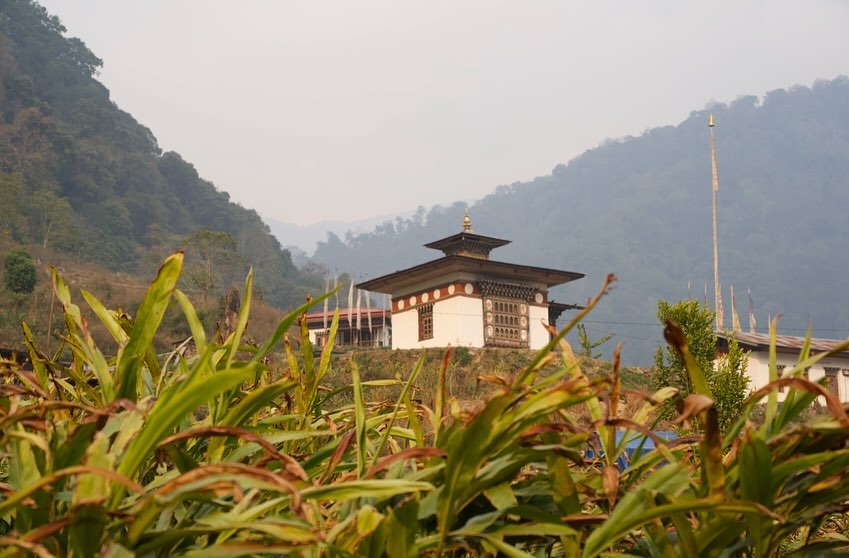
Retey Guru Nye, in Retey village of Jigmecholing Gewog, Sarpang, is associated with Durshingphu, a sacred site traditionally known as Mongoen Drak Pemai Baeyul—a hidden sacred land. According to local religious tradition reported by Kuensel, Guru Rinpoche meditated here for five months in the eighth century while travelling to Bumthang to resolve the conflict between King Sindhu Raja and King Nawoche. The site is revered for its meditation cave, sacred imprints, holy water and other religious features.
Planning a Visit to Retey Guru Nye?
Ask us about current access to Durshingphu, local guide arrangements and how to include Retey and other sacred places in your Bhutan pilgrimage.
This guide brings together the local traditions and details reported about Retey Guru Nye, its sacred features, the approach to Durshingphu and the community tourism initiative reported by Kuensel. Retey also appears in the published itinerary of the developing Lotus-Born Trail, linking the southern foothills with Nabji Korphu and sacred places further north. For the wider route, see our Lotus-Born Trail guide.
Table of Contents
- Spiritual Significance of Retey Guru Nye
- Meaning of Nye and the Names Retey and Durshingphu
- Retey and the Lotus-Born Trail
- Day 1 and Day 2: Walking Out of Ritey
- Durshingphu: The Sacred Cave and Religious Relics
- How to Reach Retey Guru Nye (Durshingphu)
- Community Tourism Plans and Current Access
- Best Time to Visit
- Pilgrimage Preparation and Safety
- Permits, Guides and Sustainable Development Fee
- Other Sacred Places Connected to the Wider Journey
- A Meaningful Pilgrimage Beginning at Retey
- Frequently Asked Questions
Spiritual Significance of Retey Guru Nye
Retey is regarded locally as a Guru Nye, a sacred place associated with Guru Rinpoche. The site of Durshingphu is traditionally known as Mongoen Drak Pemai Baeyul. As reported by Kuensel, Guru Rinpoche is believed to have blessed the site by meditating in its cave for five months during the eighth century, on his way to Bumthang to settle the dispute between Sindhu Raja and Nawoche. This account belongs to the religious tradition associated with the site and is presented here as a local belief, not as a claim of independently established historical chronology.
For devotees, the cave and the sacred signs associated with Guru Rinpoche make Durshingphu an important destination for prayer and pilgrimage. Local residents quoted by Kuensel describe reaching the Nye as a blessing and speak of the spiritual merit and protection associated with visiting it. These beliefs are part of the living religious traditions of Retey and should be understood with respect for the community that preserves them.
It is important, however, to distinguish devotional tradition from a modern route plan. Accounts of Guru Rinpoche’s journeys are preserved in different religious and oral sources, and details may vary. The Lotus-Born Trail is a contemporary pilgrimage project inspired by these traditions; its published itinerary should not be treated as proof of one historically surveyed route taken in every detail by Guru Rinpoche.
Meaning of Nye and the Names Retey and Durshingphu
A nye (also commonly written ney; Tibetan gnas) is a sacred place associated with the presence or blessing of enlightened beings and revered Buddhist masters. Such places may include caves, cliffs, rocks, springs, temples and landscapes connected with meditation, religious practice or sacred narratives. Pilgrims visit a nye to pray, make offerings and receive blessings. The term also appears in neykor, meaning a pilgrimage or circumambulation of a sacred place.
English-language sources use several spellings, including Retey, Ritey, Reti and Ritay. The Kuensel report refers to Retey village and the Guru Nye there, while Sarpang Dzongkhag’s sacred-site listing uses the spelling “Reti Ney”. The sacred destination described in the Kuensel report is called Durshingphu and is traditionally known as Mongoen Drak Pemai Baeyul. These name variants are useful when searching for local information, but visitors should confirm the precise route and site name with residents or the gewog administration.
Ritey and the Lotus-Born Trail
Ritey’s importance is closely connected with the route published by the Lotus-Born Trail project. Three developments help explain its role:
- It appears at the beginning of the published itinerary. The seven-day itinerary starts with border formalities and the journey towards Ritey. The second day is identified as “Ritey Lhakhang to Nabji”. This describes the project’s planned stages, not a guarantee that all facilities or trail sections are currently operational.
- It was included in the first phase of on-ground work. Coverage of the trail’s launch during the fourth phase of the Gelephu Mindfulness City volunteer programme in late December 2025 reported that one volunteer group worked on the Norbugang–Ritey section. The launch took place at Lhayul in Chhudzom Gewog.
- Work continued on sections in the wider southern trail area. In a report dated 6 September 2026, Bhutan Broadcasting Service said volunteers were working on a 25-kilometre segment between Ritay and Jigmeling as part of trail restoration and development.
The references to Norbugang and Ritey should not be confused as names for the same place. Guru Rinpoche Ney Norbugang is a separate sacred cave site associated in local tradition with Guru Rinpoche’s meditation. Ritey is identified separately in the Lotus-Born Trail itinerary. Both are part of the wider southern sacred landscape described in connection with the project.
Read the project updates and route information on the official Lotus-Born Trail website. For the BBS report on the 25-kilometre section, see Volunteers restore sacred trails and conserve nature in GMC.
Day 1 and Day 2: Walking Out of Ritey
The following is a summary of the published itinerary. Treat it as a planning outline rather than confirmation of current trail conditions, transport, accommodation or overnight arrangements.
Day 1: Border Area to Ritey
The itinerary places the first stage between the border area and Ritey. Before setting out, confirm the precise meeting point, border formalities, road transfer, walking section and overnight arrangements with the trail project or a licensed trekking guide. The available public information does not establish a dependable overnight facility at Ritey.
Day 2: Ritey Lhakhang to Nabji
The second stage is titled “Ritey Lhakhang to Nabji”. It leads towards the Nabji Korphu area, which is associated with Guru Rinpoche and the traditional account of the reconciliation between King Sindhu Raja and King Nawoche. Read our guide to Nabji Lhakhang and the stone pillar of oath for the sacred history associated with that destination.
Durshingphu: The Sacred Cave and Religious Relics
According to the Kuensel account, the centre of Durshingphu is a cave regarded as Guru Rinpoche’s principal meditation place. The report describes several sacred features associated with the cave and surrounding rocks:
- Guru Rinpoche’s meditation cave: regarded as the main place where the Precious Master meditated.
- Khandroi Sanglam: a secret opening inside the cave, as described in local tradition.
- Footprint and animal imprints: sacred marks attributed to Guru Rinpoche, including imprints associated with a tiger, elephant and a snake subdued by him.
- Three-edged ritual effigy: a religious object or sign described in the report.
- Rock-carved stoves: features that local accounts associate with the sacred site.
- Drubchu: holy water at the site.
- Place for collecting soil: a small opening in the cave through which devotees are said to pass to collect soil for making tsa-tsa, miniature stupas.
- Hidden treasure tradition: local residents describe precious stones believed to be locked away, with a key represented by several cross-like marks on a rock.
These descriptions are drawn from the Kuensel report and local beliefs quoted in it. They are religious features and traditions, not objects or imprints that should be touched, removed or altered. Visitors should follow the guidance of local caretakers, avoid collecting soil or other material without permission, and ask before photographing sacred areas.
- Ask the caretaker or local guide about the history and religious significance of the lhakhang.
- Do not touch statues, paintings, ritual objects, rock formations or offerings unless permission is given.
- Ask before taking photographs, especially inside the temple or during prayers.
- Keep voices low and avoid disturbing people who are praying or carrying out religious activities.
How to Reach Retey Guru Nye (Durshingphu)
Durshingphu is described as being about a two-hour walk from Retey village. The Kuensel report also notes that the sacred site can be approached from Nabji Korphu in Trongsa. It mentions walking routes from Chhudzom or Doban, and reports that Retey is more than six hours’ drive from the Jigmecholing Gewog Centre. These are descriptions from the newspaper report; actual journey times depend on the starting point, road conditions, season and the route used.
The final approach involves the Durshing Chhu stream. A Retey resident quoted by Kuensel said the stream swells during the summer, making the sacred site difficult or inaccessible to reach. Do not attempt a river crossing when water levels are high. Before travelling, confirm the current road access, walking route, stream conditions and local guide or caretaker arrangements with the Retey community and Jigmecholing Gewog administration.
Community Tourism Plans and Current Access
Kuensel reported that Sarpang Dzongkhag officials had visited the sacred site for an assessment and gathered information from village elders. The dzongkhag was planning to form a community group to look after the Nye and train members in camping and basic visitor services. The Economic Development Officer quoted in the report said the operation would be community-run, with support from relevant stakeholders. The Jigmecholing Gup also spoke of the site’s potential to support local livelihoods and promote one of the southern dzongkhags’ sacred destinations.
The report describes a development plan, not confirmation that a visitor service, campsite, trained group or improved access infrastructure is already operational. Contact the gewog administration or local community before making arrangements, and ask which services are currently available. The community’s role is central: visitors should respect local guidance and support arrangements established by residents.
Seasonal access is a major consideration. The Durshing Chhu stream can swell in summer, and local residents have reported that this can prevent access to the Nye. Confirm conditions shortly before departure and be prepared to postpone the visit if the crossing is unsafe. Do not assume that camping, food, drinking water, accommodation or emergency support are available unless the community confirms them directly.
Best Time to Visit
Spring and autumn may offer more practical conditions for walking in the southern foothills, but the safest time depends on local weather and the condition of the Durshing Chhu crossing. The Kuensel report notes that the stream swells during summer and can make the Nye inaccessible. Check conditions with the Retey community before travelling; never attempt a swollen river crossing.
Pilgrimage Preparation and Safety
- Prepare for a multi-day walk. Build up your walking fitness in advance and discuss the route’s actual daily distances and elevation changes with your guide.
- Wear suitable footwear. Use broken-in trail shoes or boots with good grip.
- Pack for the southern climate. Bring lightweight clothing, rain protection, sun protection and insect repellent.
- Carry essentials. Take drinking water, snacks, personal medicines, a basic first-aid kit, a headlamp, a power bank and some cash.
- Respect the temple. Dress modestly, remove footwear where requested and follow local instructions about photography and offerings.
- Respect the forest. Stay with your guide, avoid disturbing wildlife and carry all rubbish out with you.
- Assess mobility honestly. Ritey is presented as the start of a remote walking route. Confirm the approach and walking requirements before inviting older pilgrims or anyone with limited mobility. Our guide to pilgrimage for elders offers further considerations for planning a more comfortable journey.
Permits, Guides and Sustainable Development Fee
Visitors should arrange trekking through the appropriate licensed tourism services and a licensed trekking guide. Bhutan’s Tourism Rules and Regulations set requirements for trekking permits in areas with security installations or protected areas, licensed trekking guides and safety and communication equipment. Whether any additional site-specific permission is required for Ritey should be confirmed before travel.
Visa, entry-permit and Sustainable Development Fee requirements depend on the visitor’s nationality and current government policy. These rules can change, so consult the official Bhutan Travel FAQs and the Department of Tourism before booking. For the wider route context and planning notes, see our Lotus-Born Trail guide.
Other Sacred Places Connected to the Wider Journey
These places are connected with the wider spiritual landscape or the Lotus-Born Trail story. They are not all immediate neighbours of Ritey, so check distances and travel times before combining them in one itinerary.
Guru Rinpoche Ney Norbugang: A separate cave site near the Norbugang area, associated in local tradition with Guru Rinpoche. It should not be confused with Ritey Lhakhang.
The 108 Jangchub Chortens in Gelephu: A major Buddhist landmark in the Gelephu Mindfulness City area.
Spiritual Sites in Gelephu Mindfulness City: Explore our overview of temples, chortens and other spiritual places in the developing city.
Nabji Lhakhang: A sacred destination on the published trail itinerary, associated with the stone pillar of oath and the traditional account of reconciliation between two kings.
Kurjey Lhakhang: The northern destination named in the Lotus-Born Trail project, in Bumthang, where Guru Rinpoche is revered for leaving the imprint of his body.
A Pilgrimage to Retey Guru Nye
Retey Guru Nye is more than a point on a developing pilgrimage itinerary. Through the sacred cave of Durshingphu and the traditions preserved by the people of Retey, it holds a distinct place in the religious landscape of southern Bhutan. The Lotus-Born Trail offers a wider route connection, while the community’s care and guidance remain essential to any visit. Travellers should confirm access and local arrangements before setting out.
Frequently Asked Questions
What is Ritey Nye?
Retey Guru Nye is a sacred site in Retey village, Jigmecholing Gewog, Sarpang. The associated sacred place is Durshingphu, traditionally known as Mongoen Drak Pemai Baeyul. According to local tradition reported by Kuensel, Guru Rinpoche meditated in its cave for five months in the eighth century.
Why is Ritey called the southern gateway of the Lotus-Born Trail?
It is the first named sacred destination in the published walking itinerary after the border-area approach. The project also reported early trail-clearing work on the Norbugang–Ritey section.
Where is Ritey located?
Retey village is in Jigmecholing Gewog, Sarpang. Durshingphu is about a two-hour walk from Retey, according to the Kuensel report. The report also mentions approaches from Nabji Korphu, Chhudzom and Doban. Confirm the route and travel time locally before setting out.
Is Ritey spelled Ritey or Ritay?
Both spellings appear in English-language sources. BBS uses “Ritay”, while other trail coverage uses “Ritey”. Searching both forms may help you find current information.
Can I visit Ritey now?
Confirm access before travelling. The Lotus-Born Trail is still being developed, and BBS reported restoration work on the Ritay–Jigmeling section in September 2026. That report does not confirm that the complete route is open.
Do I need a guide?
For trekking, arrange a licensed trekking guide and check whether the route requires any additional permit. The Department of Tourism’s rules set specific requirements for trekking groups, guides and safety arrangements.
What is the best time to visit?
Spring (March to May) and autumn (September to November) are generally more practical periods to consider for walking in the southern foothills. Check the local weather and current trail conditions before departure, as rain can affect forest paths and access roads.
Is Ritey suitable for elderly pilgrims?
Suitability depends on the road approach, the walking section and the visitor’s mobility. As Ritey is presented as the beginning of a remote walking route, older visitors should confirm the actual access arrangements and walking requirements before making plans. A shorter visit may be more appropriate than joining a multi-day trek.
How is Ritey different from Guru Rinpoche Ney Norbugang?
Retey Guru Nye (Durshingphu) is the sacred site described in the Kuensel report as being associated with Guru Rinpoche’s meditation. Norbugang is a separate sacred site in Sarpang and should not be confused with Durshingphu.
Plan your Retey pilgrimage
Make your journey to Retey Guru Nye meaningful and well prepared
Ask us about current access to Durshingphu, local guide arrangements and how to include Retey and other sacred places in a pilgrimage through southern Bhutan.
