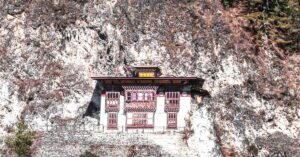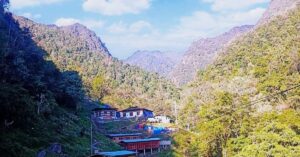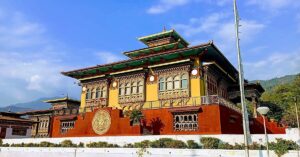

Lhuentse Dzong, also known as Lhuendruptse Gi Dzongchen or Lhundub Rinchentse Phodrang, is one of the 16 dzongs built by Zhabdrung Ngawang Namgyal in Bhutan. It was built in 1654 to bring the entire Kuri Dozhi under the control of the central government.
The majestic fortress sits atop a hill overlooking the Kurichhu River in Lhuentse Dzongkhag. From afar, the dzong is said to appear like a resting pigeon on a rocky perch, as often mentioned in a local folk song.
Today, it serves as the administrative and religious center of the Lhuentse district, hosting the famous Lhuentse Tshechu.
How to Reach Lhuentse Dzong
Lhuentse Dzong is located in the eastern part of the country. From the capital city, the distance is approximately 503 kilometers and takes around 15 hours following the Bumthang-Ura Highway. From Mongar, it is a 3-hour drive over 74 kilometers to the destination, and an additional 63 kilometers from Gangola junction.
History of Lhuentse Dzong
Lhuentse Dzong was built by Chogyal Minjur Tempa in 1654.
According to one legend, when Ngagi Wangchuk went in search of a winter seat, he arrived at the site of the present-day Lhuentse Dzong. There, the local deity appeared as a white goat, bleating loudly. Considering the bleating as an auspicious sign, he built a temple in 1552, naming it Leyley Dzong, the fortress of the Goat.
Another version has it that the dzong was to be constructed in Minjay village. However, a rock shaped like a frog began crying out like a goat. The goat’s bleating was considered inauspicious. As a result, the site for the dzong was moved to Lengleng, where the fortress stands today.
The Prophecy of Zhabdrung
In the 17th century, when Zhabdrung Ngawang Namgyel visited Kurtoe following the route of his great ancestor, Ngagi Wangchuk, he envisioned a new dzong there. However, due to the political conflicts among local rulers, it could not be materialized. Before leaving, he prayed that one day a fortress would be built here to unify the whole of Kuri Dozhi under the control of the central government.
Foundation of Lhuendrup Rinchentse Dzong
In 1654, Chhoetse Penlop Chhogyal Minjur Tempa, who was then well aware of Zhabdrung’s prophecy to bring the Kurtoe region under central government, marched to Kurtoe with his troops. There, he defeated two powerful rulers of Phagidung and Kidling and brought Kurtoe under the central government’s control.
Following this, he replaced the small dzong built by Ngagi Wangchuk at Lengleng with the majestic Lhuendrup Rinchentse Dzong, meaning “the fortress of the Precious Peak of Spontaneous Fulfillment”. The present-day Karsel Lhakhang is believed to be the one constructed by Lama Ngagi Wangchuck.
During the reign of Desi Gyalsey Tenzin Rabgye, a Rabdey (monastic school) was established, and various religious artifacts and relics were also installed in the Dzong.
Renovation of Lhuentse Dzong
Lhuentse Rinchentse Dzong was reconstructed and renovated over the years.
- 1962: The Third Druk Gyalpo, Jigme Dorji Wangchuck, reconstructed the dzong, coinciding with the reconstruction of Tashichhodzong in Thimphu.
- 1972-1974: The subsequent restoration of the dzong was carried out.
- 2013: The renovation of the dzong was completed, following major damage suffered during an earthquake in 2009.
Description of Lhuentse Dzong
The Lhunduptse Dzongchen, resembling a resting pigeon on a rocky perch, is approached along a flagstone-paved path that runs along the cliffs. The dzong is designed around a long, narrow courtyard, surrounded by pavilions, dormitories, and other structures built along the inner face of the shabkhor walls.
Dzong Thogma
The upper area of the courtyard is called the Dzong Thogma. It houses the Dratshang (monastic body) and eight temples. Within the Utse (central tower) are three temples: the Guru Lhakhang on the ground floor, a Goenkhang dedicated to Mahakala on the middle floor, and the Tshepamey Lhakhang dedicated to the Buddha of Long Life on the upper floor.
The main relic of Lhuentse Dzong is a sacred bronze statue of Tshepamey. According to a legend, a local fisherman found the statue in his fishing net. He took it to Kidlung (Kyiling) Lhakhang, but the statue refused to remain inside the shrine, repeatedly flying out of the temple. Even the iron chain curtain couldn’t stop it. As it fled the Lhakhang, the local deity, Kyiling Gonpo, threw a stone at the statue, breaking its crown. Even today, the statue is missing part of its crown, Rignga.
Dzong Wogma
The lower area of the courtyard is Dzong Wogma. It is the administrative office of the Lhuentse district.
Lekpagang gi Tshenden, the cypress trees of Lekpagang
The cypress trees of Lekpagang (Lekpagang gi Tshenden) are located opposite the Lhuentse Rinchentse fortress. It is said that these trees emit smoke once every year before Thrue Bab, the Blessed Rainy Day. Their origin dates back to the 8th century, when Khikha Rathoed was exiled from Khenpajong.
Festival of Lhuentse Dzong
Lhuentse Tshechu, known as Tshempay Tshechu, is a three-day annual religious festival held in Lhuentse Dzong. The highlight of the festival is receiving blessings of long life from the statue of Tshepamay, housed in the central tower of the fortress. It is celebrated from the 7th to the 12th of the 11th month of the lunar calendar.
Best Time to Visit Lhuentse Dzong
The best time to visit Lhuentse Dzong is during the annual Lhuentse Tshempay Tshechu festival. You can visit the major pilgrimage sites of Lhuentse with the Bhutan Pilgrimage Package.
Enjoyed reading this blog?