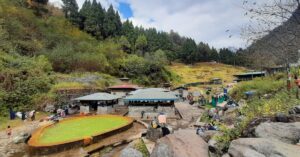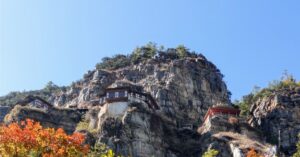

Dechen Phodrang Ney is a Drupkhang (meditation cave) of Guru Rinpoche discovered by Lama Karma Jamyang in the 15th century. It is located in Womanang, under the Bumdeling gewog of Trashiyangtse Dzongkhag, at an elevation of 2,260 meters.
A temple is built against the holy rock face, housing the Kurje (body print) of Guru Rinpoche as the main relic.
Visiting Dechen Phodrang Nye is considered equivalent to a pilgrimage to Tsari Ney, with the merit of reciting Benza Guru 12 million times.
How to Reach Dechen Phodrang Ney
Dechen Phodrang in Trashiyangtse is situated at the front of a ridge that resembles a sleeping elephant. From Yangtse town, take the 10-kilometer farm road above Trashiyangtse Dzong to Shiling village. Those approaching from Rigsum Goenpa Monastery need to hike 4-5 hours southeast, passing two smaller temples, Zamu Goenpa and Pelri Goenpa, along the way.
Dechen Phodrang Ney Hike
The hike begins from the parking area of Shiling or Womanang Primary School with a short descent to a suspension bridge. After crossing the river, the trail winds gently to Ramsar village. From Ramsar, it is just a short 15-minute walk to Dechen Phodrang Nye.
History of Dechen Phodrang Ney
According to history, Guru Rinpoche arrived at Yangtse after a serpent demon fled from Samye monastery in Tibet. He subdued the serpent in Neychen Pemaling and traveled to Palri-Tse, where he blessed the three La-Tshos (soul lakes) of Rigsum Goenpa. From there, he continued to Dechen Phodrang and meditated for over a month before conquering the remaining negative forces. After completing his spiritual mission, Guru Rinpoche flew onward to Paro Taktsang.
Due to this legend, Dechen Phodrang Ney is revered as a Beyul and a branch of Nye Pema Ling. It is also regarded as the twin of the Monkha Shri Dzong in Lhuentse.
Later, Lama Karma Jamyang Rabjor discovered this sacred site following a prophecy by Guru Rinpoche in the 15th century. He then built a small Tsulakhang (meditation temple).
Sacred Sites around Dechenphodrang Ney
Many spiritual landmarks surround the Dechen Phodrang Ney.
- Shawa La ridge on the right;
- Rigsum Goenpa further along the ridge;
- Pelri Goenpa and Zangpup Tse in front;
- Magzor (battle hill), shaped like a wish-fulfilling jewel, warding off enemies from external forces on the left.
Description of Dechen Phodrang Ney
Dechen Phodrang Ney is home to many sacred Nye-do (treasure stones) blessed by Guru Rinpoche. Among them are a large rock at the entrance believed to be the ‘gateway to Zangdopelri’, a golden tortoise rock, where pilgrims crawl through its crack to cleanse all their sins, self-arising symbols such as a pair of golden fish, a piwang (musical instrument), steps to heaven, Avalokiteshvara, Zambhala, a sacred cremation ground, Guru Rinpoche’s hat, Guru’s throne, a treasure trove of Zambuling, and the holy syllables Om Ah Hung.
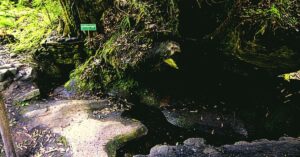
The site also features a holy spring of a thousand Buddhas and a huge ancient cypress tree (Tsenden Dongpo).
The Cypress Tree of Dechen Phodrang Ney
Guru Rinpoche is said to have planted his walking sticks only in three sites in Bhutan. One of these is the cypress tree that stands in Dechen Phodrang Ney, measuring 8 meters in circumference and about 93 meters tall. The other two are located in Kurjey Lhakhang in Bumthang and Baylangdra Nye in Wangduephodrang.
Dechen Phodrang Lhakhang
Dechen Phodrang Lhakhang is a three-storied temple built against the rock face. It was expanded by the Royal Government of Bhutan in 2007. The main relic of Dechen Phodrang Lhakhang is the Kurje (body print) of Guru Rinpoche.
Ground Floor
The ground floor is the Drupkhang (meditation cave) of Guru Rinpoche, considered a wish-fulfilling cave. Other relics on this floor are a holy spring, drubchhu, double diamond thunderbolt, a hat-shaped stone, a subdued demon’s entrails, and a fertility stone believed to bless couples who wish to have children.
First Floor
The first floor features a shrine with a statue of Zhabdrung Ngawang Namgyal flanked by Manjushri on the right and Buddha Shakyamuni on the left. Behind the shrine is a Ter-do (treasure stone) of Khandro Yeshe Tsogyal.
Second Floor
The second floor houses a statue of Guru Rinpoche and an additional Ter-do of Yeshe Tsogyal.
Best Time to Visit Dechen Phodrang Ney
The best time to visit Dechen Phodrang Ney in Trashiyangtse is during spring (March to May) and autumn (September to November). You can visit the major pilgrimage sites of Trashiyangtse with the Bhutan Pilgrimage Package.
Places to Explore in Trashiyangtse
Gomphu Kora: A sacred cave where Guru Rinpoche meditated to subdue an evil spirit in the 8th century.
Omba Ney: It is a sacred site featuring the holy Mantra “OM” and cliffside temples, often referred to as the “Taktsang of the East”.
Gongza Ney: Gungja Ney is a revered site where Khandro Yeshe Tsogyal offered tea to Guru Rinpoche at noontime.
Chorten Kora: This is a Boudhanath stupa built to subdue a powerful demon terrorizing the people in the Yangtse valley.
Pemaling Ney: The most sacred site of Guru Rinpoche, where he meditated.
Rigsum Goenpa: A monastery founded in the 18th century by Lama Tshering Gyamtsho, which guards Bhutan’s sovereignty from the north.
Enjoyed reading this blog?